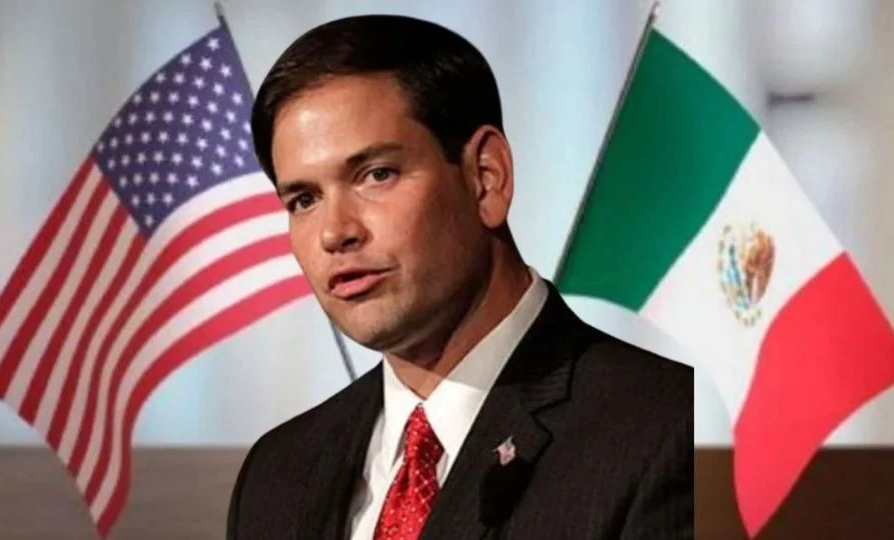

Secretary of State Marco Rubio will make a working visit to Mexico tomorrow, meeting with the president. As a result of these meetings, it has been announced that a bilateral security treaty could even be signed with our country, something like the third edition of the “Mérida Initiative” or the second part of the “bicentennial understanding.”
The results of the Mérida Initiative were marked by light and shade. Cooperation was carried out under strong political and operational conditions, with technological and doctrinal dependence on the United States. Added to this was Washington’s ongoing audit of the resources provided, supervised by the infamous Government Accountability Office (GAO), which could halt the funds if Mexico did not meet the imposed goals and determined, perhaps for the better, that the funds would be in kind. Behind it all lay a deep mistrust of Mexican institutions.
During Felipe Calderón’s six-year term, the concession was total: attorneys general, prosecutors, and senior officials had to submit to confidence checks at the US embassy itself. Under Enrique Peña Nieto, there was a shift: a one-stop shop was established within the Ministry of the Interior to deal with US agencies. But the lack of trust in Osorio Chong and the erosion of the bilateral relationship ultimately led to the measure being called into question. He was no longer even invited to participate in international tours to the United States or in bilateral meetings. It is recalled that Foreign Minister Videgaray even had to act as a security envoy in response to the fiasco that the Hidalgo politician turned out to be.
What did Obrador do? The discussion took a new direction. In 2021, Marcelo Ebrard responded to the fentanyl threat by proposing an updated cooperation framework. The official discourse pointed to a comprehensive vision that prioritized health, justice, and safe communities over militarism. However, in practice, militarization deepened, and reforms to the National Security Law limited the operations of foreign agents. The consequence was a weakening of cooperation and collaboration and an increase in pressure from Washington.
The slogan “hugs, not bullets” was never a real strategy, but rather a political narrative. In practice, it left a vacuum for which Mexico paid dearly: historical asymmetries were not overcome and, on the contrary, anti-Mexican and anti-immigrant sentiment in the United States was exacerbated.
The situation changed radically with Donald Trump. The former president designated the cartels as transnational terrorist organizations and, with this, opened the door to the use of all his country’s legal, technological, and military instruments. In less than eight months, the US administration deployed capabilities with unprecedented speed. The pressure became structural and permanent. The possibility of direct incursions into Mexican territory has even been raised.
In this context, Mexico has attempted to show results with the joint efforts of federal and local authorities. Claudia Sheinbaum’s administration, in particular, has sought to project a narrative of shared responsibility and action. However, Secretary Rubio’s visit establishes new rules of the game.
Toss of a Coin: Security or Submission
What is at stake is not just another treaty, but the redefinition of the cooperation framework. Mexico faces the dilemma of accepting conditions that perpetuate asymmetry or building its own framework that combines security with sovereignty. The question is whether, this time, our country will be able to negotiate from a position of strength or will it once again buckle under pressure.

Source: lasillarota