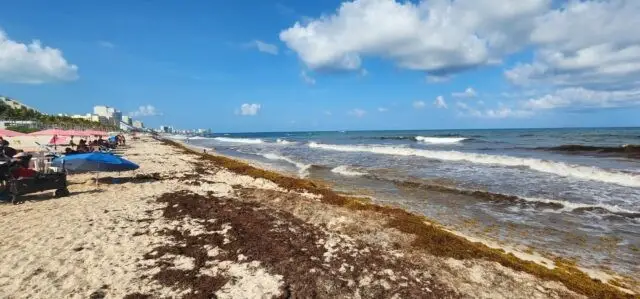

In just one week, 663 tons of sargassum have been collected on Cancún’s beaches, mainly in Delfines. So far this year, more than 13,000 tons have been removed, far exceeding what was collected last year, reported Antonio Chambé, director of municipal public services for Benito Juárez.
According to the official, almost four times more has been collected than what was collected in all of 2024, when only 3,700 tons were reported.
“Since June, we had already surpassed last year’s figures; today’s figure is historic; we’ve had large amounts of sargassum arriving, especially on the coast of Delfines toward Chac Mool,” he acknowledged.
Chambé added that the largest number of sargassum has been collected on beaches such as Delfines, Coral, Tortugas, Las Perlas, and Langosta, where municipal brigades, along with federal and state agencies, have worked on massive cleanup efforts. “On one Friday, we reached more than 800 people, with support from the Navy, the National Guard, and soldiers, as well as street sweepers and heavy machinery,” he explained.
Due to the large volume collected, the municipality set up a special cell at the landfill while the state project for a recycling plant is being finalized. “Final disposal is guaranteed; we are not mixing the sargassum with urban waste; a special cell has been set up,” he clarified.
Chambé noted that the harvesting season generally ends in November, when cold fronts begin, so the “Everyone Against Sargassum” program, which coordinates inter-institutional efforts to combat the problem, will continue.
The official asked the public to also participate in urban cleanup and risk prevention efforts ahead of the upcoming cyclone season.
Researchers from the National Autonomous University of Mexico (UNAM) released a documentary in which they expose the problem of the massive sargassum washup on the coasts of the Mexican Caribbean with the aim of finding solutions to address it.

Source: reportur