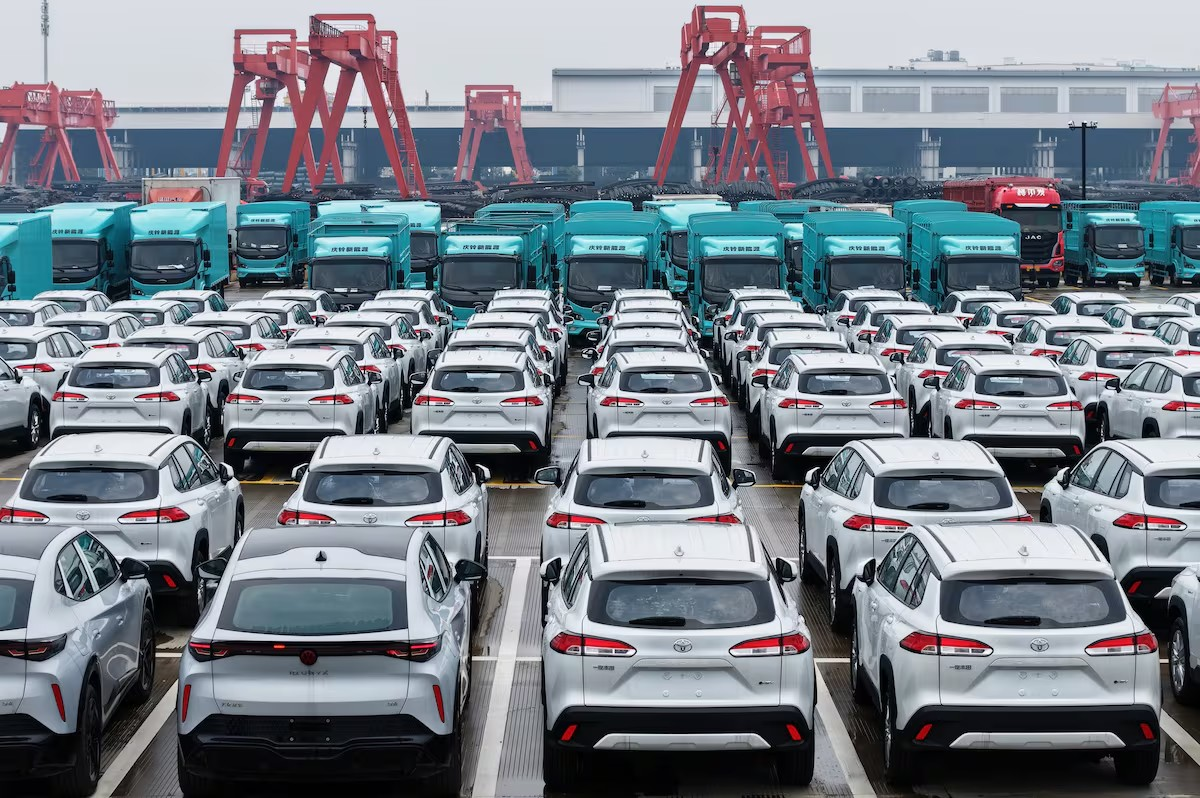

Tariffs on auto imports from China to Mexico could increase from 20% to 50%. At a time when the country is preparing for a heated trade dispute with the United States, its main partner, Claudia Sheinbaum’s administration appears to be extending an olive branch by making purchases from its main ideological and economic rival more expensive.
The Mexican Ministry of Economy released a list this Wednesday mentioning 19 sectors that could receive 1,463 new tariffs: from cars to clothing, including plastics, manufactured products, aluminum, and glass. The initiative—which must be approved by the legislature to go into effect—would apply to countries with which Mexico does not have free trade agreements: China, South Korea, India, Indonesia, Russia, and Thailand. The proposal aims to raise tariffs from the current average of 16.1% to 33.8%.
Among the products with tariffs of up to 50% are cars, auto parts, textiles, clothing, steel, paper and cardboard, glass, motorcycles, soaps, perfumes, and cosmetics. Together, the measures would impact imports of $52 billion, equivalent to 8.6% of purchases abroad.
Secretary of Economy Marcelo Ebrard stated that they have detected dumping practices in imports. “Vehicles from Asia, particularly China (…) already have tariffs. The 20% tariff. Now, what are we going to do? We are going to raise it even higher, according to what the World Trade Organization allows us to do, which goes up to 50%. Because the prices at which they are arriving in Mexico are below what we call reference prices,” he added in a press conference.
“When a product arrives in your country below the reference price, if it’s a single product, you conduct an antidumping investigation. But if there are many, what do you do? You modify your tariff. Because if not, the domestic industry is at a disadvantage. That’s why we’re taking this measure,” he concluded.
Easing Tensions
The draft decree to reform the tariff items within the General Import and Export Tax Law has already been submitted to the Chamber of Deputies, which must now discuss it. The initiative was presented as a crucial part of President Claudia Sheinbaum’s Economic Package for next year, with which she will seek to increase public revenue through taxation.
Mexico is adopting a more protectionist stance toward its local industry, although it has avoided specifying whether these measures also mean it is yielding to trade pressure from the United States, a country with which it is about to begin renegotiating the North American Free Trade Agreement. “The first Economic Package developed exclusively by the current administration showed signs of alignment with the market, rating agencies, and the United States,” said investment management firm Franklin Templeton.
“The package contemplates a considerable increase in import revenue from countries without a free trade agreement (such as China) (…) Is this a sign of strategic alignment in the run-up to the USMCA review?” the analyst asked, highlighting the contrast in effective tariffs at the end of July: while US tariffs on China reached 40.4%, in Mexico they stood at 4.7%, less than an eighth of that.
The trade balance between Mexico and China is clearly tilted in favor of the Asian giant. In the automotive sector, exports of global brands from China have been growing steadily. According to official data for 2024, the main commercial origins of vehicles were the United States ($25.685 billion) and China ($13.49 billion), followed by Japan, Germany, and India, a country that will also be impacted by the tax increase.
Source: elpais