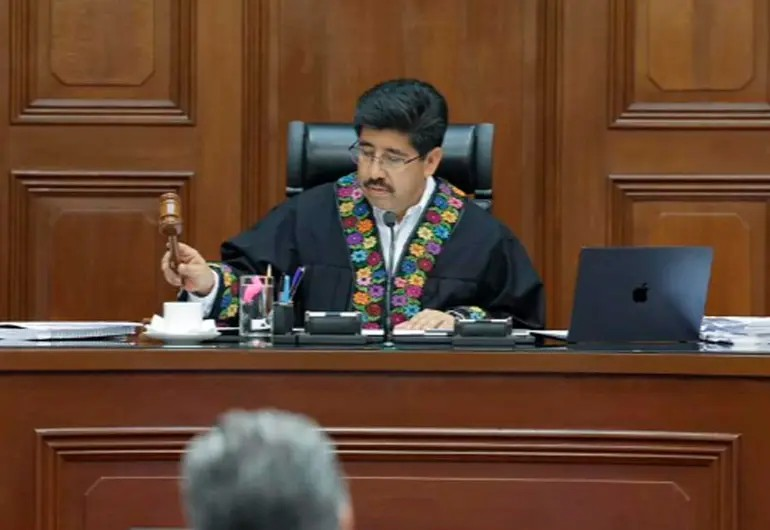

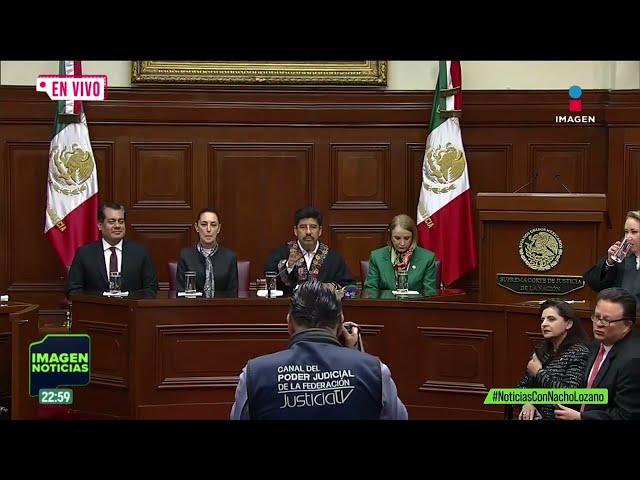
The first plenary session of the so-called new Supreme Court of Justice of the Nation took place this Thursday, September 11, 2025, and lasted four hours.
At ten-one-fourth a.m., the justices entered the plenary hall in silence. Before beginning the discussion of the first item and delivering the traditional gavel, Chief Justice Hugo Aguilar Ortiz issued a greeting in Mixtec and emphasized that this was a new plenary session.
The plenary’s secretary of agreements then addressed the matter listed for the session: a constitutional action filed against the Chihuahua state health law by the National Human Rights Commission, in which Yasmín Esquivel Mossa served as the reporting judge.
Thus, upon speaking and before presenting the bill, the minister took the opportunity to thank the voters for electing her, because otherwise she would never have become a minister “in a democratic manner.”
She also maintained that she will always seek consensus; she offered dialogue and respectful debate to her colleagues, and in the case of those seeking justice, she asked them to express their views “verbally or in writing.”
At the time, Minister Loretta Ortiz wished her new colleagues success and reminded them that they arrive at a historic moment that does not allow for indifference, especially when it comes to those most demanding justice.
“I reiterate my full willingness to build, through dialogue and openness, a common agenda that will allow us to respond in a way that is worthy of history and strengthen justice for the people of Mexico. We are witnessing a historic beginning in the life of this constitutional court. We are at a stage that does not allow for indifference because it demands a more humane, more sensitive, and more humane justice that is closer to the concrete realities of all people (…) We are fully aware of the magnitude of the responsibility we assume,” he expressed in his speech.
In a similar vein, Justice Giovanni Figueroa Mejía stated that in a democratic society, fundamental rights must be guaranteed and that it is essential to maintain contact with society.
He also spoke about what people expect from the new composition of the court.
“They expect a strong commitment to defending constitutional principles, rules, and values so that they are not seen rhetorically, but as a reality that positively impacts their daily lives. Thus, we must ensure that the resolutions we issue are not only based on the legal system or jurisprudence (…) but also take into account the diverse realities facing the nation and, at the same time, are concise and clear to contribute to a more equitable and responsive justice system,” he emphasized.
Speaking, Justice Lenia Batres recalled that the vote on June 1st advocated for transparency in the justice system, and opening the doors of the Court to the people is an example of that mandate.”
Remotely, Justice Arístides Guerrero García participated throughout the session, which had a ten-minute recess shortly before 12:30 p.m. and concluded at 10:00 p.m.
In addition to Justice Yasmín Esquivel Mossa’s unconstitutionality motion, a matter by Justice Loretta Ortiz was also discussed, related to a constitutional motion filed by the federal executive branch against certain articles of the Education Law of the state of Yucatán.
Throughout the session, Justice Sara Irene Herrerías Guerra made limited oral participation; while her colleague, Loretta Ortiz, made clear her annoyance at one of the criteria approved by the majority in one of the matters voted on this Thursday.
She crossed her arms. Arms, he let out a sniff when asked about his vote and reiterated his disapproval of those approved by his colleagues.
At the beginning of the session, media representatives were prevented from taking videos or photographs of the start of the new plenary session “by decision of those above.”
Three matters were resolved during the session and ended at 2:00 p.m. with 13 minutes left; just 13 minutes longer than the previous plenary session, which usually ended at 2:00 p.m., unless it was a matter of greater importance.
Source: excelsior