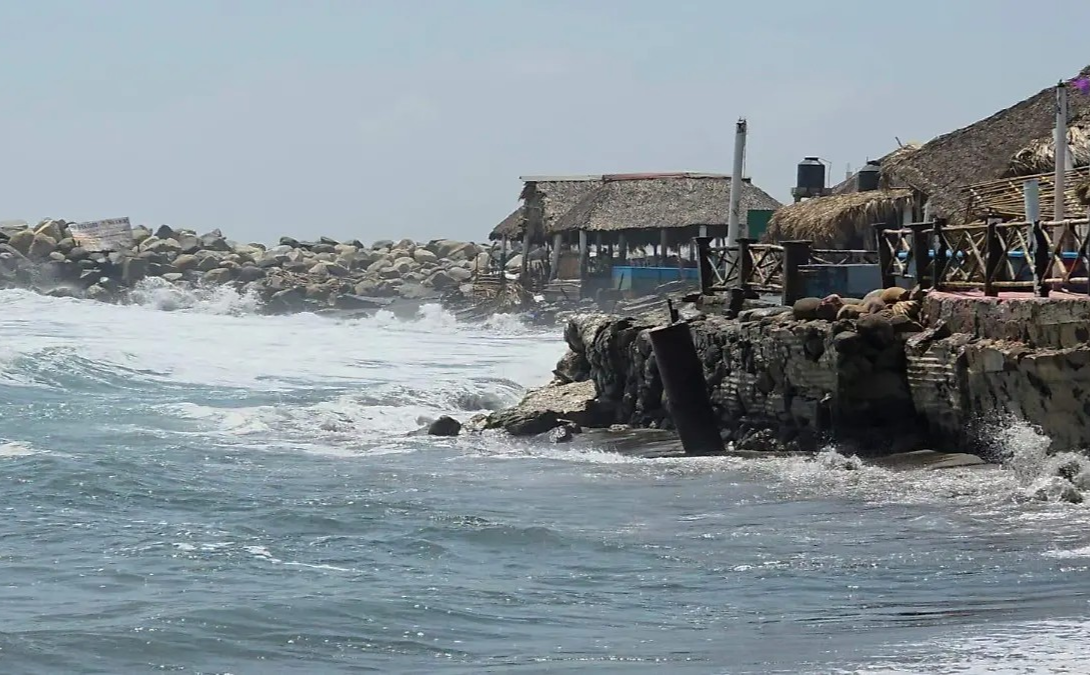

Beach erosion along the Chiapas coast continues to advance without a comprehensive coastal management plan, warned Vicente Castro Castro, professor and researcher at the Autonomous University of Chiapas (UNACH).
In an interview, the academic noted that, despite the state having nearly 260 kilometers of coastline, no effective strategy has been implemented to mitigate the impacts of phenomena such as ground swells and coastal soil loss.
He has asserted that Chiapas has not paid attention to its coastal or marine area, which has led to increasingly serious problems with soil loss. Erosion has caused damage in the San Benito area, with the loss of at least 500 meters (half a kilometer) of beach due to the constant advance of the sea.
Retaining walls built with stone only offer temporary protection, as these structures eventually collapse over time and with the constant movement of water. This forces communities to invest large amounts of money to repair them, without a definitive solution.
The researcher said that the construction works are carried out without adequate technical planning, as many of them are done solely for financial gain and do not generate a positive impact for the population. From the academic sphere, at least three concrete proposals have been put forward to address this situation, but they have also been ignored by federal, state, and municipal authorities:
“The first is the creation of a state coastal management program; the second is a change in beach zoning, which currently only considers the first 20 meters as a federal maritime-terrestrial zone; and the third is that protective structures, such as breakwaters or jetties, be built only after prior oceanographic studies have been conducted to ensure their long-term effectiveness,” he noted.
He also noted that as a complementary measure, wave energy dissipators could be used, structures that could reduce the force of the sea before it reaches the coasts of Chiapas.
Finally, I have called on decision-makers not to undertake improvised projects, but rather to plan them before implementing them, as otherwise, they only represent a waste of public resources and do not solve the problem.

Source: oem