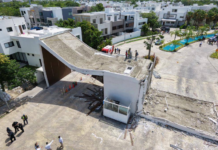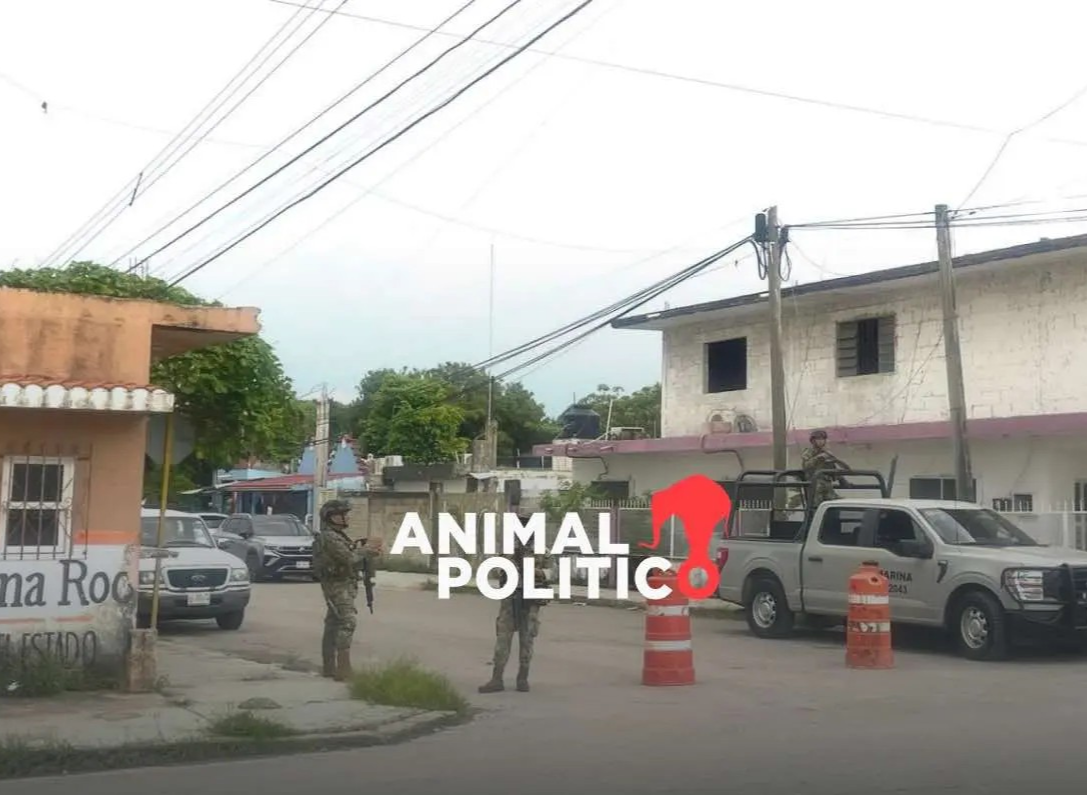

The athletes of Felipe Carrillo Puerto, Quintana Roo, no longer have a place to train: for months, the Ministry of the Navy (Semar) has set up shop on the Chan Santa Cruz sports field, while nearby, on the Expo Maya site, the Ministry of National Defense (Sedena) is building military housing units and recently remodeled the city’s historical museum in the central park.
The military presence in the municipality of Felipe Carrillo Puerto is not limited to the town: in the Sian Ka’an Biosphere Reserve, the Sedena is building the Puerta al Mar tourism megaproject, and the number of rock extraction banks the agency exploits for its projects is increasing.
This year alone, the Ministry of Environment and Natural Resources (Semarnat) authorized the Army to open eleven new large “sascaberas”—open-air excavations to extract sascab, a material derived from underground limestone—in the municipality.
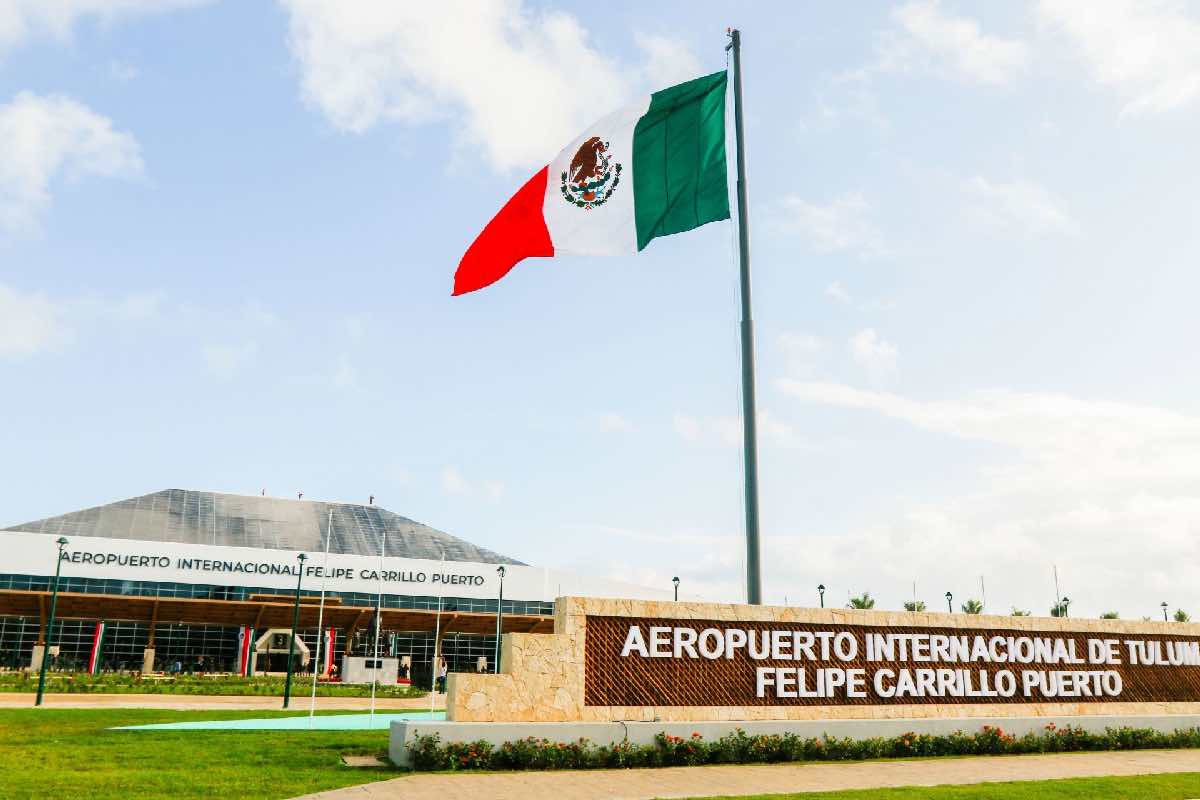
Two stations of the Mayan Train operate in Felipe Carrillo Puerto. One is located inside the Tulum International Airport, administered by the Army. Within its grounds is a hotel managed by the Ministry of National Defense (Sedena) and Military Air Base No. 20. Furthermore, there are National Guard barracks at each exit from the town, and a military camp was set up for the construction of the railway, which was never built.
Consequences of the Mayan Train in Felipe Carrillo Puerto
The Felipe Carrillo Puerto Mayan Train station is empty, and there are no tourists on the town’s streets. So far, the railway has brought neither visitors nor development to this Mayan town in central Quintana Roo, but soldiers.
In March 2022, a few months after the Tourist Security Battalion began patrolling the beaches of the Mexican Caribbean, the Ministry of National Defense (Sedena) arrived in Felipe Carrillo Puerto to build the Tulum airport and the Mayan Train, and it hasn’t left.
In the following years, the Sedena’s work multiplied, and once they began operating, the military remained: they began patrolling the main avenues, flying over the town in helicopters, and it became common to find them armed in stores, at gas stations, or in the central park. Cameras filled the corners, and high-ranking officers became neighbors. Surveillance of the population became constant, with implications for their daily lives and for human rights.
“There are cases of young women being harassed and young men being beaten by members of the National Guard. Children and youth no longer grow up the same way,” says Wilma Esquivel Pat, a resident of Carrillo de la Frontera, who is a member of the National Indigenous Congress.
The civil organization Community Cohesion and Social Innovation A.C. The National Civil Defense Commission (CCIS) warns that in Felipe Carrillo Puerto—as in the municipalities of Calakmul and Othon P. Blanco—a process it calls “military irruption” is developing, which could also occur in other territories where the Sedena (National Defense Ministry) is constructing civil works.
In its research “What Did They Come For?”: Military in the Context of Megaprojects and Their Implications for Daily Life and Human Rights, CCIS defines “military irruption” as something that goes beyond militarization (which involves the delegation of public security functions to the armed forces) and consists of the surveillance of people and nature, not out of national security interests, but as part of a commercial strategy of military corporatization and integration.
“By military corporatization, we understand the holding company strategy that first consisted of separately forming majority-owned companies affiliated with the Sedena, which were later merged into GAFSACOMM, now called Grupo Mundo Maya,” explains Suhayla Bazbaz Kuri, director of CCIS.
“When we talk about military integration, we’re referring to the concentration and monopolization of the links in a supply chain: now you can buy your ticket with Grupo Mundo Maya, fly with them, land at their airport, sleep in their hotel, and go to their tourist park.” It is within the framework of this commercial strategy, says Bazbaz Kuri, that the military incursion occurs.
Felipe Carrillo Puerto has a strategic position
Many of the residents of Felipe Carrillo Puerto have normalized the military’s incursion into their territory, but there are also critical voices. Two hundred and fifty ejidatario families, for example, reject the presence of uniformed personnel, especially since the conflict that arose with the Sedena (Ministry of Agriculture and Livestock) after the occupation of the Expo Maya (Maya Expo) in November 2024, where the agency is building apartments for military personnel.
The ejidatarios consulted are unclear about the Army’s interest in this municipality, which had already been militarized during the Caste War, when it was the cradle of the Mayan resistance.
According to Ángel Sulub Santos of the U kúuchil k Ch’i’ibalo’on Community Center, Felipe Carrillo Puerto has a strategic position for military and economic control of the Yucatán Peninsula. “We always say that here we are close to everything: Cancún, Chetumal, Mérida, Valladolid, and now close to Puerta del Mar and the Tulum airport, which is a military base,” says Sulub Santos.
Mass Tourism and Insecurity
The government often justifies the military presence by combating insecurity, which has grown exponentially in Felipe Carrillo Puerto, although it is low compared to the national average. For example, reports of disappearances, according to the Executive Secretariat of the National Public Security System, increased from 1 in 2015 to 7 in 2024.
“The justifications given by the federal Executive Branch for the deployment of the armed forces in Mexico do not correspond to the reality in the invaded territories,” states the CCIS in the aforementioned investigation.
On the other hand, the U kúuchil k Ch’i’ibalo’on Community Center affirms that insecurity is driven precisely by the mass tourism that the Mayan Train aims to promote. For example, the evolution of crime rates in Caribbean municipalities, which significantly increased their visitor flow over the last decade, even before the construction project. In Solidaridad, whose main city is Playa del Carmen, intentional homicides rose from 20 in 2015 to 76 in 2024; over the same period, in Tulum, they increased from 9 to 62.
In her article “Why are tourist destinations attractive to transnational crime? The case of the Riviera Maya,” Elisa Norio of George Mason University asserts that the high economic flows in Quintana Roo facilitate money laundering. Norio writes that, in addition, fugitives from justice may find the Mexican Caribbean attractive because of the high turnover of tourists, workers, and businesspeople, which guarantees a high level of anonymity. According to Mexican authorities, in 2019, there were criminal cells in Quintana Roo with ties to 10 transnational criminal organizations.
Cultural Resistance
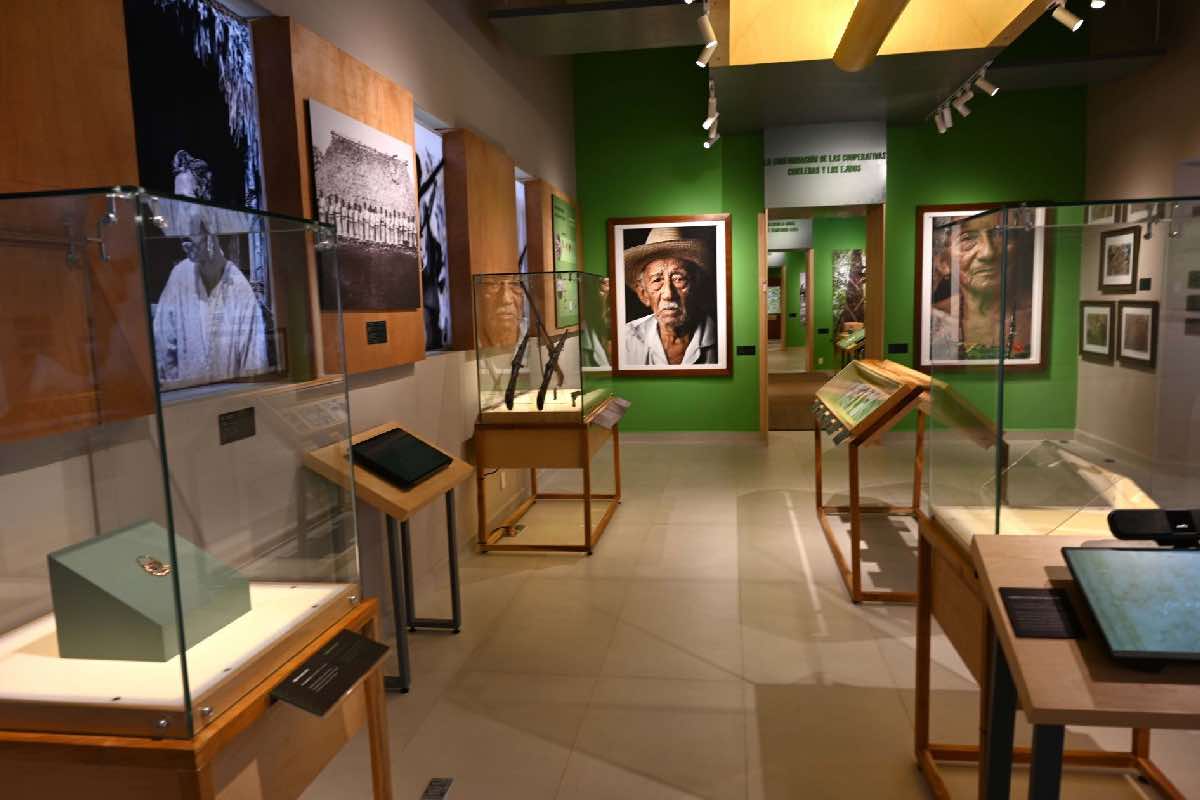
Marcelo Jiménez, artist and former director of the Felipe Carrillo Puerto Historical Museum, prefers not to visit the space after the Army’s renovation because someone told him he’d cry if he saw how it turned out.
Jiménez learned that the Sedena (National Army of the Maya) would be carrying out the renovation around September 20, 2023, when the military informed him about the rehabilitation project, planned for the Puerta al Mar tourism megaproject, in a meeting. He was told he had just over a month to remove the exhibits, some of which belonged to him.
With these, the artist decided to install a gallery in the patio of his house, inspired by the initiative of an acquaintance who opened an autonomous museum in her community. “These spaces represent a form of cultural resistance for us as Mayans, in the same way as preparing our traditional food, organizing our festivals and ceremonies, or speaking our language,” says Marcelo Jiménez.
“As Maya, we don’t have a concept of a museum, but we do have a concept of how we should transmit our historical memory. It was based on this criterion that we built the museum in the central park of Felipe Carrillo Puerto, and we received fair recognition for it,” says the artist.
After the remodeling of the Sedena (National Security Agency), the space became alien: a museum in which they no longer feel represented in the community.
Source: animalpolitico