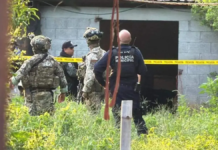
Officers from the Polish Central Investigation Bureau of the Police (CBŚP) were preparing for war: helicopters armed with heavily armed personnel took off from the air, and on the ground, they added a convoy of dozens of agents from the Counter-Terrorist Operations Office with long weapons and ballistic equipment.
No precautions were enough: they had been told they would be confronting the internationally feared Sinaloa Cartel in their country, the land of Chopin and John Paul II.
It was September 3rd, and the final stage of a long investigation was underway: the possible existence of a drug laboratory located in a remote rural area of the Świecie district in northern Poland, run by men who idolized the infamous Joaquín “El Chapo” Guzmán.
An operation revealed a Mexican cartel drug laboratory in the European country.
Investigations indicated that the Sinaloa Cartel had managed to expand its operations into Polish territory | Special
The mere mention of that name made Polish authorities think about the possibility of a confrontation with people who fit the stereotype of a Mexican cartel member: hitmen who chop off heads for fun and respond to any attack by firing assault rifles.
For that reason, they assumed, they had to bring in the heavy artillery. It was necessary to bring everything when confronting Mexican drug traffickers, whose reputation frightens even European mafias. In total, the operation required two aircraft, eight armored vehicles, and more than 50 elite officers.
Everyone was focused on the surprise operation: surrounding the property where the drug lab was located, a site with three buildings with brown and white roofs in the middle of nowhere, far from the police’s eyes in the historic region of Pomerania, and breaking in with the caution required to enter a facility belonging to the most famous cartel in the world.
The four-letter cartel crossed the sea and attempted to conquer Australia and its neighboring island until a group of locals attempted to defraud them.
Around 2:00 p.m., elite Polish police swarmed into the house. What they thought was a home-made drug lab was, in fact, a professional drug factory with continuous production and specialized chemical procedures to minimize odors and the risk of detection.
It might be the envy of a mid-sized pharmaceutical company, but it’s actually proof of the technological advancement of global drug trafficking.
On the property, they found two Mexicans and a Pole who didn’t resist arrest once they saw the scale of the operation. The three were working with dozens of blue drums, stacked one on top of the other, containing highly flammable substances.
That day alone, they had 300 liters of methamphetamine at their disposal, plus three tons of chemical precursors for other synthetic drugs. With this raw material, the Sinaloa Cartel hoped to produce at least 330 kilos of drugs ready to be cut and shipped to the European black market. A production with a minimum value of 30.5 million Mexican pesos.
Breaking Bad-style “Cooks”
“Police suspect the finished drugs were destined for the Western European market, and that Poland served only as a production base,” reported the local newspaper Dziennik Narodowy, which, like other media outlets, highlighted the presence of Mexican drug traffickers in rural areas as a rarity. “Polish version of Breaking Bad. Mexicans linked to the cartel arrested!” headlined another news site.
The news caused surprise in Poland, but not within police forces or among experts who know how drugs move around the world. It was not the first Sinaloa Cartel drug lab found on Polish soil, although many believed it to be. And, unfortunately for the European country, it surely won’t be the last.

There are about 10,000 kilometers between Mexico and Poland. A physical distance that translates into a lack of familiarity with customs and traditions. Although in 2023 both countries celebrated 95 years of friendship, we Mexicans actually know little about this friend.
The Polish community in our country is so small that during the COVID-19 pandemic, the Ministry of Foreign Affairs only repatriated 419 Poles to spend the lockdown in their communities of origin.
Except for the fact that Mexico welcomed hundreds of Poles fleeing the Nazi regime, and many of them settled in a community on the outskirts of León, Guanajuato, which they called “Little Poland,” few other facts are widely known: that Poland was a republic under Soviet aegis, that its invasion enraged the dictator Adolf Hitler, and that it is the birthplace of the great musician Frédéric Chopin and Karol Józef Wojtyla, better known as John Paul II.
Few Mexicans could name a typical dish from those lands, their current president, or even locate the country on a world map.
But there’s one more fact that most Mexicans don’t know about Poland: it’s a nation coveted by national cartels, especially the Sinaloa cartel—or what’s left of it after the internal fight between Los Chapitos and La Mayiza.
This criminal organization has set up several drug labs in the region since the first decade of this century, according to reports from the US Drug Enforcement Administration (DEA) and Europol.
In their years of criminal glory, Joaquín “El Chapo” Guzmán and Ismael “El Mayo” Zambada warned that the European border where Poland is located is ideally suited to be a continental drug manufacturing and distribution center: it’s right at the crossroads between Western and Eastern Europe, with vast rural areas that are poorly policed.
That’s a double blessing and a curse. On one side, it borders Germany, one of the countries with the highest consumption of cocaine and methamphetamines in the entire European Union, and on the other, the Balkans, a key mountain range for the transit of synthetic drugs to Russia, another attractive market.
To reach its territory, it is not necessary to cross the high Alps or vast deserts. It is enough to sail calmly to its two major ports on the Baltic Sea—Gdansk and Gdynia—which are the driving force of the national economy and use them as entry points for thousands of contraband containers.
Given that, according to the United Nations, 70 percent of the world’s drugs move via maritime routes, it is not surprising that for almost two decades, chemical precursors for synthetic drugs from Latin America, mainly Mexico, Ecuador, Colombia, and Brazil, have been detected on Polish territory.
The Supreme Pontiff visited the strongholds of the most dangerous Italian mafias.
Poland has extensive land transportation networks, which are ideal for drug diversion. Local, German, Dutch, Albanian, Serbian, and other criminal organizations move along its roads, rebuilt after World War II, responsible for drug trafficking throughout Europe after being hired by major players in global drug trafficking, such as the Italian ‘Ndrangheta mafia or the Sinaloa Cartel.
To top it all off, the war in Ukraine, a nation adjacent to Poland, has improved the country’s narcotics position, as the border has become a volatile zone through which weapons and exploited people pass.
And where bullets pass, drugs pass. It seems that the historical events of recent years have prepared the country of the red and white flag to become a center for the manufacturing and distribution of narcotics, although not for high consumption, at least not yet.
An additional element: corruption in Polish customs facilitates the work of Mexican drug traffickers. This is a cursed legacy of the Pruszkow Mafia, better known worldwide as the “Polish Mafia.”
Red communism falls, black consumerism rises

In 1989, after a long opposition to the communist regime, the Polish parliament approved a new government with a capitalist and free-market orientation. The Polish People’s Republic had died, giving way to, simply, the Republic of Poland. This change was also reflected in the security forces: the Soviet-led Citizens’ Militia was abolished and replaced by the Polish National Police.
The change was long and complex. Bureaucracy delayed the consolidation of a modern corporation, and the lost time was used by petty criminals with experience in and out of prison.
Democracy opened up brilliant new opportunities for pickpockets, thieves, burglars, and smugglers in the city of Pruszków, who began to band together to confront a distracted police force.
They soon discovered they didn’t have to settle for petty crimes. The free world offered million-dollar black markets, such as drug and arms trafficking, so they jumped right in. They had no competition.
By the early 1990s, they controlled Pruszków, their hometown, and the capital, Warsaw; by the middle of the decade, they dominated the entire country. There was no dirty business they didn’t have their hands in: from illegal gambling to cattle rustling.
“Some Poles hated the gangsters for forcing their prosperity through extortion, drug trafficking, and robbery; others respected them as men who took what they wanted with a Kalashnikov in one hand and a shot of vodka in the other,” wrote journalist Christopher Oten in his piece “A Polish Mafia Knockout.”
Like any criminal group, the Pruszków Mafia had legendary and bloodthirsty leaders. The most famous was Andrzej Kolikowski, alias Pershing, a ruthless businessman who cold-bloodedly murdered his enemies from the Wolomin Mafia and any police officers who interfered with his business dealings.
Among other anecdotes, Pershing used to bet thousands of dollars on boxing matches in Atlantic City, New Jersey, where he could easily find himself in the VIP stands with future US President Donald Trump.
The murderous rampage of the Pruszków and Wolomin Mafias became frenetic. The bodies piled up so quickly that there was no time to replace them. Like a virus that infects a body and kills it within, by the beginning of the 21st century, the old Polish mafia had become extinct due to its own ambitions and had given way to local criminal organizations that used Poland as a transit and drug production country, according to the Global Crime Index.
Despite the death of the Polish mafia, its corrupting effects remained alive for several years. Police remained hungry for bribes and eager to work with global drug trafficking groups. It was only a matter of time before the Sinaloa Cartel, driven by Chapo Guzmán, enamored with his 701st place on the list of world billionaires, planted its flag in the land of Karol Wojtyła.
Thus, Mexican drug traffickers took advantage of a country accustomed to living with ruthless mobsters and dirty cops. And, well versed in the matter, they opened their own embassy.
A year before the discovery of the Świecie drug lab, Polish authorities discovered another one in Podlasie, in the east of the country, where rural life drags on. There, mainly Poles, Belarusians, Ukrainians, and Lithuanians live side by side, congregating every day in Catholic churches surrounded by forests and rivers.
In October 2024, CBŚP agents concluded an undercover investigation by raiding a fake farm in a hard-to-reach area that hid a massive methamphetamine lab. There, they seized nearly 120 liters of liquid narcotics with a black market value of nearly 36 million pesos.
The seizure was celebrated as if a bacterium that would imminently sicken, and kill, thousands of people in Europe had been stopped.
A cocktail of synthetic opioids is poised to displace those little blue pills that sparked a health crisis in the US.
The detainees immediately provided clues about the owners of the drug kitchen: four were Mexicans originally from Sinaloa, and one was Polish. He served as a driver, translator, and helper to overcome the cultural and language barrier.

The Sinaloa Cartel, as a mega-criminal enterprise, had hired a freelance representative for its representatives on a long business trip. They all lived in old buildings in Podlasie, concrete shells reminiscent of the region’s communist past. They camouflaged themselves as migrants, like many others in the province. The perfect disguise.
“What a disaster!” said one resident in an interview with TVN24 journalists, quoted by the Polish website Natemat. Another resident acknowledged: “I didn’t expect it, but it’s possible anywhere.” The news highlighted this surprise: how and why had the world’s most notorious drug cartel for its violence set up shop, of all places, in boring Podlasie?
Their comments were intended to provide calm and context: Mexican drug traffickers are all over the planet, even in a country like Poland, which ranks 32nd on the Global Peace Index, above nations like Sweden and Montenegro.
Polish authorities continue their hunt for more drug labs. In several press conferences, they have emphasized that they are not naive: they are the fifth most populous country in the European Union, and a large portion of their 312,000 square kilometers are far from police surveillance, making them a magnet for drug manufacturers.
They, like the Mexican authorities, are pursuing the ever-present Sinaloa Cartel in their forests and mountains. Or what’s left of it.

Source: milenio