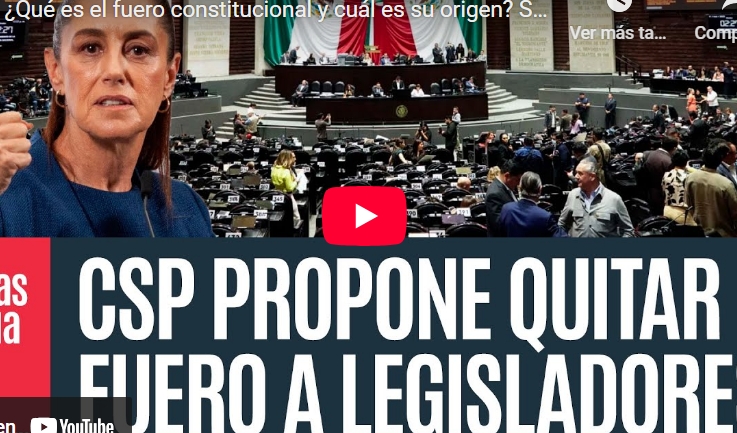

President Claudia Sheinbaum Pardo will appear before the Presidential Commission on Electoral Reform to propose the elimination of immunity, a constitutional provision that grants immunity from prosecution to certain public servants, such as legislators, protecting them from prosecution for common crimes.
“I will also go to the Presidential Commission to tell them some of my ideas: that the immunity of representatives and senators be eliminated. In the Electoral Reform proposal that will be presented,” she commented this Wednesday at her morning press conference. “My opinion, which I will present in writing to the Commission, is that there should be no immunity. Why does there have to be immunity? That’s in the past. The President doesn’t have immunity, and representatives and senators shouldn’t have immunity either.”
Parliamentary immunity is a legal provision that prevents authorities from detaining or prosecuting representatives and senators during the performance of their duties for the possible commission of a crime, except in cases of flagrante delicto.
Under this protection, in recent years politicians accused of corruption and other crimes have managed to evade justice, as has happened, for example, with Alejandro Moreno Cárdenas, the leader of the Institutional Revolutionary Party (PRI), accused of illicit enrichment; Cuauhtémoc Blanco Bravo, a Morena representative, accused of allegedly abusing his half-sister; or Francisco Javier García Cabeza de Vaca, former governor of Tamaulipas, who is accused by the Attorney General’s Office (FGR) of organized crime, operations with illicit proceeds, and tax fraud.
This legal concept is provided for in Article 11 of the Organic Law of the General Congress of the United Mexican States, which establishes that “deputies and senators enjoy the immunity granted by the Political Constitution of the United Mexican States” and therefore “are inviolable for the opinions they express in the performance of their duties and may never be reprimanded or prosecuted for them.”
However, it establishes that “deputies and senators are responsible for crimes they commit during their term of office and for crimes, misdemeanors, or omissions incurred in the exercise of that same office, but they may not be detained nor may criminal proceedings be brought against them until, following constitutional procedure, a decision is made to remove them from office and subject them to the action of the ordinary courts.”
In turn, Article 61 of the Constitution makes it clear that “the president of each Chamber shall ensure respect for the constitutional immunity of its members and the inviolability of the premises where they meet.”
In the study “Parliamentary Impunity and/or Constitutional Jurisdiction of Legislators,” by professor and parliamentary researcher Claudia Gamboa Montejano, she notes that constitutional jurisdiction has its origins in Europe, in England (in the 15th century), France (1789), and Spain (1810), “so it is not a concept specific to modern times, and it arises as a prerogative for legislators given the need to provide protection for their work in the performance of their duties.”
In America, the study notes, it has been in place in the United States since 1787. And particularly in Mexico, constitutional jurisdiction has been applied since 1812 through the Cadiz Constitution, and subsequently the Fundamental Laws that have governed the country have contemplated the immunity of legislators and the prohibition of prosecution for criminal liability except with express authorization from Congress.
Although it wasn’t until 1977 that the concept of constitutional jurisdiction as it is known today emerged, it was replaced by a declaration of origin in 1982 through a constitutional reform.
The Cadiz Constitution of 1812, “Chapter VI On the Holding of the Cortes” in Article 128, established that deputies shall be inviolable for their opinions, and may not be challenged for them by any authority.
“In criminal cases brought against them, they may be tried only by the Court of the Cortes, in the manner and form prescribed in the regulations of the internal government of the Cortes. During the sessions of the Cortes, and for one month afterward, deputies may not be sued civilly or executed for debts.”

Two years later, in the Constitutional Decree for the Liberty of Mexican America of 1814, in Chapter III of the Supreme Congress, Article 59, “The deputies shall be inviolable for their opinions, and at no time or in any case may they be held accountable for them; but they shall be subject to the trial of residence for their part in public administration, and may also be charged during their term of office, in the manner provided by this regulation, for the crimes of heresy and apostasy, and for state crimes, particularly those of treason, extortion, and embezzlement of public funds.”
Later, in the Decree of February 24, 1822, on the Inviolability of Deputies for their Opinions, it was specified that “no action, lawsuit, or proceeding whatsoever may be brought against the persons of the deputies at any time, and by any authority of any kind, for their opinions and rulings.”
The 1824 Constitution already stated in Section Four, “Regarding the economic functions of both chambers and the prerogatives of their members, that deputies and senators shall be inviolable for their opinions expressed in the performance of their duties, and may never be reprimanded for them.”
“In criminal cases brought against senators or deputies, from the day of their election until two months after the end of their term, they may not be accused except before the Chamber of Deputies, nor may they be accused except before the Chamber of Senators, each Chamber in turn constituting itself as a grand jury to declare whether or not a case is admissible,” the law continued. “If the Chamber acting as a grand jury in the cases described in the preceding article declares, by a vote of two-thirds of its members present, that a case is admissible, the accused shall be suspended from office and brought before the competent court.”
It was in the 1836 Constitution, in Section Three, “The Powers of the Chambers and Prerogatives of Their Members,” that it was established that “in common crimes, no criminal accusation may be brought against the President of the Republic, from the day of his appointment until one year after his presidency is concluded, nor against senators, from the day of their election until two months after the end of their term, nor against ministers of the High Court of Justice and the Court of Justice, secretaries of the Cabinet, counselors, and governors of departments, except before the Chamber of Deputies.”
“If the accused is a Deputy, during his term of office and two months after, or if Congress is in recess, the accusation shall be brought before the Senate. Deputies and senators shall be immune from violation for the opinions expressed in the exercise of their duties, and may not be reprimanded or harassed for them at any time or by any authority.”
Subsequently, the 1857 Constitution, in Title II of the Division of Powers, Section I, Paragraph I, on the election and installation of Congress, established in Article 59 that deputies are inviolable for their opinions expressed in the performance of their duties and may never be reprimanded for them.
The same sentiment was maintained in the 1917 Constitution, which established that “deputies and senators are inviolable for the opinions they express in the performance of their duties and may never be reprimanded for them.”
It was 60 years later, on Tuesday, December 6, 1977, under José López Portillo that Article 61 established that “the president of each Chamber shall ensure respect for the constitutional jurisdiction of its members and the inviolability of the chamber where they meet.”
Source: sinembargo