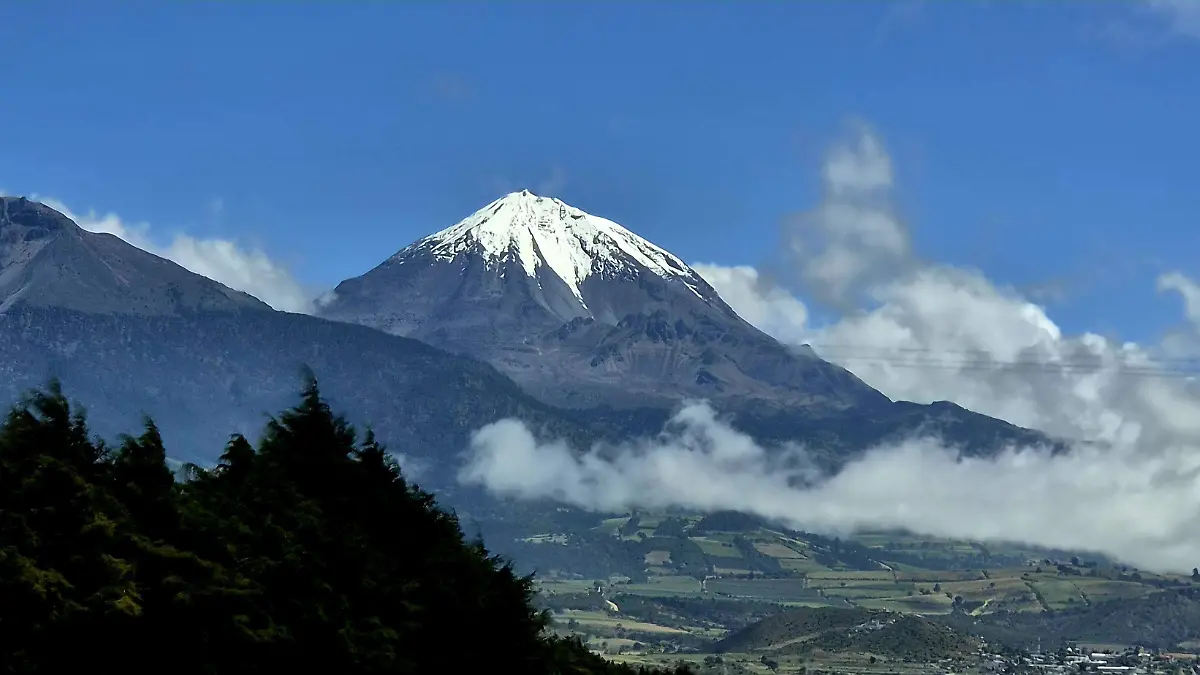

The Jamapa Glacier, the last remaining glacier on Pico de Orizaba, is facing a critical situation due to the loss of ice thickness and the exposure of rock formations beneath it.
Environmental advocate Ricardo Rodríguez Deméneghi warned that the glacier could divide into as many as eight separate sections within approximately two years because of the changes occurring beneath the remaining ice.
The reduction in thickness has altered the glacier’s structure. As the ice retreats, increasingly large portions of the rocky surface beneath it become exposed, contributing to the fragmentation of the remaining glacier.
The situation is part of the accelerated deterioration that has affected the glaciers of Mexico’s highest mountains. The Jamapa Glacier is currently the last glacier remaining on Pico de Orizaba and the last glacier in Mexico.
Researchers have documented a significant reduction in its surface and thickness in recent years. Scientific studies indicate that the glacier has been losing ice rapidly because of changes in temperature and precipitation patterns associated with climate change.
Research by University of Veracruz scientists has documented the glacier’s accelerated retreat. Between 2019 and 2024, the glacier lost approximately 100 meters of extension, according to researcher Víctor Soto Molina of the University’s Center for Earth Sciences. By 2024, images showed that the glacier no longer had significant recent snow accumulation and that much of the remaining mass consisted of older solid ice that had already lost thickness and surface area.
The glacier’s deterioration is especially significant because Pico de Orizaba is an important source of water for surrounding regions. The mountain gives rise to the Jamapa-Cotaxtla hydrological basin, which supplies water to more than 2 million people in Veracruz, while the mountain’s rivers and watersheds also contribute to water supplies in Puebla.
The rivers Blanco, Cotaxtla, Metlac and Jamapa originate in the Pico de Orizaba region and together provide water to municipalities in the High Mountains region of Veracruz. Cities including Orizaba, Córdoba, Huatusco, Coscomatepec, Veracruz and Boca del Río depend, directly or indirectly, on water originating in the mountain’s hydrological system.
The progressive disappearance of the glacier therefore represents not only an environmental problem but also a potential water-security problem for communities located downstream.
Experts have explained that the loss of ice is linked to a combination of higher temperatures, reduced snowfall and changes in precipitation patterns. Snow that falls on the mountain is increasingly insufficient to compensate for the amount of ice lost through melting.
Research published by the University of Veracruz has also documented changes in the mountain’s slopes associated with the loss of the glacier. As the ice retreats, exposed volcanic rock experiences significant temperature changes between daytime and nighttime. Water that enters cracks can freeze and expand, contributing to the fracturing of the rock.
The disappearance of the Lengua de Jamapa, a former extension of the glacier, illustrates the magnitude of the retreat. That section, which still extended from the glacier’s main body in the early 1970s, has completely disappeared, while large rock blocks have become exposed on the mountain’s slopes.
The changing conditions also increase the possibility of rockfalls, landslides and other geomorphological hazards on the mountain. The deterioration of the ice and the resulting instability of exposed rock can affect mountaineers, tourists and populations located in areas surrounding the volcano.
Scientists have previously estimated that the Jamapa Glacier’s surface has declined substantially over the decades. A scientific review published in Mexico reported that the glacier lost 23% of its surface in the five years leading up to 2023, with an estimated remaining coverage of approximately 0.46 square kilometers at that time. The study also indicated that the disappearance of the glacier’s accumulation zone may be one of the main causes behind its accelerated retreat.
The continued reduction of the glacier is expected to affect the natural regulation of water availability. Glacial ice acts as a long-term water reservoir, releasing water gradually as it melts. Once the glacier disappears, that source of stored water will no longer provide the same contribution during periods of low precipitation.
The situation has led environmentalists and researchers to call for greater attention to the conservation of the Pico de Orizaba ecosystem, including reforestation and protection of the mountain’s surrounding forests.
The loss of vegetation is considered another factor affecting the mountain’s environmental balance. Forests contribute to water infiltration, soil protection and the regulation of runoff, making the conservation of the entire watershed important beyond the glacier itself.
Experts have repeatedly warned that the disappearance of the Jamapa Glacier is no longer a distant possibility. Studies and observations conducted over recent years show that the remaining ice is continuing to shrink, lose thickness and become increasingly fragmented.
The glacier is therefore approaching a point where its remaining ice mass could break apart into multiple sections, further accelerating its deterioration and marking another stage in the disappearance of Mexico’s glacial ecosystems.
Source: oem