
Although we might not think so, the truth is that almost every day some place is abandoned in Mexico. Whether it’s a shopping mall, a memorial site, an archaeological site, or even an entire town. Let’s look at some examples.
San Juan Parangaricutiro
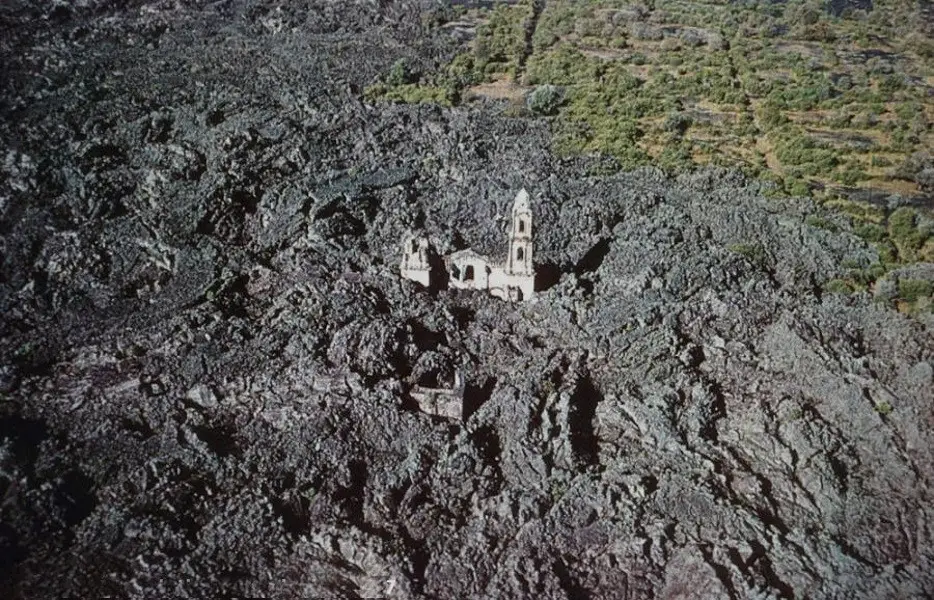
The town of San Juan Parangaricutiro in Michoacán is perhaps the most famous of all these abandoned places. In February 1943, a farmer noticed smoke rising from his land in Parangaricutirimícuaro and notified the municipality.
Geologists arrived and discovered that a volcano was emerging: Paricutín, which in less than a month rose from nowhere, erupted, and submerged the entire town in lava. Fortunately, there were no casualties.
Mineral de Pozos
During the colonial era, Mineral de Pozos in Guanajuato was considered the richest town in the entire Viceroyalty of New Spain, with more than 70,000 inhabitants who dedicated themselves to the extraction of gold, silver, copper, mercury, and aluminum from one of the many mines surrounding the town.
But the mines flooded, and by 1982, only 200 inhabitants remained in the town.
Ojuela
The town of Ojuela, in Durango, was one of the first mining towns founded in New Spain. It was founded by the Jesuit priest Servando de Ojuelos in 1598 next to a mineral-rich ravine.
To cross the ravine, they built a suspension bridge that still stands and can be visited. But in 1920, a series of storms left the mine completely flooded, and the town was deserted.
Real de Catorce
The town, originally called Real de Minas de Nuestra Señora de la Purísima Concepción de los Álamos de Catorce, is one of Mexico’s most famous abandoned towns.
It was located at the foot of a hill where several mines were built, yielding a vast amount of silver—so much, in fact, that the state where Real de Catorce is located began to be called Potosí, after the silver-rich mountain in South America of the same name. But the silver ran out, and by the mid-19th century, the town was deserted.
Guerrero Viejo
The town of Guerrero Viejo in Tamaulipas, very close to Mexico’s northern border, became a ghost town overnight when, in 1944, the Mexican and U.S. governments inaugurated the Falcon Dam, which would at least partially flood the town, and the inhabitants were relocated to Guerrero Nuevo.
Currently, when the dam’s water levels allow, some of its buildings can be visited.
Former Hacienda of San Diego de Jaral del Berrio
This hacienda was once home to the Marquises of Jaral del Berrio, a family so wealthy that their palace in Mexico City still exists today and is known as the Iturbide Palace.
In 1830, Marquis Juan Nepomuceno de Moncada y Berrio was considered one of the richest men in the world. But with independence and the revolution, the hacienda was gradually abandoned, and of its 6,500 inhabitants and train station, nothing remains.

San Pedro Hill
The town of Cerro de San Pedro in San Luis Potosí is also a mining town that was abandoned, but this time not because the mine ran out of ore. In 1948, the first major workers’ strike in modern Mexico erupted: the miners’ strike. The company that owned the mine, the American firm Asarco, decided to dynamite it rather than hand it over to its workers.
Currently, fewer than 100 people live in Cerro de San Pedro.
Villa del Carbón
Near the present-day town of Villa del Carbón, in the State of Mexico, lies a village submerged beneath a dam, the Taxhimay Dam, one of the largest in the region.
In 1934, the town of San Luis de las Peras was submerged by the dam’s waters, and today its submerged remains can be visited, among which the tower and the church’s facade stand out.
Churumuco
In 1800, the church in the town of Churumuco, Michoacán, very close to the state of Guerrero, was inaugurated. The town was one of the largest in the Tierra Caliente region, and the church was very famous; so much so that in 1813, Father José María Morelos y Pavón celebrated Mass there.
But around 1961, the Infiernillo Dam was built, and most of the town was submerged.
Tequesquitengo
The Tequesquitengo area has been continuously inhabited for thousands of years, partly due to its easy access to clean, crystal-clear meltwater. Nearby is a hacienda called Temixco, built by Hernán Cortés.
The town of San Juan Tequesquitengo was founded very near a small lake, but around 1865, the diversion of irrigation water caused the entire basin to flood. Today, the church and other buildings can be seen by diving in the lake.

Quechula
The town of Viejo Quechula in Chiapas, southern Mexico, is yet another victim of progress. In 1966, the Nezahualcóyotl Dam was built, submerging the entire town.
When rainfall is scarce, almost the entire old Santiago Quechula church, built in the early 18th century, can be seen. It had already been abandoned due to a disease that struck the town in 1776.
Opera Cinema
Among so many towns, there are also abandoned places in cities that were once major gathering spots.
The Cine Ópera in Mexico City is one such place, one of those two-story cinemas with a huge screen, which by the 1990s had already closed as a movie theater and was primarily used as a concert hall. One of these concerts, the Bauhaus concert in 1998, was the last one held there.
Cine Orfeón
In 1938, one of Mexico City’s most luxurious and modern cinemas, the Orfeón, opened on Luis Moya Street in the Historic Center.
A venue for countless lavish premieres during the Golden Age of Mexican Cinema, the cinema has been abandoned for decades, despite several attempts to reopen it. Local residents keep its exterior relatively clean.
Hotel Posada del Sol
In Mexico City, there is a 500-room hotel with a cinema, theater, and gardens, located on a central avenue, that is completely abandoned.
A dream of its owner, the politician, businessman, and architect Fernando Saldaña Galván, who committed suicide in its gardens eight months after its inauguration. Since then, it has been used as government offices and as a warehouse, but for more than 20 years it has remained completely abandoned.
Atlantis
Atlantis was an amusement park in Mexico City, conceived to complement the “Mechanical Games” in the first section of Chapultepec Park in the 1980s.
It featured several attractions, including shows with seals, dolphins, and exotic birds. However, expenses exceeded its budget, and the city revoked its operating permit, so it closed before 1996.
The Wave

The water park that operated alongside Atlantis for a couple of years, La Ola, was also located in Chapultepec Forest and featured several pools, including a very famous wave pool, as well as various water slides and a children’s play area.
La Ola suffered the same fate as Atlantis and by the mid-1990s had closed its doors, never to reopen its taps of water and fun.
El Patio
Few places are as emblematic of the 1960s, 70s, 80s, and 90s as El Patio, the nightclub that hosted stars of all kinds and calibers, from José José and Luis Miguel to The Doors, who were invited by Gustavo Díaz Ordaz’s son to play in Mexico.
The incredibly elegant venue, with its exorbitant entrance fees, has been abandoned since the late 1990s, and a building is currently under construction on its site.
Insurgentes 300
Halfway down Avenida de Los Insurgentes, very close to the roundabout of the same name and nestled among several major thoroughfares, the Insurgentes 300 condominium complex has stood since the 1960s as a symbol of the modernity of a new and cosmopolitan Mexico City.
But shortly after its inauguration, the condominium ran into financial difficulties, and the residents of the apartments went to court to avoid eviction. Since then, the complex has been partially abandoned.
Ex-Convent of Desierto de los Leones
Although it is currently under the protection of the Mexican government and forms part of the Desierto de los Leones protected natural area west of Mexico City, the former convent was actually abandoned by its original inhabitants, the Discalced Carmelites, in 1801 because the area was too cold (of course, if you go barefoot, well, you know).
It then remained completely abandoned for almost two centuries until 1976.
Teotihuacan
Although these are archaeological ruins, where obviously no one has lived for hundreds of years, the complex of Teotihuacan, the City of the Gods, is a special case. This is because when the Mexica arrived to inhabit Lake Texcoco and founded Tenochtitlan in 1325, Teotihuacan had already been abandoned since at least 900 AD.
In fact, to this day we do not know who lived there, what language they spoke, or why they abandoned their city.

Source: desafiomundial