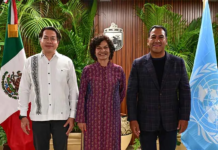
In 2024, when the current Mexican consul in Miami finished his term as governor of Chiapas, the handling of federal funds was marred by irregularities, while the state once again sank among the poorest.
The use of federal funds in 2024 placed Chiapas second among states with irregularities due to alleged misappropriation of millions of dollars in priority areas such as education and health, according to the 2024 Public Accounts review by the Superior Audit Office of the Federation (ASF).
This was the last year of Rutilio Escandón Cadenas’s administration, which concluded amid accusations of rampant violence in rural and urban areas that forced the displacement of entire communities. Official figures indicate that while 596 intentional homicides occurred in 2018, when his administration began; In 2024, 894 cases were committed. This tragedy unfolded in Chiapas, the southern state with the highest historical levels of poverty in Mexico, amidst a crisis of transparency in public funds.
The accounts of former governor Escandón Cadenas, now Mexico’s Consul General in Miami, Florida, are tainted by irregularities in public works and healthcare contracts, delayed payments, payments to more than 100 dismissed employees, payments to dozens of deceased individuals, and the failure to disburse scholarship funds.
The auditing body indicates in its report that these anomalies were committed through alleged violations of the Fiscal Coordination Law and the General Education Law. It took only months for a financial hole to appear in the state’s accounts.
According to a search by Reporte Indigo on Compras MX, the Chiapas state government’s public procurement records for that year, using federal funds, show a total of 915,587,056 pesos. Now, according to the Superior Audit Office (ASF), the state must clarify the whereabouts of 678.5 million pesos; that is, 74.1 percent of the public contracts registered in open data.
Millions spent on health, public works, and education
While irregularities were committed with money from various sectors, according to the auditing body’s findings, spending on public procurement was constant. Compras MX lists 268 contracts, 23 of which exceeded 10 million pesos.
The highest expenditure occurred between March and December, for imaging services for the Health Institute, totaling 95,714,250 pesos. However, the impact was minimal. At the end of the administration, the state ranked among those with the greatest social deficiencies in health, with six out of ten residents lacking access to medical services or medical services with technology, according to poverty data from the National Institute of Statistics and Geography (INEGI) presented in September.
The other most significant contracts, based on their value, were for public works projects aimed at expanding the sewage and drinking water systems in some municipalities, as well as the renovation of schools.
In Palenque, 55,922,443 pesos were invested from May to August to extend the northern collector and emergency outfall, while in Frontera Corozal, Ocosingo, the drinking water system was expanded for 28,949,000 pesos.
However, the lack of drinking water persisted. These resources did not reach the nearly 700,000 Chiapas residents without direct access to sufficient and acceptable drinking water. In half of the municipalities, according to INEGI (the National Institute of Statistics and Geography), there are problems with the water supply network, and only nine of the 124 municipalities have wastewater treatment facilities. This is the case in Chiapas, whose underground water reserves are among the 10 largest in the world, according to the National Water Commission.
Regarding schools, renovations were carried out at the physical therapy center of the System for the Integral Development of the Family (DIF), the Faculty of Veterinary Medicine and Zootechnics, the Higher Technological Institute of Cintalapa, the Intercultural University, and the Faculties of Social Sciences and Humanities of the Autonomous University of Chiapas. On average, 30 million pesos were spent per contract.
This expenditure was not reflected in the results at the end of Escandón Cadenas’ administration. Educational deficiencies worsened for the population aged three to 17. INEGI’s multidimensional poverty data showed that 17 percent of the child and adolescent population was experiencing educational disadvantage.
The figure, the highest in the country, is almost double the national average of 10.6 percent. But the situation is even more dire. In Chiapas, the educational gap deepened in 2024. In 2016, 240,816 children were not attending school. By 2024, that number had risen to 311,983.
Source: reporteindigo