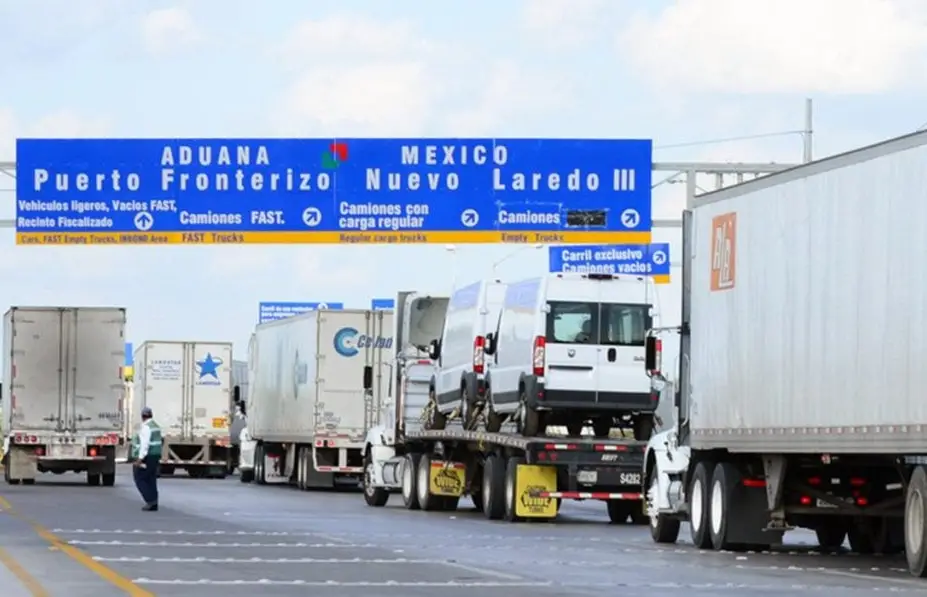

At the main land port of entry for trade between Mexico and the United States, the engines remain silent. Nearly three thousand truck drivers in Nuevo Laredo are waiting to renew or obtain their federal licenses, an essential document for operating on national and international routes.
The situation, truckers report, has not only reduced productivity but also jeopardizes the flow of logistics across a border that moves millions of tons of goods each year.
In the loading yards and warehouses of the industrial corridor, trucks parked with cold engines reflect the problem facing the sector.
“We are in a critical situation. Many drivers cannot go out on their routes because they don’t have a valid license or their trucks lack license plates. This delays shipments and generates financial losses,” explained a spokesperson for the Nuevo Laredo Truckers Association.
The backlog at the Ministry of Communications and Transportation (SCT) has reached unprecedented levels. Service centers are overwhelmed, and the mandatory medical evaluations for license renewals have become another bottleneck.
The delays are not only impacting local businesses but also international trade. Nuevo Laredo is the main border crossing point for goods between the two countries, and the lack of certified drivers is slowing down deliveries and increasing operating costs.
“Every day a truck is out of service, the company loses money. And right now, dozens of trucks are stuck waiting for licenses or license plates,” lamented a transportation company owner.
The disruptions are also affecting U.S. customers, who depend on the constant flow of food, electronics, and automotive products.
Faced with increasing pressure from the industry, the Ministry of Communications and Transportation (SCT) acknowledged the backlog and announced an internal restructuring to streamline processes at the licensing and preventive medicine offices.
According to the federal agency, the measures include the partial digitization of procedures, extended hours of operation, and the temporary hiring of certified medical personnel.
“We are working to normalize service in the coming weeks and significantly reduce wait times,” assured a spokesperson for the SCT.
The lack of federal licenses and license plates in Nuevo Laredo has implications that extend far beyond the local area. According to data from the National Chamber of Freight Transportation (CANACAR), approximately 40% of land-based trade between Mexico and the United States passes through this border crossing.
Every delay represents a risk to competitiveness, especially in a context where nearshoring has increased the demand for transportation in northern Mexico.
Truck drivers insist that the solution must go beyond temporary measures.
“If the licensing system isn’t modernized, the problem will return every year. We need ongoing attention and federal coordination,” stated the association’s representative.
Meanwhile, the drivers patiently await their return to the road. Amid the uncertainty, they remain hopeful that the SCT’s promise will be fulfilled and that they can resume the route that sustains binational trade.
Because in Nuevo Laredo, every truck stopped not only represents a delay, but also a story of hard work waiting to get back on the road.

Source: msn