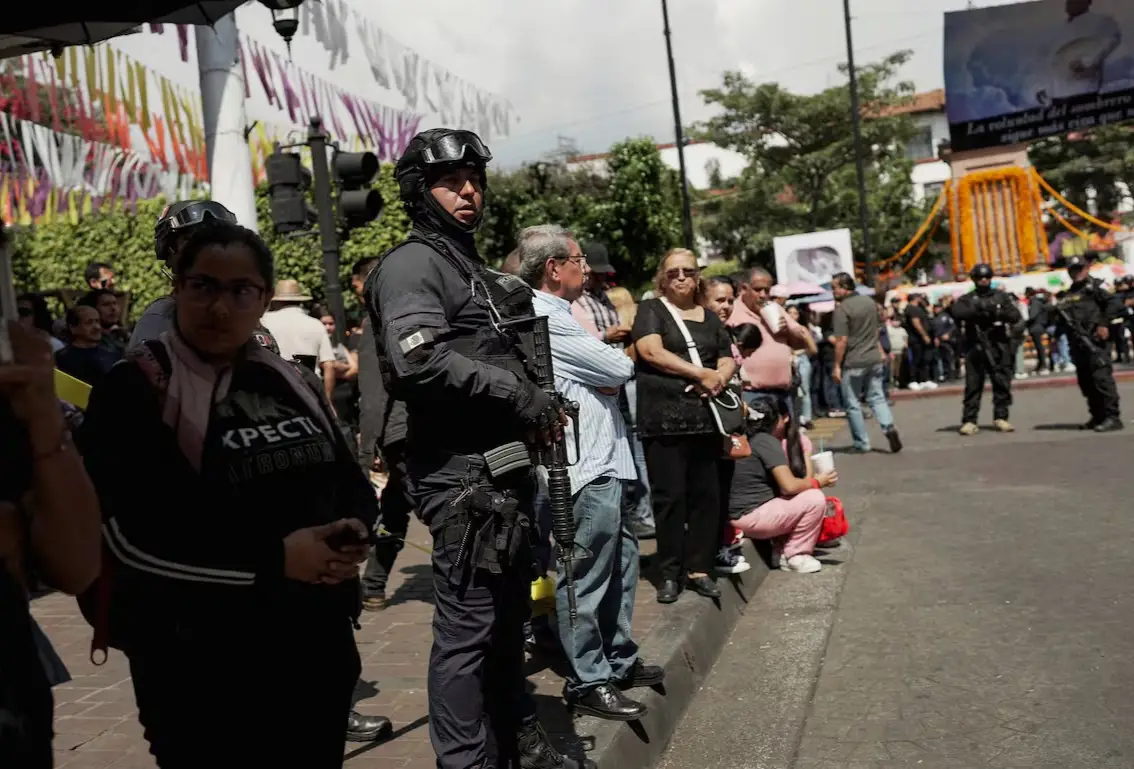

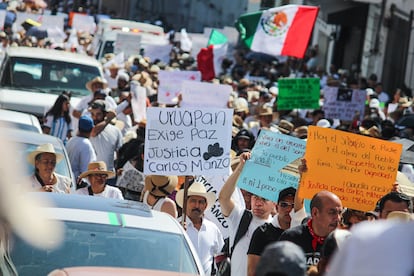
Since the beginning of the so-called “war on drugs,” Michoacán has become the epicenter of violence against mayors in Mexico, a bloodbath that has claimed the lives of at least 122 sitting mayors nationwide between 2006 and 2025, 18 of them in Michoacán, the state where former President Felipe Calderón launched an operation against organized crime. Nearly two decades later, Mayor Claudia Sheinbaum is finalizing a plan to pacify the state, which continues to struggle with the problems that have plagued it for decades. Sheinbaum’s offensive comes a week after the assassination of Carlos Manzo, the mayor of Uruapan, a murder that has sparked outrage and a crisis within the executive branch.
During Sheinbaum’s administration, three mayors have been murdered in Michoacán: Salvador Bastida García, mayor of Tacámbaro and a member of the Labor Party (PT), who was attacked on June 6, 2025; Martha Laura Mendoza, mayor of Tepalcatepec and a member of the National Regeneration Movement (Morena), murdered on June 17; and Carlos Manzo Rodríguez, mayor of Uruapan, whose murder sparked a political battle between Sheinbaum’s government and the opposition.
Manzo is the most recent victim on a list that includes politicians from all parties, men and women who, according to all indications, were gunned down by different organized crime groups that control Michoacán territory.
This weekend, the federal government will present the “Michoacán Plan for Peace and Justice,” a set of actions related to security, economic development, education, and culture, which includes a municipal alert system so that mayors can request assistance from state and federal authorities in the face of frequent threats from organized crime.
Sheinbaum’s plan is reminiscent of previous federal interventions in Michoacán, considered by experts to be a state under the control of a “criminal government.” “They represent a challenge to the state and send the message that criminal groups not only dispute territory, but also decide who can govern,” says Eduardo Guerrero, a specialist with the Lantia news agency.
The analyst explains that the assassinations of mayors are symptoms of a deep-seated process of criminal capture of local governments and the imposition of their governance systems outside of established institutions.
The specialist suggests combating the crisis in Michoacán by professionalizing and purging municipal police forces, with federal support and external oversight; that the state government assume operational command of the most vulnerable and infiltrated municipal police forces; and that the federal government develop a strategy of sustained, not merely reactive, presence, prioritizing the effective protection of mayors and community leaders.
Juan Marcelo Ibarra Villa, a member of the PRI party, was the first on the list. He was mayor of the municipality of Madero when he was assassinated on June 1, 2008, just six months after taking office. By then, 18 months had passed since the operation launched by Calderón, which involved sending troops into Michoacán to combat the cartel then known as La Familia Michoacana.
The former president of the National Action Party (PAN) defended his strategy, stating that the federal intervention was requested by then-Governor Lázaro Cárdenas Batel, a politician from the Party of the Democratic Revolution (PRD) with a highly symbolic lineage: grandson of General Lázaro Cárdenas del Río, president of Mexico from 1934 to 1940, and son of Cuauhtémoc Cárdenas, the man who led the PRI’s split in the late 1980s.
Cárdenas Batel left the governorship in 2008, handing it over to Leonel Godoy, another member of the PRD party. Godoy’s administration was plunged into crisis by the offensive against the cartels and the rise of the Knights Templar cartel, a splinter group of La Familia Michoacana.
The criminals’ reaction to the declaration of war resulted in clashes in public streets, the display of dismembered bodies, beheadings, road blockades, ambushes of Mexican Army patrols, and terrorist acts such as the explosion of two grenades during the Independence Day celebrations in the Plaza de Toros Morelia, the state capital, on September 15, 2008. The violence also targeted the mayors of the 113 municipalities, who became targets of the cartels.
On February 24, 2009, Octavio Manuel Carrillo Castellanos, the PRI mayor of Vista Hermosa, a municipality of 20,000 inhabitants, was assassinated. Like almost all the municipalities in Michoacán, Vista Hermosa lives under the threat of criminal groups involved in drug trafficking and extortion. In the following years, two more mayors were killed by organized crime while Calderón was president and Godoy was governor.
In December 2009, the entire municipal council of Tancítaro resigned due to the violence and drug trafficking situation. The state Congress appointed Gustavo Sánchez Cervantes, a karate instructor and local leader with no party affiliation, as interim mayor. Ten months later, on September 27, 2010, the interim mayor and his private secretary were beaten to death. Their bodies were found with their hands tied behind their backs and their eyes blindfolded with bandanas; “their heads were smashed from the blows they received,” according to the state prosecutor’s report.
On November 2, 2011, the mayor of La Piedad, Ricardo Guzmán Romero, was shot and killed just 11 days before the state elections. The mayor, a member of the National Action Party (PAN), was murdered while distributing campaign materials for his party’s gubernatorial candidate, Luisa María Calderón, sister of the President of Mexico. Like Carlos Manzo, he was gunned down amidst the Day of the Dead festivities, which in Michoacán are celebrated with lively street parties.
These four Michoacán mayors are among the 47 mayors who, according to the National Association of Mayors (ANAC), were murdered throughout Mexico during Felipe Calderón’s six-year term (2006-2012).
The murders during Peña Nieto’s six-year term
The PRI returned to power in 2012; first in Michoacán, with Governor Fausto Vallejo, and then nationally, with President Enrique Peña Nieto. But the change of party did not stop the violence.
In 2013, two mayors were assassinated in the state: Wilfrido Flores Villa, a member of the Institutional Revolutionary Party (PRI) who was serving as interim mayor of Nahuatzen, was gunned down on February 4 while having lunch at a restaurant; and Ygnacio López Mendoza, mayor of Santana Maya and a member of the Labor Party (PT), was murdered on November 7, a month after leading a protest at the Senate to denounce the fact that Michoacán mayors were being forced to pay extortion fees to organized crime.
That same year, self-defense groups emerged in several municipalities of Michoacán. Faced with the authorities’ inability to provide security, these groups armed themselves to confront the drug cartels. In that context, in January 2014, President Enrique Peña Nieto created a special commission for security in Michoacán, headed by Alfredo Castillo, a man he trusted implicitly who had been his attorney general in the State of Mexico government. Castillo’s mission was to engage in dialogue with the self-defense groups, support them in their fight against the cartels, and pacify the state.
Castillo failed, and along the way, another mayor was assassinated, this time in Tanhuato, a municipality located in the northwest of the state, bordering Jalisco, where the Jalisco New Generation Cartel was already vying for territory with La Familia Michoacana. Mayor Gustavo Garibay was murdered on April 24, 2014; he was a member of the National Action Party (PAN) who had already survived an assassination attempt in 2012.
The fourth murder during Peña Nieto’s six-year term occurred in October 2017, when the mayor of Paracho, Stalin Sánchez González, was shot as he left his home. The assassination of this mayor, a member of the PRD party, took place while his party was once again governing the state. It was the first mayoral assassination during the term of Governor Silvano Aureoles, who had won the 2015 election.
In 2018, as Peña Nieto’s term was drawing to a close, two more murders occurred in the same municipality: Javier Ureña González, the PRD mayor of Buenavista Tomatlán, was killed on June 27, and Eliseo Delgado Sánchez, the mayor-elect of the same town, who had won the election under the Morena party banner, was gunned down on July 20.
Buenavista Tomatlán is a municipality of 12,000 inhabitants, located in the Tierra Caliente region of Michoacán. The municipality is home to several lemon packing plants that have been victims of extortion in recent years, and it is one of the towns where self-defense groups emerged, such as the one led by Hipólito Mora, who was murdered in 2023 after a decade of fighting in his community. Buenavista has been the scene of violent events, such as the recent murder of Alejandro Torres Mora, nephew of the former self-defense leader.
2018 was a federal and local election year, and in that context, dozens of Michoacán politicians were attacked. Among them was the mayor of Taretan, Alejandro Chávez Zavala, who had requested a leave of absence to campaign for reelection. The mayor and candidate was shot while campaigning in a neighborhood of the municipality, accompanied by his wife. Taretan, with 12,000 inhabitants, is a town located 100 kilometers from Morelia, bordering Uruapan.
According to figures from the National Association of Mayors (ANAC), 37 mayors were murdered nationwide between 2012 and 2017 during Peña Nieto’s six-year term, with five more homicides occurring in 2018. Six of the 42 mayors murdered during that period governed municipalities in Michoacán.
According to data from the organization Data Cívica, the National Association of Mayors, and other consulting firms, 23 sitting mayors and three mayors-elect were murdered during Andrés Manuel López Obrador’s six-year term. And, so far in Claudia Sheinbaum’s administration, ten more murders have occurred. Michoacán has remained at the epicenter of this violence, with eight mayors murdered during the current administration (the “Fourth Transformation”), five under López Obrador and three under Sheinbaum.
In the first months of López Obrador’s six-year term, the first murder occurred in Nahuatzen, a municipality of fewer than 30,000 inhabitants, located in the north of the state and the scene of several clashes. The mayor, David Eduardo Otlica Avilés, was kidnapped and murdered on April 23, 2019. As in almost all cases, the state Attorney General’s Office opened investigations and, months later, reported the arrest of the alleged perpetrators without detailing the motive.
In 2022, two more homicides occurred: that of Enrique Velázquez Orozco, the PRI mayor of Contepec, a municipality of 35,000 inhabitants bordering the state of Querétaro, and that of César Arturo Valencia Caballero, mayor of Aguililla, a southeastern municipality with 14,000 inhabitants and high levels of marginalization.
In 2024, the last year of López Obrador’s six-year term, there were two more cases: Guillermo Torres Rojas, a member of the Morena party who was mayor of Churumuco, and Yolanda Sánchez Figueroa, the PAN mayor of Cotija. In both cases, the murders occurred as their terms in office were drawing to a close.
Violence in Michoacán has also affected mayoral candidates in recent elections. In 2024 alone, two murders occurred in the same municipality, just hours apart.
The incidents took place on February 26 in the municipality of Maravatío, governed by the PRD. First, Miguel Ángel Reyes Zavala, Morena’s pre-candidate for mayor, was murdered. He was shot by two armed men while parking his truck. Hours later, Armando Pérez Luna, a PAN pre-candidate, was also shot inside his vehicle.
The settling of scores and violence unleashed by organized crime have also claimed the lives of five former mayors in Michoacán in recent years. According to records from Data Cívica, these murders occurred in the municipalities of Penjamillo (2018), Morelia (2020), Aquila (2022), Cotija, and Maravatío (2024).
Source: elpais