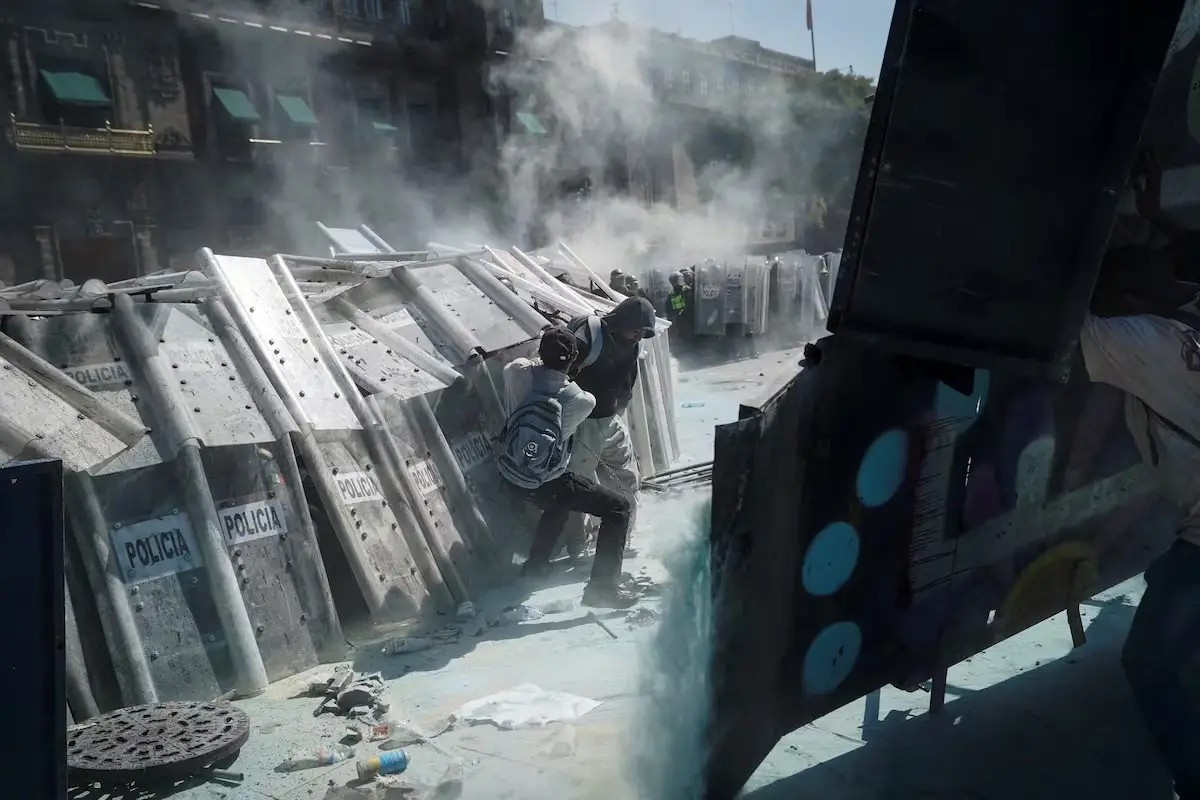

Waving white flags, One Piece anime flags, and Mexican flags with Carlos Manzo’s face instead of the coat of arms, the Generation Z demonstration began at the Angel of Independence. White clothing and sombreros were prevalent, mimicking the attire of the mayor of Uruapan. Most of the attendees were over 30, with young people in the minority. Except for the final stretch in the Zócalo, when a group of hooded youths threw rocks and bottles at the National Palace, which was barricaded as usual during protests. They managed to knock down some barriers and clashed with the police. Otherwise, the day unfolded peacefully. Among the most repeated slogans were insults directed at the president, the assertion that “we are not artificial intelligence,” and demands for “Morena out.”
This Saturday’s mobilization, the first major protest against the Sheinbaum administration, was fraught with controversy. Throughout the week, the government has denounced the opposition’s manipulation and co-opting of a supposed spontaneous mobilization of younger generations, a movement that has toppled governments in countries as diverse as Nepal, Peru, and Madagascar in the last month. Sheinbaum presented a detailed report pointing to an “articulated digital strategy.” The report implicates influencers, opposition figures, bots, and accounts linked to the Atlas Network, an ultranationalist organization with a presence in several countries.
Fernanda, 29, explains her reasons for attending. “I’m here because I love Mexico. I’m tired of so much violence, so much insecurity in our streets.” The young woman criticizes the Infodemic report presented by the government. “Claudia is afraid. We are not few, as they said, nor are we bots. We are real people, tired people, students, workers, and people who want a better Mexico.” For her, President Nayib Bukele of El Salvador is an example of an international leader. He considers himself nonpartisan, opposed to Sheinbaum’s government, but in favor of Ricardo Salinas Pliego running for office in the future: “He has different ideas because I know he’s a businessman who doesn’t know much about politics, but if he were to run, he would have my full support.”
The businessman was among the first to amplify the messages of Generation Z mobilizations around the world. Amidst his ongoing dispute with the government over his massive tax debts, he has publicly supported the march. This Thursday, following the court ruling that compels the businessman to pay a 50 billion peso tax debt, the Generation Z account posted a cartoon depicting Sheinbaum strangling and pointing a gun labeled SAT (Tax Administration Service) at a person. The government maintains that the magnate is part of an orchestrated campaign of attrition, with an estimated cost of 90 million pesos.
The march, called Generation Z Mexico, emerged as a scattered online movement, fueled by AI-generated messages, anime references, and anti-government slogans, which in a matter of weeks transformed into a national mobilization. The assassination of Uruapan Mayor Carlos Manzo accelerated the call to action, which is presented as a nationwide youth protest. Cities like Puebla, Monterrey, and Guadalajara have also seen protests under the same banner.
On social media, where the call to action originated, AI-generated videos abound, encouraging participation with posts from teenagers denouncing political manipulation. Promoters include influencers like Temach, Chumel Torres, and Arturo Herrera, as well as opposition websites and figures. The movement appeals to young people between 15 and 20 years old who did not experience mobilizations like #YoSoy132 and shares advice for those marching for the first time. Meanwhile, the government has insisted on exposing the movement’s true nature. The president maintains that the movement’s origins “are not genuine” and that business and media actors instigated the protest from abroad.
When the march reached the Zócalo, a group of about a hundred young people began throwing objects over the fences protecting the National Palace. People dispersed at the entrances due to the pepper spray used by the police. Hooded youths managed to break through some of the fences and threw firecrackers while the protesters, dressed in white—mostly families and elderly people—watched from a distance. Some even encouraged others to enter the Palace: “That’s how you should attack the drug traffickers,” “There are more of us,” “The National Palace belongs to the people.”
The demands of Generation Z in Mexico include a recall referendum, judicial reforms, and transparency, although social media is dominated by messages about security, frustration, and corruption. The figure of Carlos Manzo has been used as a symbol, even though his family has distanced itself from the protest. The report presented by the government traces the origin of the protest to early October, with a report by Azteca Noticias, the television network owned by Salinas Pliego, followed by posts from influencers and the coordinated creation of accounts on various social media platforms. Between October 16 and November 1, the tone shifted from a “peaceful” protest to AI-generated images depicting the National Palace in flames.
Source: elpais