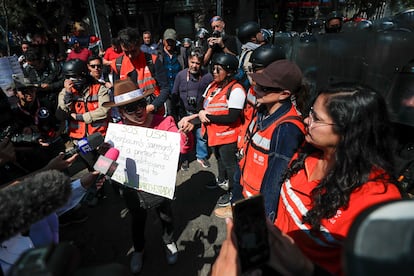
The massive protests against Claudia Sheinbaum’s government last Saturday presented a rare sight in Mexico, a country that has historically served as a bulwark against the regional and global far right. Growing social unrest over the country’s insecurity, fueled by the assassination of Uruapan Mayor Carlos Manzo, and widespread frustration with seemingly endemic corruption, have opened a small breach in the wall that has been quickly exploited by leading figures of the far right. Argentinians Eduardo Menoni, Agustín Antonetti, and Agustín Laje, Spaniard Javier Negre, and American Alex Jones are among those now trying to widen this small gap in a country that is key to their agenda but resists its penetration.
Mexico is among the 15 largest economies in the world and is the second largest in Latin America, second only to Brazil. It also shares a border of more than 3,000 kilometers with the United States, where far-right rhetoric finds its greatest defender in President Donald Trump, who is also the person most interested in its success in his southern neighbor. Everything that happens in the Latin American country matters and resonates beyond its borders. “Of the remaining left-wing governments on the continent, Mexico is clearly the most important and the most successful. Not even Lula in Brazil has the power that Sheinbaum has today,” notes Lisandro Devoto, a political scientist at UNAM (National Autonomous University of Mexico). This makes it a priority target.
Mexico is also the main link between countries and regions, adds Mario Santiago, an expert on the far right at the Mora Institute: “Vox and some other actors in Spain translate the debate of the new European right for Latin America, and the first point of entry for this exchange of ideas, texts, and figures is Mexico.” “Lately, for obvious reasons, Argentina has taken that place, but it has much less influence in the region,” he concludes.
Tearing down the Mexican wall is vital for the far-right’s discourse to continue its crusade, and those directly involved understand this. “Mexico is a key country for freedom to prevail in Latin America and for freedom to have a crucial country on its side,” said Javier Negre, convicted several times for spreading misinformation, who announced he will “double down” and invest in a widely circulated Mexican media outlet to gain a foothold in the country. Both he and the other agitators have tried to amplify images that, taken out of context, depict a country where the government is struggling to stay afloat amidst social unrest. “As soon as they get a photograph, a front-page image of someone injured, the narrative of chaos begins, which is what they’ve been trying to construct,” Mario Santiago points out.
These kinds of strategies, successfully implemented in other countries, never seem to work in Mexico. “It seems to me that they’re still in a phase of experimentation here. They’re launching one image after another, trying one symbol, then another, to see which ones are truly creating cohesion,” the specialist observes. “They’ve been trying for years, investing money, effort, and resources, and they haven’t succeeded,” notes Ernesto Bohoslavsky, author of the book A Brief History of Latin American Right-Wing Politics, who considers Mexico proof of the “irreducibly national character of politics.” “There’s a risk of thinking that international actors have a lot of influence when it comes to politics in each country, and perhaps they have more influence in smaller countries, but in a country like Mexico, it’s more difficult for external actors to interfere,” the expert tempers.
The “international conspiracy” narrative that the government is trying to outline is also, for Mario Santiago, somewhat “deceptive,” since other local factors come into play that the Executive branch must pay attention to without minimizing them. The North American country has its own unique breeding ground that makes it susceptible to these discourses gradually taking hold. Claudia Sheinbaum’s government enjoys extraordinary popularity ratings, unlike her party, Morena, which loses support in each new poll, rapidly widening the gap with the president.
Source: elpais