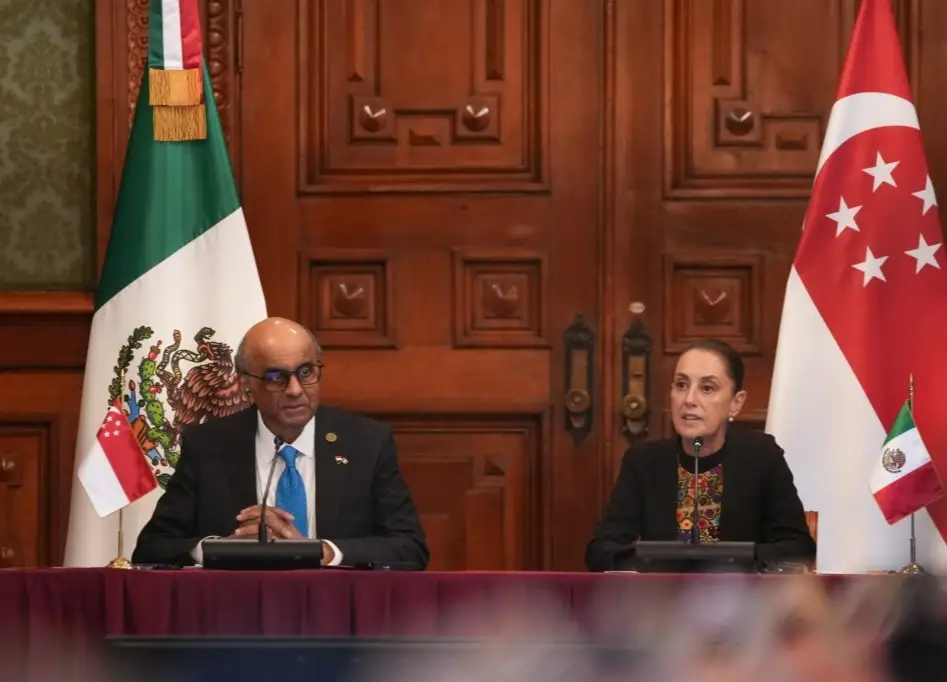

The state visit, the first by an Asia-Pacific leader since the start of the new Mexican administration, focused on expanding trade, investment, and bilateral connectivity.
Sheinbaum emphasized that the dialogue with the Singaporean delegation, which included private meetings, cabinet meetings, and a joint business roundtable, demonstrated the Asian nation’s growing interest in expanding its presence in Mexico.
As evidence of this, she enthusiastically announced Singapore’s decision to open a resident embassy in Mexico City in 2026, its first in a Spanish-speaking country and its second in Latin America. With its establishment, Mexico will have 87 resident embassies of countries accredited within its borders.
The announcement, the President stressed, reflects international confidence in the Mexican economic environment and the opportunities offered by the so-called Mexico Plan, a development strategy that the Singaporean business sector identified as a way to expand investments in infrastructure, logistics, digitalization, and ports.
Currently, Singapore is the fifth-largest investor in Mexico among Asia-Pacific countries, a figure that, according to Sheinbaum, will increase in the coming years.
During the visit, both governments signed two Letters of Intent: one on environmental matters, focused on reef restoration, and another on development cooperation. This also includes the exploration of a new digital cooperation framework, which will involve the exchange of experiences in technology governance and digital infrastructure modernization projects, with the participation of Mexico’s Digital Transformation Agency.
President Tharman agreed on the need to strengthen the economic relationship in an uncertain international context, where, he affirmed, both countries, as open economies integrated into global value chains, can benefit from reliable partnerships. He emphasized that Singapore considers Mexico a natural partner for innovation and economic diversification, given its advanced manufacturing, specialized talent, and strategic location.
The president recalled that Mexico and Singapore were among the first countries to join the CPTPP and reiterated his interest in moving toward Singapore’s full membership as an associate member of the Pacific Alliance. He noted that work is already underway on the ratification of the PAFTA, which will expand opportunities for companies from both countries and strengthen Asia-Latin America connectivity.
The bilateral economic relationship is already showing dynamism: trade between the two nations grew by 60 percent last year and exceeds $2 billion, with the participation of Singaporean companies such as Temasek Holdings, Banyan Tree, and Sunningdale, as well as more than 70 Mexican companies operating in Singapore in sectors ranging from food to technology.
Sheinbaum and Tharman agreed that cooperation should also encompass the cultural, historical, and scientific dimensions, as reflected in the exhibition “We Are Pacific: The Acapulco-Manila Galleon,” which will be inaugurated at the Colegio de San Ildefonso. This project, they noted, exemplifies the century-old bond between Asia and Mexico and serves as a reminder of its strategic role in the Pacific.
Both leaders stated that the state visit marks the beginning of a renewed phase in the bilateral relationship, one oriented toward the future and based on innovation, economic development, and mutual collaboration. For President Sheinbaum, the meeting confirms that Mexico is consolidating its position as a key hub for international investment; for President Tharman, the phrase that encapsulates this alliance is simple:
“Where there is friendship, there is no distance.”
Source: revistafortuna