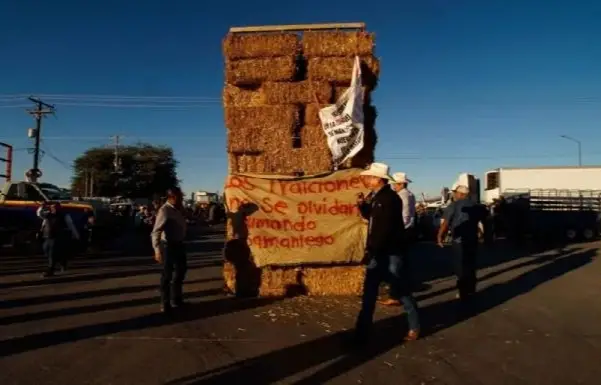

Nearly two days into the blockade of the Mexicali-Calexico border crossing, the Business Coordinating Council (CCE) of Mexicali, Baja California, estimated that 100 million pesos could be lost daily due to the protest by producers against the approval of the General Water Law.
Octavio Sandoval López, president of the organization, and Cristian Apodaca del Ángel, treasurer of the Maquiladora and Export Manufacturing Industry (Index) Mexicali, made this statement on Friday, December 5, at a press conference held in the Baja California capital.
The blockade began on the afternoon of Thursday, December 4, by farmers, along with organizations such as the Baja California State Wheat Council and the Mexicali Local Delegation of the National Front for the Rescue of the Countryside.
To block the road, they have brought heavy machinery and even set up a camp; participants include producers from the Mexicali Valley as well as producers from San Luis Río Colorado, Sonora, according to reports.
In general, the Calexico East Port of Entry, also known as the Port of Entry, is a border crossing that connects Mexicali with the U.S. cities of Calexico and California.
“The problem we have at the border crossing is that trucks coming from the United States and trucks going to the United States are being stopped. It has a double effect: the problem is that merchandise isn’t arriving,” explained Sandoval López.
He added that this includes merchandise needed for processing or transformation, which has one or two days’ worth of inventory, and that if it doesn’t arrive, industry would be “paralyzed”; the other issue is imports for consumption, such as chicken or food, which currently cannot be imported, he exemplified.
“Based on the figures I’ve been working on, the impact we’re considering is 100 million pesos per day. That’s the impact it’s having on the economy because our economy is paralyzed,” asserted the president of the Mexicali Business Coordinating Council (CCE).
Octavio Sandoval López indicated that 1,800 trucks cross the border daily at this point, so merchandise is beginning to be lost, and it’s also part of a global logistics chain.
“In the case of imports, well, as long as we have inventory, but companies only have three or four days’ worth of inventory,” he reiterated.
Apodaca del Ángel stated that they represent 135 companies, 90,000 direct jobs, and 300,000 indirect jobs.
“The losses are incalculable at this time, and if this process is prolonged, we’re talking about one of the most important months of the year in terms of exports,” he commented.
He added that the organization’s leadership is seeking solutions in Mexico City with various federal agencies and is analyzing which customs offices could be used to facilitate the transit of merchandise.
“We are practically losing the entire day: it is something that needs to be redirected and right now we depend a lot on facilitating transit at the checkpoint in La Rumorosa, in order to access the customs offices in Tecate and Tijuana,” said the treasurer of Index.

Source: proceso