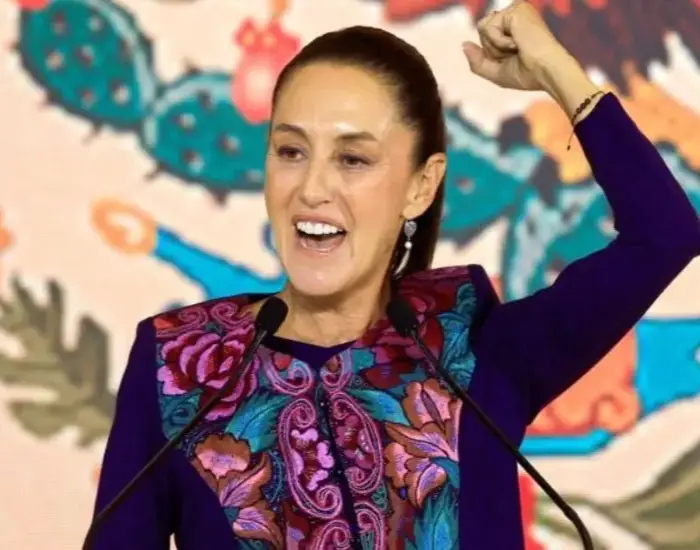

Oaxaca has once again taken center stage in the international conversation thanks to Mexican President Claudia Sheinbaum Pardo, who was included among The New York Times’ list of the 67 most stylish people in the world in 2025. The list, compiled by renowned fashion journalist Vanessa Friedman, highlights figures whose influence transcends aesthetics, and in the case of the Mexican president, it underscores her political and symbolic decision to wear garments of indigenous origin.
Friedman explained that Sheinbaum has captured global attention “by intentionally combining traditional embroidered clothing with textiles created by artisans from different regions of the country,” adding that this choice is not merely stylistic: the president has taken steps to curb the plagiarism of designs that directly affect indigenous communities, including those in Oaxaca, one of the states with the richest textile traditions in the world.
The president’s connection to Oaxacan fashion has been evident since the beginning of her administration. One of the most iconic garments she has worn—her inauguration dress in October 2024—was crafted by Oaxacan artisans. The textile company Lari Guie’, based in the state, confirmed that the floral embroidery was the work of artisan Claudia Vásquez Aquino, while the garment’s construction was handled by Saúl Mosqueda and designer Olivia Trujillo.
This hasn’t been the only instance. Throughout 2025, Sheinbaum has worn pieces from different regions of the country; however, Oaxaca remains one of the most consistent influences on her wardrobe. The state, known for its San Antonino embroidery, the backstrap loom weaving of the Sierra Sur, the textiles of Pinotepa, and the iconography of the Isthmus, has found an unexpected platform in the presidential figure.
The president has also taken a stand against the commercial plagiarism of indigenous designs. In August, her administration questioned Adidas for launching the “Oaxaca Slip-On” sandals without consulting the communities that inspired the design. The incident triggered a legal review process and opened a broader debate about collective ownership and respect for artisanal creations.
“Large companies often appropriate community designs. We are reviewing the legal aspects to protect them,” Sheinbaum said at the time, supporting artisans from Oaxaca and other states.
In her first year in office, the mayor has worked with creators such as Olivia Trujillo Cortez, Thelma Islas, Crystel Martínez Torres, and Virginia Verónica Arce Arce, all specialists in traditional techniques. Her outfits have blended embroidery from Chiapas, women’s military attire—as seen in her first Independence Day celebration—and artisanal elements from central and southern Mexico.
Sheinbaum’s inclusion on the New York Times list places her alongside figures like Bad Bunny and Sabrina Carpenter. However, her presence has a distinct nuance: her style, more than a trend, has become a vehicle for showcasing the work of thousands of women artisans and for placing the value of Mexican textile heritage, especially that of Oaxaca, on the global agenda.
In a year in which Mexico declared 2025 the “Year of Indigenous Women,” this international recognition underscores that fashion can also be a form of memory, politics, and cultural resistance.

Source: nvinoticias