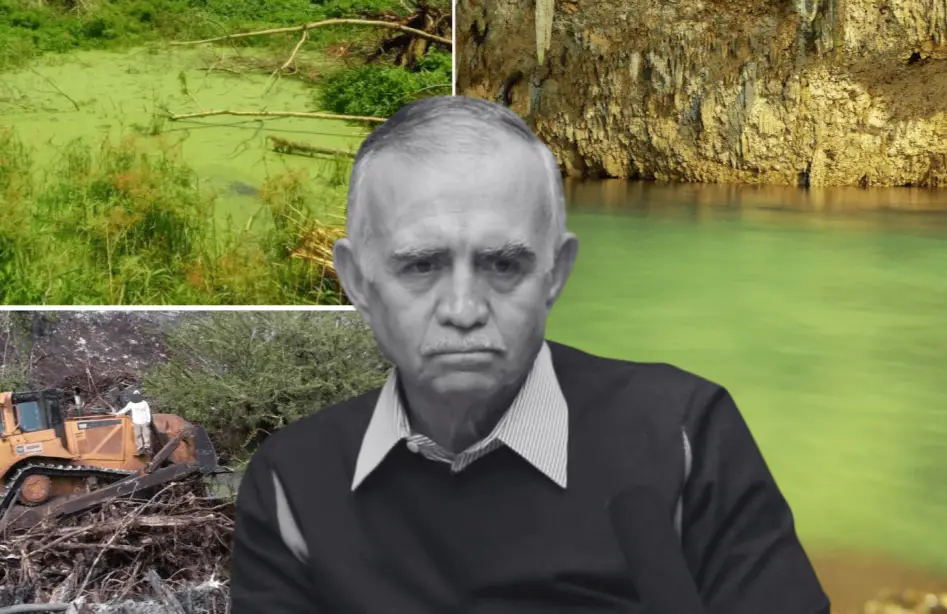

The company Enerall, founded by Alfonso Romo, filled a 5,500-square-meter cenote in Yucatán with earth and rocks, destroying it. The Federal Attorney for Environmental Protection (Profepa) did not demand restoration of the damage or refer the case to the Public Prosecutor’s Office to investigate a possible environmental crime; instead, the only consequence was a fine.
Although the incident occurred in 2018, it is being remembered in 2025 due to the Morena party’s rushed passage of the controversial Water Law in the Mexican Congress. Various civil, agricultural, and activist organizations have pointed out that this law not only betrays the indigenous population and communities but also fails to address the needs of large corporations.
Enerall, founded in 2007 by Alfonso Romo Garza, who served as Chief of Staff to the President of Mexico under Andrés Manuel López Obrador, established itself in Tizimín, Yucatán, atop the country’s most important freshwater reserve, according to the 2021 Atlas of Water in Mexico by the National Water Commission (Conagua).
But the company’s location is no coincidence: being there in Tizimín is like having Moses’ staff capable of making water flow from a stone, figuratively speaking, as it is a region with a large number of cenotes—at least 369—and soil with a high capacity for recharge from rainfall. And it was there that Enerall was accused of damaging one at Rancho Asideros, details of which are provided later.
The vast aquifer of the Yucatán Peninsula has been at risk for years, thanks to water concessions like the 23 obtained by Enerall—the so-called “Water Chief of the Mayan Paradise” in a report by Conectas—which allowed it to consume 16.81 million cubic meters annually, with an additional 168 million cubic meters secured for a decade, according to 2020 figures.
But Rodrigo Llanes Salazar, a columnist for this publication, provides more recent data: “Currently, Enerall’s concession is for 30,812,153 cubic meters per year.”
And it helps to put that amount into perspective by pointing out that it doubles the annual consumption of the capital of Yucatán, which supplies the vital resource to more than 1.3 million residents:
“To give you an idea of the magnitude of this volume, the Mérida Municipal Water and Sewerage System has a concession for 14,186,719 cubic meters per year. That is, Enerall consumes more than twice the water of the entire Mérida municipal system.”
What the new Water Law says: an advantage for large companies
The issue arises because the modifications to the Water Law are causing uncertainty among the agricultural population, mainly for these two reasons:
It eliminates the transfer of concessions between private individuals and replaces it with reassignments overseen by Conagua (National Water Commission).
That the State is now the sole regulator of water use
According to farmworkers, the new Water Law prevents them from inheriting or selling their land, since without the water use permit it has no value. Giving an advantage to large corporations that will acquire their land at ridiculously low prices.
And although they staged massive roadblocks across much of Mexico, their protests went unheard by the federal government.
Even this past weekend, the national president of the PAN party, Jorge Romero Herrera, warned that the General Water Law represents “the beginning of the end for private property in Mexico,” by concentrating decision-making power in the federal government.

Source: yucatan