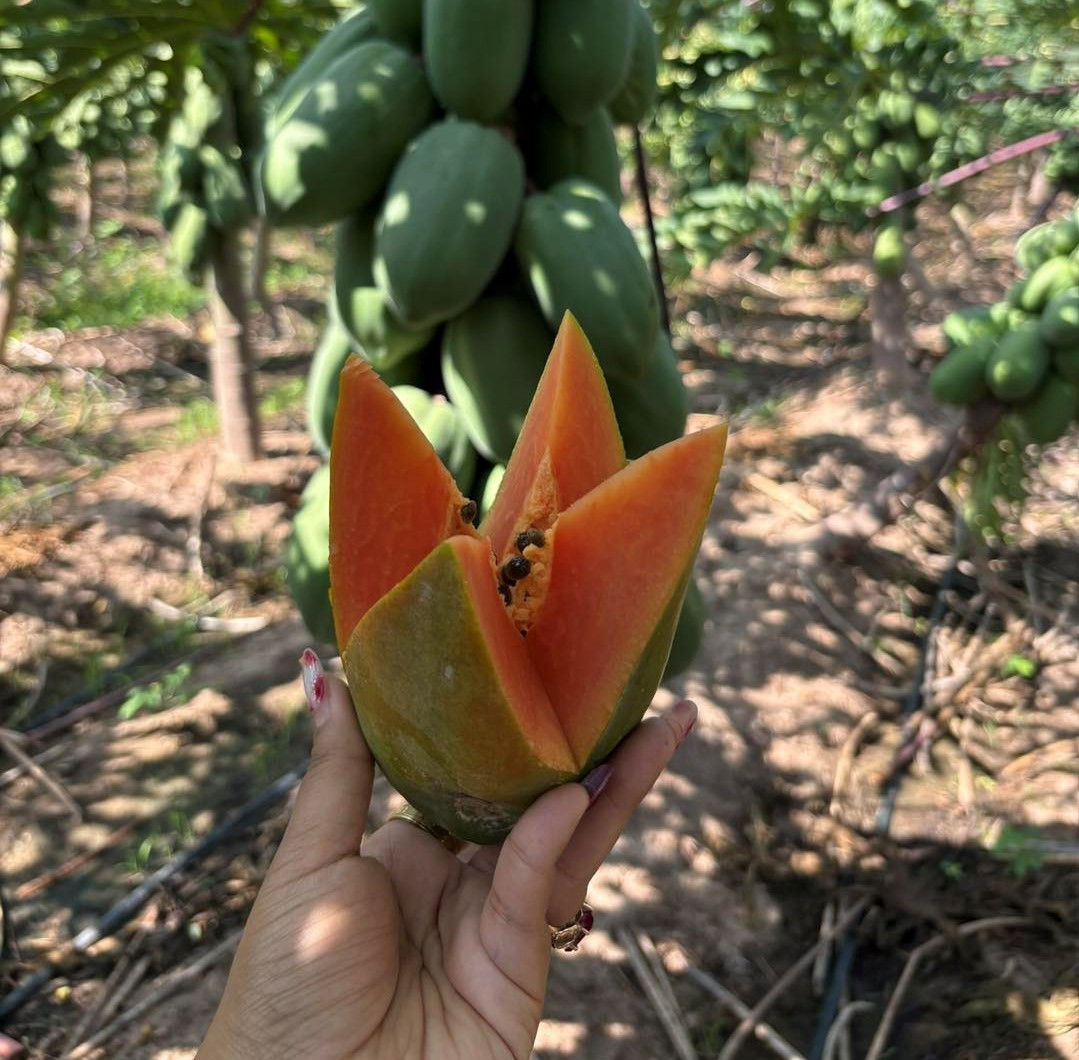

Although its origin has been debated for years, it’s a proudly Mexican fruit. It’s sweet, soft, juicy, with a very distinctive orange color and a flavor unlike anything else. Yes, we’re talking about the Carica papaya!
There are different types and varieties around the world, popular depending on the region where they are grown. But on this occasion, the Regional Office of Agriculture focused its attention on the production of Julián Grajales, a town belonging to the magical town of Chiapa de Corzo, in Chiapas.
That’s why the team from the Rural Development Support Center (CADER) 01 Tuxtla Gutiérrez, led by engineer José Luis Calero Olmedo, met a small but strong partnership made up of cousins Asunción Martínez Pérez and Ismael Martínez Madrigal, both producers of Maradol papaya.
As a way of reminiscing, Don Asunción recounts that the countryside has been his life, an inheritance from his father, who cultivated the land with corn and beans. However, over time he decided to grow papayas because he believes that, compared to other crops, it is very forgiving and has fewer losses.
“There was a time when I left work to go to the city and work for 15 years as a papaya vendor. There, I would pick the fruit and place it where my boss told me to; that’s how I learned the business. But a little over seven years ago, I decided to become a producer and invested all my savings. My need to work and grow pulled me through,” he recalls.
Today, after all those years, his orchard covers 12 hectares. Each hectare has 2,200 plants, which can produce up to 80 tons.
In total, there are approximately 26,400 papaya trees, and each tree bears between 40 and 60 fruits.
Despite being a year-round fruit, its cultivation is delicate and expensive, says Don Ismael, who constantly battles diseases, sap-sucking insects, and pests.
Viral disease, for example, is the most aggressive virus the Martínez family struggles with. They explain that it is an incurable disease, akin to cancer, contagious, and spread through insect carriers.
This causes the plant to yellow, lose nutrients, and develop pigmentation in the leaves, hindering fruit production.
Despite effective management of sap-sucking insects, fumigation is essential to maintain the orchard’s health, and they use liquids that are not harmful to humans.

Source: gob