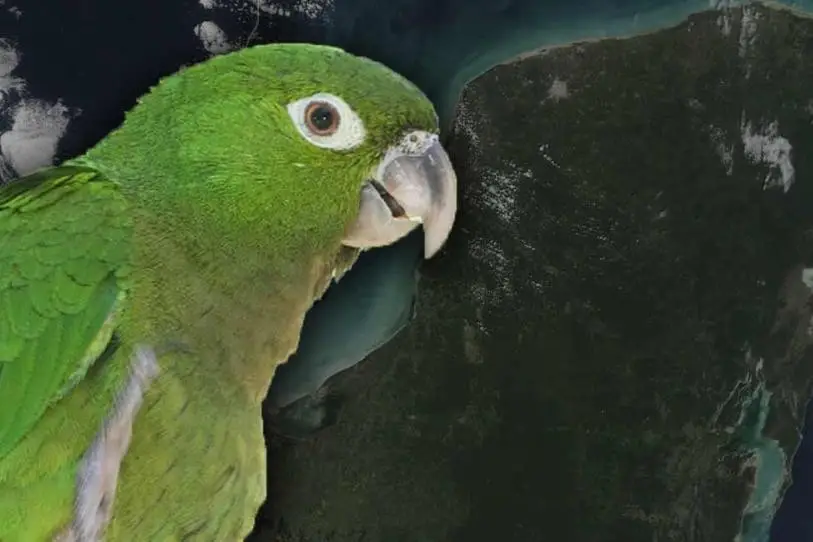

The K’ili, popularly known as the Dirty-Breasted Parakeet, is considered one of the most representative birds of Mayan culture and the state of Campeche. Its presence on the edges of the jungle and in semi-open areas has been part of the region’s natural and cultural landscape for centuries.
However, today it faces a high risk of extinction, according to the Campeche State Biodiversity Platform, due to massive deforestation and illegal capture for the pet trade.
The K’ili is known for its sociable and energetic nature. It is rare to see it alone, as it usually travels in flocks ranging from a few pairs to dozens of individuals.
Its chatter and high-pitched squawks fill the air as it flies from tree to tree, becoming a sonic symbol of the Campeche jungle.
One of its most unique habits is its nesting method. Unlike other birds, it doesn’t build nests with branches, but rather excavates tunnels and chambers in termite mounds attached to tree trunks, taking advantage of the hardness of these structures as a natural fortress to protect its chicks.
The Rufous-breasted Parakeet is a medium-sized, slender bird with a long, pointed tail. Its bright green plumage contrasts with its olive-brown breast and belly, a feature that gives it its common name.
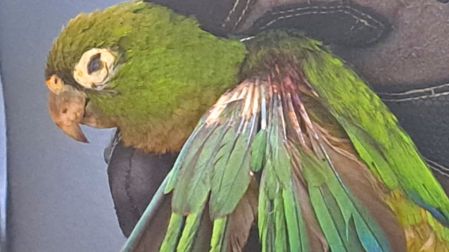
Its most distinctive characteristic is the ring of white skin around its eyes, resembling large spectacles.
It is a native species that inhabits areas from eastern Mexico to Panama. In Campeche, it is the most common parakeet, found in forest edges, secondary forests, plantations, and semi-open areas with tall trees. However, it avoids the interior of denser forests and completely open areas.
The Rufous-breasted Parakeet forms monogamous bonds that can last a lifetime. Its breeding season occurs from spring to early summer, coinciding with the abundance of fruits and seeds.
The female lays between 3 and 5 white eggs. Incubation lasts 24 to 28 days. The chicks remain in the nest for 7 to 8 weeks before fledge. They reach sexual maturity between 2 and 3 years of age.
The K’ili is frugivorous and granivorous, feeding on fruits, seeds, and flowers. Its ecological role is fundamental as a seed disperser, contributing to forest regeneration and the balance of ecosystems.
The K’ili is at risk
According to the Campeche Biodiversity Platform, the K’ili is listed in three risk categories:
National conservation status: Threatened (A)
Global conservation status: Critically Endangered (CR)
Trade status: Appendix I of CITES, which implies the highest level of protection and a ban on its international trade
Source: excelsior