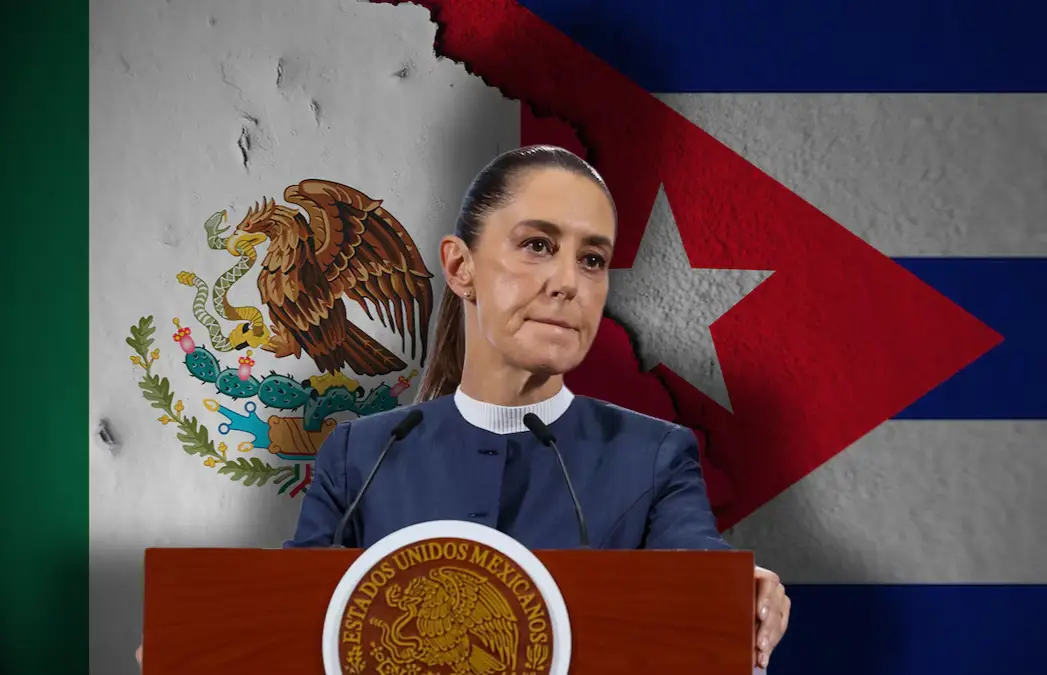

President Claudia Sheinbaum responded to pressure from officials in the Donald Trump administration to “reconsider” Mexico’s support for the Cuban regime, in the context of oil shipments to the Caribbean nation and the hiring of Cuban doctors to integrate them into the Mexican healthcare system.
President Sheinbaum stated that the position on the Cuban regime is “a point of difference” between the Mexican and U.S. governments, but denied that this influences the relationship with Mexico’s most important trading partner.
She reiterated that the decision to maintain relations with Cuba is a sovereign one and is based on humanitarian principles, since the U.S. embargo affects the population in general.
“This has been a constant issue in the Mexico-U.S. relationship since the Cuban Revolution in 1959. (…) This relationship has always been a point of difference between the Mexican and U.S. governments; it should not influence the Mexico-U.S. relationship, and our decision is sovereign and based on humanitarian principles,” she reiterated.
Sheinbaum criticizes Kast’s view on migrants in Chile: ‘We will never agree with criminalizing them’
President Claudia Sheinbaum was questioned about the proliferation of anti-immigrant rhetoric, which is now being seen in Chile following the victory of José Antonio Kast, the president-elect, who proposed a “humanitarian corridor” for the repatriation of migrants.
She stated that her government rejects actions and positions that criminalize migrants and reiterated that one way to reduce migration is through investment in countries of origin, with the goal of reducing inequality.
“The criminalization of migrants is an inhumane act that creates problems. Since the transformation process began, we have always maintained that the best way to reduce migration is to invest in the countries, to help and protect people, and to prevent inequality (…). We will never agree with actions that criminalize migrants,” she commented.
The president reiterated her government’s willingness to mediate conflicts between countries to reach a peaceful solution, amidst escalating tensions between the United States and Venezuela.
“We will work with all countries in Latin America and other continents that wish to do so to find a peaceful solution, one that avoids intervention. I repeat, beyond the Maduro government in Venezuela, the central issue is interventionism and meddling. If there is a conflict, all the mechanisms established by the United Nations are available to achieve a peaceful solution to any dispute,” she stated.
President Claudia Sheinbaum explained that, as has been the custom for years, members of the U.S. Armed Forces will come to Mexico to receive training in collaboration with the Mexican Ministry of National Defense (Sedena).
She explained that just as foreign armed forces can enter Mexico with permission and authorization, members of the Mexican Army also frequently travel to the United States for training.
“These are agreements that were signed some time ago; there’s nothing extraordinary about what was agreed upon with the United States. Specifically, there are federal forces that will be training in the United States on certain topics, and also forces from the United States, from Northern Command, that will be training in Mexico, for example, on Plan DN-III-E and other training programs. This training is provided not only to the United States military but also to other countries. It’s part of the coordination, collaboration, cooperation, and training exercises that were included in the agreement,” she clarified.
Mayor Claudia Sheinbaum stated that the “Wives Law” is targeted, although she did not mention the names of the people who are said to be likely to benefit from the reform approved in San Luis Potosí and which appears to be moving forward in Nuevo León.
She asked the State Congresses to analyze the proposal, as it has both pros and cons. She reminded them that the National Electoral Institute (INE) requires political parties to ensure gender parity and that women—in the majority—and men are nominated for elected office.
“My opinion is that in any case, we need to see if an action of unconstitutionality is appropriate or not. The National Electoral Institute has already defined a system to ensure parity in party candidacies. For example, there are 17 governorships to be elected in 2027, so the INE says, ‘It must be guaranteed that half, nine, must be female candidates and eight male candidates; this helps achieve parity (…).

Source: elfinanciero