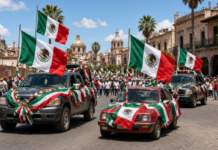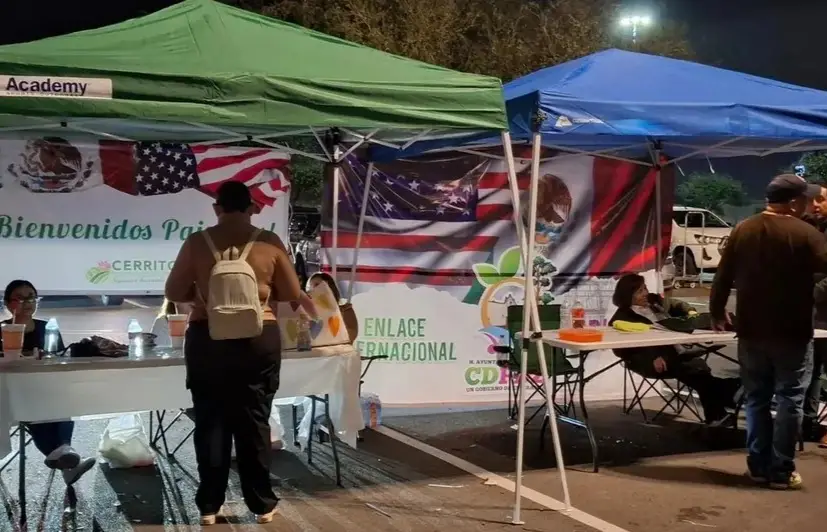

“They’re bringing people down!” warned the chat group that was set up to organize the more than 400 members of the migrant caravan from San Luis Potosí. It was almost five in the morning when a long line of pickup trucks with overflowing beds was already waiting to cross from Brownsville to Matamoros, heading towards San Luis Potosí.
Everyone was wearing a micro-perforated sticker to identify them as part of the caravan that the authorities of San Luis Potosí and a group of mayors had organized to bring back the people who return home every year. But this time, the Texas police—who collaborate with immigration authorities—were still waiting for them on the U.S. side. One by one, they checked the documents of the caravan’s occupants. There was an unknown number of detentions.
This was something that had never been seen before, but on this occasion, it served to swell the numbers of detentions and processing of undocumented people who had been booked, since they were subjected to administrative procedures and had their fingerprints taken.
Thus, while Mexico was carrying out Operation Heroes Paisanos 2025, the Donald Trump administration took advantage of the return of thousands to detain migrants seconds before they were to cross back into Mexico.
Carlos was pulled from the truck. Before the police approached, he didn’t know if he would return to the United States after the holidays, where he had lived for the past five years. Undocumented, he embarked on the adventure of returning home to see his family and, perhaps, take another chance with a smuggler or, like thousands of other Mexicans, deport himself and start his life anew in Mexico, this time without the ever-present fear of being detained by an ICE agent, because in the United States there is no longer a sanctuary where migrants are safe.
As every year, thousands of migrants return home for the Christmas and New Year’s holidays, but, unlike other times, this time extortion or insecurity on the highways wasn’t the biggest risk on their return to their communities.
Milenio documented that at the Brownsville-Matamoros port of entry, one of the highway routes for returning to Mexico, Texas state police officers collaborating with ICE and the Border Patrol were stationed a few meters from the crossing point, where hundreds of vehicles were already waiting. They requested passports and residency permits from the passengers. They practically searched everyone and removed several people from the vehicles.
More than 145,000 Mexicans have been detained under the Trump administration.
In almost a year of Donald Trump’s administration, 145,537 Mexicans have been deported. In addition, many have opted to return home due to the harassment they face as a result of the U.S. administration’s detention policies.
The end-of-year holidays have been a pretext for returning with vehicles full of belongings, since the Héroes Paisanos program helps migrants avoid excessive taxes on their new or used possessions.
The federal program and the caravans organized by states like San Luis Potosí, Guanajuato, Michoacán, and Zacatecas allow them to reach their places of origin with highway patrols to prevent robberies and extortion, to which they are vulnerable.
However, there was no prior warning of police presence before crossing into Mexican territory, and this took those in an irregular situation by surprise—those who risked their lives trying to leave or who had already decided not to return.

Source: milenio