
The report shows that Mexico has the highest number of cases, with three confirmed murders and five more still under investigation. Other organizations, such as Reporters Without Borders, documented up to nine journalists killed in the country during 2025, reinforcing its position as the most dangerous environment.
2025 was a deadly year for journalists worldwide, with violence particularly prevalent in Latin America and Mexico.
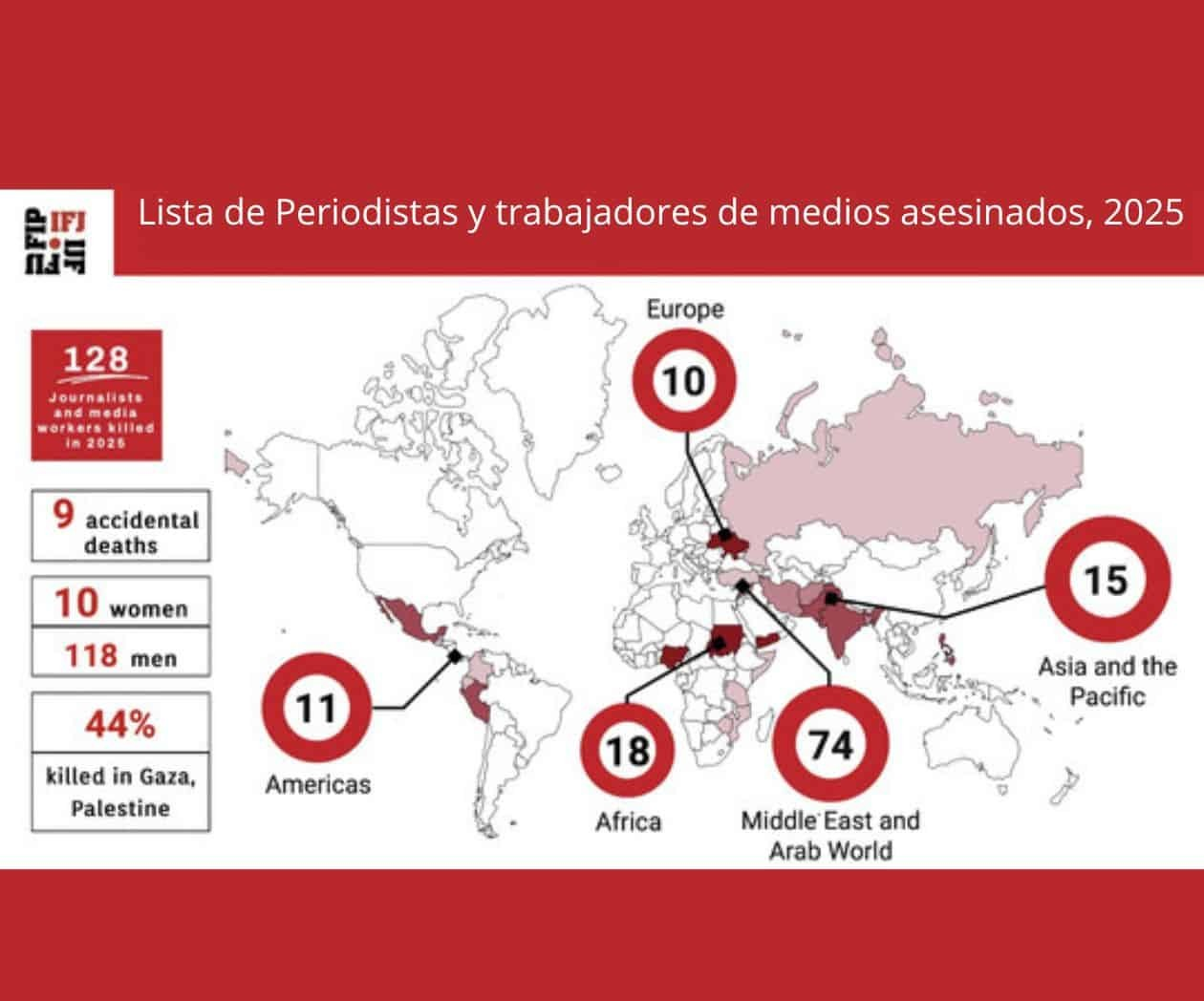
According to the International Federation of Journalists (IFJ), at least 128 journalists and media professionals lost their lives globally, including nine accidental deaths, according to the final list published on December 31. Ten of the victims were women.
The report confirms that Latin America and the Caribbean continues to be one of the most dangerous regions for journalists, with Mexico being a prime example.
The LATAM region recorded at least 11 journalists killed during the year, in addition to eight more cases that remain under investigation or without official confirmation of their connection to journalistic work.
The IFJ warned that these figures reflect a persistent pattern of violence and impunity, and demanded that States take immediate and decisive measures to break this cycle by 2026.
The report shows that Mexico has the highest number of cases, with three confirmed murders and five more still under investigation. Other organizations, such as Reporters Without Borders, documented up to nine journalists killed in the country during 2025, reinforcing its position as the most dangerous environment for the press in the region.
Mexico is followed by Peru (four cases), Ecuador (one confirmed and two pending), Guatemala (two cases under investigation), Colombia (one), and Honduras (one).
Most of the victims worked for local, community, or digital media outlets, and covered issues of corruption, organized crime, political violence, and abuses of power at the local level.
Furthermore, in numerous cases, there were prior threats or known risks, yet effective protection mechanisms were not activated.
In addition to Mexico, the IFJ highlighted the case of Peru, where, after almost a decade without murders of press workers, four killings were recorded in the last 12 months that the National Association of Journalists of Peru directly links to journalistic activity.
These are compounded by threats and attacks that constitute an accelerated deterioration of press freedom in that country.
The IFJ warned that the lack of official confirmation, incomplete investigations, and the absence of sanctions are not isolated incidents, but rather symptoms of a structural institutional weakness, marked by judicial delays and a lack of political will.
In most of the cases in 2025, the masterminds have not been identified, and in many, there has not even been substantial progress.
The IFJ recalled that each journalist murdered also represents a direct attack on the collective right of societies to be informed, particularly in communities where the local press is the main barrier against corruption and abuses of power.
“Lethal violence against journalists is, in this sense, an extreme form of censorship,” the IFJ stated. He added that without justice, there are no guarantees for the practice of journalism or for democracy.
Source: alianzademediosmx