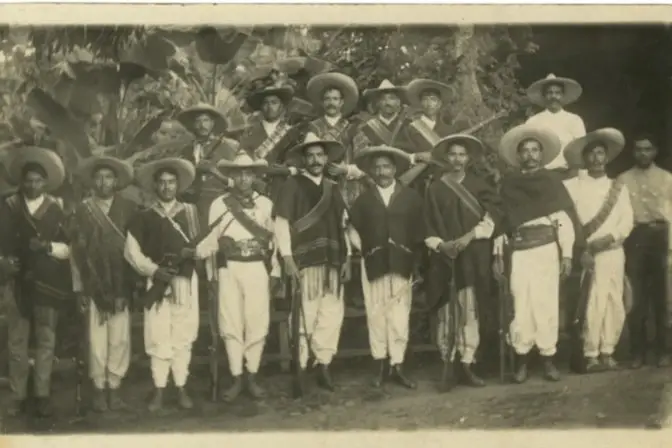

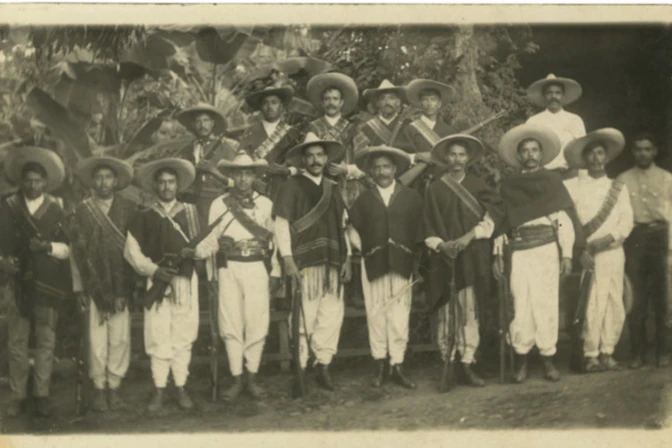
Cancun will host the first Cristero Congress, organized to commemorate the 100th anniversary of the start of the Cristero War in Mexico, a period in which Catholics took up arms against the brutal religious repression carried out by the Mexican federal government.
The congress will be held at the Church of San José Luis Sánchez del Río in Cancun and will feature among its speakers the well-known Mexican priest Juan Razo García; Uriel Esqueda, campaign leader for the Actívate platform, which defends religious freedom in Mexico; and Father Javier Olivera Ravasi, PhD in Philosophy and History and apologist through the Que No Te la Cuenten (QNTLC) project.
The event has the endorsement and participation of Bishop Pedro Pablo Elizondo Cárdenas, currently Apostolic Administrator of the Diocese of Cancun-Chetumal.
In an interview with ACI Prensa on January 8, Bishop Elizondo Cárdenas emphasized that the Cristeros had a “deeply rooted” desire to defend their faith. For them, he said, “the Catholic faith is part of their being, their life, their very core, their tradition, their family.”
“They cannot conceive of themselves without that faith,” he said, adding that it “was vital” and “more than just a theoretical matter.”
After decades of pressure against the Catholic Church, the 1917 Constitution of Mexico set one of the most serious precedents for religious persecution in Mexico, disregarding the rights and legal status of the Church and establishing significant restrictions on worship.
Less than a decade later, the restrictions imposed by the Mexican federal government became more drastic, and on July 31, 1926, the “Law on Crimes and Offenses Related to Religious Worship and External Discipline,” promulgated by then-President Plutarco Elías Calles, came into effect. This law became popularly known as the “Calles Law.”
Upon the implementation of the “Calles Law,” Mexican bishops decided to suspend public worship that same day. Many Mexican Catholics spontaneously took up arms in various parts of the country against the federal government and in defense of their faith, in what became known as the Cristero War.
Formally, the Cristero War ended on June 21, 1929, although the persecution and killings of Cristeros continued for several more years.
According to the Mexican Episcopal Conference, “more than 200,000 martyrs gave their lives defending their faith: children, young people, the elderly; farmers, laborers, professionals; priests, religious, and lay people.”
Among the best-known martyrs of the religious persecution in Mexico are Saint José Sánchez del Río, murdered at age 14; Blessed Father Miguel Agustín Pro; and Blessed Anacleto González Flores, patron saint of the Mexican laity.
It wasn’t until 1992, with a constitutional reform and the enactment of the Law of Religious Associations and Public Worship, that Mexican authorities recognized the legal status of the Catholic Church.
The cry of “Long live Christ the King!”
Monsignor Pedro Pablo Elizondo Cárdenas explained that the now-famous cry of “Long live Christ the King!”, which identifies the Cristeros, originated as a “test” administered by “federal soldiers when they captured someone for professing their faith.”
The soldiers would interrogate the Catholic, asking “Who goes there?” the prelate said, to find out “whether he had taken up arms or not, whether he was defending the faith or whether he had no involvement in the matter.”
The person being interrogated, he continued, had two options: “He could say ‘Long live the federal army!’ or ‘Long live Christ the King!’ It was like a dilemma presented by the army itself to force a confession.”
“So, at first, it was a confession of faith, and that cry became a slogan, a motto, a battle cry. ‘Long live Christ the King!’ was how they rallied. ‘Long live Christ the King and long live Our Lady of Guadalupe!’” he said.
The prelate emphasized that although there was much theological debate among bishops and priests at the time about whether it was permissible to wage war and defend the faith with weapons, “others, like the simpler and humbler people, had no choice but to take up arms in defense of their faith.”
“The people, the vast majority, or many peasants—who were the ones who fought the hardest in the guerrilla war in the states of Jalisco, Guanajuato, Michoacán, Colima, and other central states—didn’t have much theological background, nor did they engage in much speculation or make many distinctions between things; rather, it was something, let’s say, of the heart and religious feeling (…), of love for their faith.”
That faith, he said, “embodied so many values: evangelical values, family values, marriage values, life values, all the evangelical virtues… values that, for them, were worth defending with one’s own life.”
The danger of “an anti-clerical and anti-Catholic state”
Bishop Elizondo Cárdenas said that after the conflict in Mexico, “the laws and criteria of the secular state, the separation of Church and State, were established,” lamenting that “in practice, historically, this secular, non-denominational state has been misinterpreted as if it were rather an anti-clerical and anti-Catholic state.”
In this way, he pointed out, neither in schools nor in state settings “can the name of God be mentioned at all,” attempting to confine “the practice of the Catholic faith to the church and the sacristy.”
Another area affected, he continued, has been “freedom of expression, as bishops and priests, even lay people, do not have the authority or permission (…) to express their faith and speak about their faith in the media.”
Furthermore, the prelate said, in Mexico “there have been attempts at gag laws, to silence the Church in its expression.”
A “healthy secularism,” he clarified, consists of “knowing how to respect beliefs, the freedom to believe or not to believe,” valuing “the right to thought, conscience, religion, and worship,” including public celebrations.
“There is tolerance, and there is openness and freedom,” he said, pointing to massive pilgrimages like the one that draws more than 13 million people to Mexico City in December, but he warned that there are those who want to “further restrict that freedom,” with “a prejudice or a fear that religion will gain more public influence and could become an enemy of some political party.”
The power of the Church, the Mexican bishop emphasized, “is not earthly, it is not political, it has no other interests of a temporal or economic nature… but rather it is spiritual and moral.”
“That is what some people fail to understand, and they see it as an opposition political party,” he noted.
Remembering the Cristero War “Justly”
One hundred years after the start of the Cristero War, Bishop Elizondo Cárdenas believes it is important “to remember it justly, because the Mexican government, culture, and society have erased that episode of the Cristero Revolution from history.”
Today, he stressed, it is necessary “to study it, to write about it, to hold conferences, make films, and so on, because it was a historical event.”
Source: aciprensa