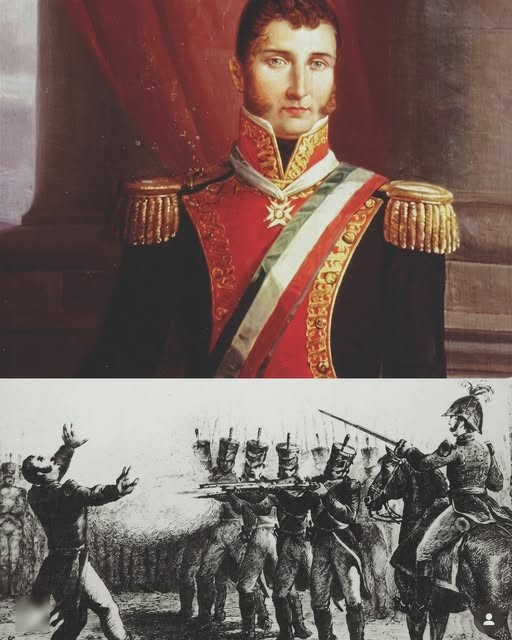

The history of Mexico did not begin with an embrace. It did not begin with a solemn declaration. It did not begin with a speech of unity. It began with gunshots. Not the shots of a battle, but those of a firing squad. On July 19, 1824, in Padilla, Tamaulipas, Agustín de Iturbide, the man who brought about Independence, the man who united liberals and conservatives, the man who could have been the father of the nation, fell riddled with bullets. He was not killed by a foreign enemy. He was killed by his own people. He was killed by the Congress he himself had established. He was killed by a country that owed him everything. Why? Why did the hero become a traitor? Why was the liberator executed? Why did Mexico begin with patricide?
The history of Mexico began with gunshots. Not necessarily those of cannons in battle, but those of a firing squad in Padilla, Tamaulipas. On July 19, 1824, Agustín de Iturbide, the architect of the consummation of Independence, went from being the “Father of the Nation” to a “traitor” executed by the very state he helped to found. It was no ordinary execution. It was a symbolic one. With him, Mexico declared: there is no place for strongmen here. There is no place for heroes here. Here, the law reigns. Or at least, that’s what it wanted to believe.
Agustín de Iturbide was born in Valladolid (now Morelia) in 1783. He was a criollo, the son of a wealthy family. He studied at the seminary, but soon abandoned the cassock for the sword. He was a brilliant military man. He fought the insurgents fiercely. He was a staunch royalist. But in 1820, when Spain turned liberal, Iturbide switched sides. Not out of republican conviction, but out of pragmatism. He saw that independence was inevitable. And he wanted to be the one to bring it to fruition.
In 1821, he proclaimed the Plan of Iguala, which proposed a constitutional monarchy, with a Spanish king at its head, and the union of all Mexicans, without distinction of race. The insurgents, led by Vicente Guerrero, accepted the alliance. On September 27, 1821, the Army of the Three Guarantees entered Mexico City. Independence was achieved. Iturbide was the hero.
But the happiness was short-lived. The Spanish Cortes rejected the Plan of Iguala. They would not accept a Spanish king in Mexico. Faced with the lack of a monarchist, Iturbide accepted the crown. On May 19, 1822, he was proclaimed emperor. It was not a coup d’état. It was a decision of Congress. But many deputies felt betrayed. They wanted a republic, not an empire.
Iturbide’s empire lasted barely ten months. The provinces rebelled. Antonio López de Santa Anna, who had been his ally, took up arms. Congress, dominated by Republicans, refused to recognize Iturbide. On March 19, 1823, the emperor abdicated. He went into exile, first to Europe, then to England.
In 1824, Iturbide learned that Spain was planning to reconquer Mexico. He believed he could be of use. He returned, confident that his former country would receive him as a hero. They did not. Congress declared him a traitor. He was captured in Tamaulipas, summarily tried, and sentenced to death. There was no clemency. There was no pardon. On July 19, 1824, he was executed by firing squad in Padilla.
Before dying, Iturbide said, “I die with honor, not as a traitor.” They did not hear him. The bullets silenced his voice. His body was buried in a common grave. Years later, his remains were exhumed and taken to the Mexico City Cathedral. Today they rest at the Angel of Independence. But his dream of a Mexican empire died with him.
Why did the man who achieved what Hidalgo and Morelos could not end up facing a firing squad? Because Mexico wasn’t ready for an emperor. Because the republicans feared him. Because the liberals saw him as an obstacle. Because the conservatives had abandoned him. Because politics is ungrateful. Because history is cruel.
Iturbide was no saint. He was an ambitious military man who switched sides when it suited him. But he was also a visionary. He understood that independence wouldn’t be achieved through civil war, but through alliances. He united the insurgents and the royalists. He united Creoles and Peninsulars. He united liberals and conservatives. That’s why he achieved independence. That’s why they killed him.
The history of Mexico began with patricide. The sons killed their father. And then, for decades, they killed each other. The Reform War, the French Intervention, the Revolution. It all began with that execution. With Iturbide’s death, Mexico lost the opportunity to build a constitutional monarchy, like England or Spain. Instead, it opted for a republic. An unstable, caudillo-led, violent republic. It wasn’t a bad decision. It was a decision. And its consequences are with us to this day.
Today, Iturbide is an ambivalent figure. For some, a traitor. For others, a hero. For most, an unknown. But without him, Mexico would not exist. Not as an independent nation. That’s why, even though it hurts, even though it’s uncomfortable, even though it contradicts the founding myths, Agustín de Iturbide deserves a place in our memory. Not as a saint. As a man. A man who did what he believed was right. And who paid for it with his life.

Source: asombroso