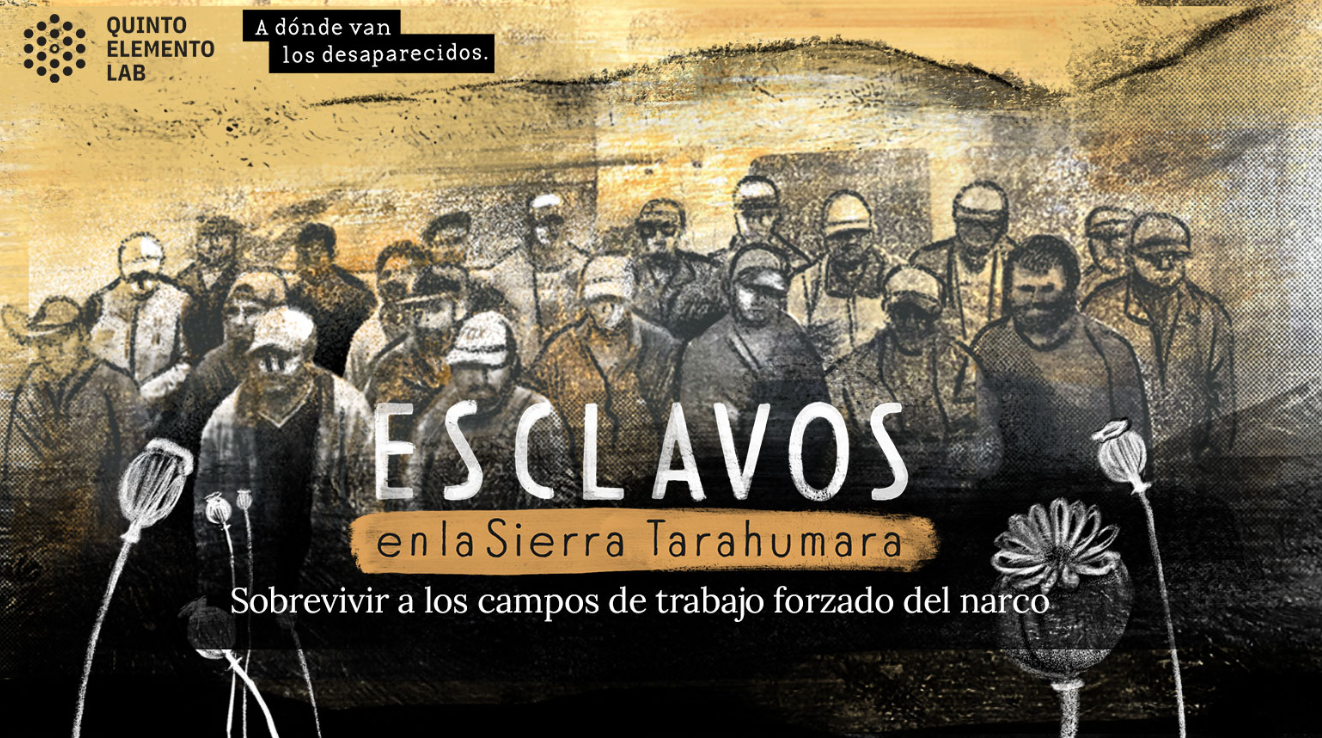

This investigative report, produced by Quinto Elemento Lab and A dónde van los desaparecidos, exposes a modern-day forced labor network operated by drug cartels deep within the Sierra Tarahumara of Chihuahua, Mexico.
Below is the translated and structured English version of the document, compiled by journalists Marcela Turati, Thelma Gómez Durán, and Eliezer Budasoff, with illustrations by Alejandra Saavedra. All advertisements, external link promotions, and recommendations have been removed.
Forced Labor and Cartel Slavery in the Sierra Tarahumara
In mid-2019, a law enforcement operation in the state of Chihuahua rescued 21 men from a forced labor camp used for opium poppy and marijuana cultivation in the Sierra Tarahumara, where captives were forced to live inside caves. One of the men had been held captive for nearly three years. Only four had ever been officially reported missing. Before that raid, several captives managed to escape on their own. Their criminal complaints and survival stories describe a human trafficking and recruitment network operating open-air concentration camps for cartel slave labor—a phenomenon that remains deeply underreported, with almost no firsthand testimonies surviving from inside.
CHAPTER 1: BAR. Those Who Reappeared
The man made his decision when the youngest captives arrived. They were two adolescents; the oldest looked 15 at the very most. He could hear them crying through the nights. “If I am going to die here,” he thought, “I’d rather die trying to get these kids out.” He waited for days. Weeks. Months. One afternoon, after hauling water from a nearby creek since dawn, the guards ordered him to take one of the boys to help him. He knew it was his moment.
On the trail, while unmonitored, he proposed an escape. They followed the creek downstream and fled into the woods until dark. They hid inside a cave, watching the flashlights of the cartel search parties below. The next day, they stayed completely still. They waited for darkness to return before moving again because the terrain was a natural trap: a massive mountain with sheer stone walls rose across the creek, leaving them only one possible direction to escape. For two days, they walked without food or water through the pine forests until they reached a highway. They begged for help from a couple in a pickup truck, rode in the back, and managed to reach Pedernales, a logging town where the man had relatives. His family called his mother.
She had not heard from him in three years. He had left the house they shared with his sister in Chihuahua City on an August morning in 2015 to sign up for public health insurance (Seguro Popular) and simply vanished. No one knew his whereabouts until June 2018.
The man, registered in the Chihuahua Attorney General’s files under the initials BAR, reported that he had been held captive by a criminal organization for the entire duration, forced to cultivate opium poppy and marijuana from dawn until dusk alongside dozens of other men. The conditions he described mirrored the exploitation of Indigenous peoples on Latin American haciendas centuries ago—a modern-day form of slavery enforced not by chains, but by the sheer brutality of cartel weaponry.
According to BAR, they were forced to sleep on the ground inside stone caves packed with up to 30 people. They were fed twice a day: a ration of beans and soup, or sometimes just cornmeal mixed with water and sugar to keep them standing. The guards forced them to consume drugs. If they failed to work to the cartel’s standards, they were beaten with oak branches, tied to trees for days, or starved.
“I also received punishments: they would grab me by my feet, hang me upside down, and submerge me in the river until I nearly drowned.”
BAR added that guards sometimes ordered the captives to rape each other as punishment.
“I had to watch them murder some of my companions. One drowned. Another was beaten to death with a gun and bare fists. Another was pushed off a cliff.”
He genuinely believed he would never leave alive.
During his three years of cartel captivity, BAR told prosecutors he learned of at least six similar forced labor camps. His testimony was filed away in a judicial archive. However, by mid-2019, a broader human trafficking network operating across multiple cities in Chihuahua since at least 2015 was exposed.
Recruiters targeted desperate men looking for quick money in impoverished hillside neighborhoods, urban settlements of displaced Indigenous families, train tracks where day laborers gathered, bus stations, or social program enrollment centers. They lured them with false promises of legitimate agricultural work—such as building fences, raising posts, clearing land, or tending livestock. Instead, the victims were driven to isolated pockets of the Sierra Tarahumara and forced into open-air labor camps under armed guard, where they were exploited to the absolute brink of human endurance for years.
The Rarámuri teenager who escaped alongside BAR recalled being recruited directly from the ranch where he lived with his grandparents. He was only 17 years old when he was taken. Throughout his captivity, he was repeatedly assaulted.
“I didn’t do anything because I was terrified, I just cried. It hurt terribly when they did that. It happened many times,”
he told authorities. He also witnessed a murder first-hand:
“She was just standing there, and he shot her in the forehead. I didn’t know her. She was the one who cooked our meals.”
He never learned the name of the man who helped him escape, but he knew exactly what awaited them if they were caught. “We walked for a very long time when we ran away,” he recalled.
The testimonies of BAR and the teenager were not the first warnings. In December 2015, Central American and Mexican migrants traveling toward the US border alerted authorities that armed groups were pulling them off cargo trains to enslave them in illegal crop fields. Those early complaints were buried in bureaucratic red tape. Three years passed before BAR and the Rarámuri youth emerged, followed by three more escapees a year later.
In early July 2019, an investigative police officer stationed at the “Las Estrellas” checkpoint—a heavily trafficked highway junction leading into the Sierra Tarahumara used by tourists visiting the Basaseachi waterfall—noticed three emaciated men climbing down from the back of a pickup truck. They were skeletal, dressed in rags, filthy, and completely disoriented.
When Commander Julio César Andrade approached to question them, the men initially lied, claiming they were returning from an apple harvest and felt sick from the trip. However, the commander knew the reality. He took them to get food and pressed them until they confessed they had been walking for nine hours after escaping an armed labor camp where they were trafficked under false pretenses to harvest opium poppies alongside dozens of others.
The police transported the three men to the Western Zone District Attorney’s Office in Ciudad Cuauhtémoc. Authorities provided clothes, food, and medical checkups. Their statements perfectly mirrored the archives from Chihuahua City a year prior: the same recruitment methods, the same cavernous terrain, and the same psychological torture.
“They beat them, tied them up, threatened them, held them at gunpoint, and beat them again… to progressively break them into slaves,”
a prosecutor involved in the case later summarized.
The escape of these three men triggered a raid one week later, on July 11, 2019, resulting in the rescue of 21 captive men from the exact same location. This was an unusual victory in a nation where the official count of missing persons exceeds 130,000. The survivors’ accounts shed light on a dark component of cartel economics: a production model designed to eliminate labor costs entirely by weaponizing traditional seasonal agricultural migration patterns, backed by absolute state indifference.
SUMMARY OF CHAPTERS 2 – 6
CHAPTER 2: Javier. The Rescue
Javier could barely believe it when investigative police raided the camp where he had been enslaved for nearly three years. He had maintained hope that he would eventually be paid, keeping a meticulous daily count of his time spent living in a cave. Like the others, he had fallen for a fake job offer. Once trapped, any disobedience was met with torture or death. In a system mirroring the historical debt-peonage of 19th-century haciendas, guards logged the cartel-supplied drugs given to the workers into notebooks, ensuring they accumulated debts rather than earnings. When the police arrived, Javier initially felt terror instead of relief, fearing he would be prosecuted as a criminal.
The 2019 raid successfully rescued 21 individuals. Officers hiked into the remote site guided by an escapee. They uncovered sleeping caves, clothing, fertilizer bags, blankets, cooking utensils, and a live radio. Though the campfire was still warm, the cartel guards had already fled. Survivors reported the existence of six or seven identical camps holding dozens of slaves. Of the 21 rescued, only four had active missing persons reports; the rest were not even being looked for by anyone.
CHAPTER 3: Andrés. The Operation
Andrés was lured by a fraudulent job offer and boarded a pickup truck with other recruits. En route, the vehicle was intercepted by a state police patrol, but the officers drove away after receiving a bribe. However, when interviewed for this investigation, Andrés revealed a darker truth: the state police did not just take a bribe; they actively delivered the recruits directly to the cartel. Andrés spent seven months enslaved in the Sierra Tarahumara. He witnessed a fellow captive beaten and thrown into a river to drown for disobeying a guard. To survive, Andrés forced himself to earn the trust of his captors by strictly obeying orders while quietly plotting his escape, noting how the line between victim and victimizer became heavily blurred within the camp.
CHAPTER 4: Margarito. Cartels That Enslave
The practice of cartel slavery is not new. In 1984, Margarito was deceived and forced to work without pay at El Búfalo, a massive, historic marijuana plantation in southern Chihuahua controlled by early drug syndicates. While the raid on El Búfalo made national headlines at the time due to its scale, the media ignored the plight of the enslaved laborers.
Security specialists and researchers note that Mexican cartels operate like corporations looking to minimize production costs and maximize profits. By utilizing slave labor, they insulate their profit margins, particularly as the wholesale market prices for raw opium gum and marijuana have dropped due to synthetic drugs. While El Búfalo proved this model existed in the 1980s, search collectives tracking missing persons only began publicly documenting organized crime’s forced recruitment practices around 2012. The enslavement of men in the Sierra Tarahumara by factions of the Sinaloa Cartel and the New Juárez Cartel occurs directly within this corporate-criminal framework.
CHAPTER 5: Hipólito. The Return
Upon his rescue and return home, Hipólito felt he had left a small hell only to enter a larger one. Most survivors were already facing severe economic hardships before being trafficked, but they returned broken—struggling with forced drug addictions, severe psychological trauma, and social rejection. Mostly in their twenties, these men found themselves completely abandoned by a government that treated them as if they did not exist.
Many, including Hipólito, were recruited from the very same impoverished, unpaved outskirts of Chihuahua City where their recruiters—often their own neighbors—lived. Even after the 2019 rescues, recruiters continued to operating in the same neighborhoods. Some locals continue to head to the mountains voluntarily out of sheer desperation, hoping that this time they might actually get paid. A few receive preferential treatment and return with money, while many others never return at all, their families refusing to file official complaints out of terror or a lingering hope for their safe return.
CHAPTER 6: El Chiapas. The Trials
While the 2019 government raid was hailed as a success, it failed to halt the trafficking operations. Recruiters continued utilizing the exact same methods to funnel vulnerable men into the very same camps for years, emboldened by systemic judicial impunity and authority figures’ indifference. The sole individual convicted in connection with the 2019 case—sentenced to 22 years and 6 months in prison—was released early without serving his full term while facing separate, open judicial proceedings.
Authorities failed to implement preventative measures against the network, nor did they investigate the hundreds of individuals mentioned in testimonies who never returned from the mountains. No psychological or social rehabilitation support was ever provided to the survivors. The victims were never informed about the judicial trials or the release of their captor. By 2025, five of the rescued men had already died due to chronic illnesses developed in captivity or separate instances of street violence.
Source: piedepagina