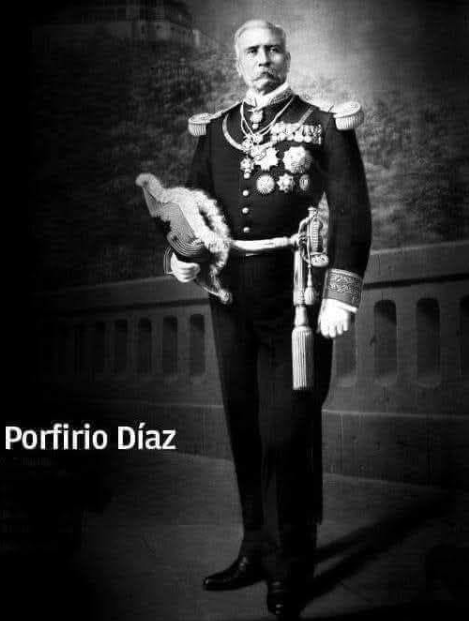

José de la Cruz Porfirio Díaz Mori was born in Oaxaca, Mexico, on September 15, 1830. His first two given names honored his father, while Porfirio came from the saint’s day on which he was born.
He lost his father at the age of three during the 1833 cholera epidemic, which severely affected Oaxaca. Díaz greatly admired and respected his mother, Petrona Mori Cortés, maintained a close relationship with his sisters, and was especially fond of his younger brother, Félix Díaz.
At the age of 13, he entered a seminary but left at 18 after meeting Marcos Pérez and Benito Juárez. He then enrolled at the Institute of Sciences and Arts of Oaxaca to study law.
He excelled as a student, later became an instructor at the Institute, and taught Latin to the son of Marcos Pérez.
His future, however, would be shaped by a military career.
He participated in the Plan of Ayutla, the Reform War, the French Intervention in Mexico, and the battles of La Carbonera, Miahuatlán, Puebla, and the capture of Mexico City, which marked the end of the French Intervention.
When Díaz assumed the presidency, he inherited a country devastated by decades of conflict dating back to the Mexican War of Independence. Supporters of his administration credit him with restoring order, paying off foreign debt, reestablishing diplomatic relations, expanding the railroad network, strengthening the economy, and promoting technological advances such as electric lighting, the telegraph, the telephone, and cinema, as well as constructing roads.
His government also established hospitals and nursing schools and participated in disaster relief efforts, including the response to the August 26, 1909 flood in Monterrey.
During his presidency, numerous public buildings, monuments, and theaters were inaugurated, including the Juárez Theater in Guanajuato.
When Francisco I. Madero proclaimed the Plan of San Luis in San Antonio, Texas, Díaz resigned from office in 1911. According to this account, he chose to step down to avoid further bloodshed and went into exile in Paris, France, although the Mexican Revolution continued for years afterward.
In Europe, Díaz was received by several heads of state. According to this account, after his death, King Alfonso XIII of Spain offered to have him buried at the Monastery of El Escorial, an honor reserved for members of Spanish royalty and distinguished figures. His widow, Carmen Romero Rubio, declined the offer, and Díaz’s remains were interred in Montparnasse Cemetery in Paris.
According to historian Carlos Tello Díaz in El exilio: un relato de familia (1995), Porfirio Díaz died in Paris on July 2, 1915. Representatives of the French government attended his wake, and physicians embalmed his body for preservation. His funeral took place on July 6 at Saint-Honoré d’Eylau Church, attended by many Mexicans living in exile. His coffin, draped with the Mexican flag, bore the general’s sword.
On December 27, 1921, his remains were transferred from the church to a chapel built by Carmen Romero Rubio in Montparnasse Cemetery, where they remain today. The chapel features a bronze engraving of the Liberal eagle with its wings outstretched.
The closing statement of the original text reflects the author’s personal opinion:
“Fellow Porfiristas, we must not give up; the struggle continues. General Porfirio Díaz, the best president Mexico has ever had, must return to his homeland with full honors.”
— Alehtse Tamez
Note: Much of the biographical information above is historically documented. However, several evaluative claims—such as describing Porfirio Díaz as “the best president Mexico has ever had” or attributing all of Mexico’s progress during the period solely to his administration—are matters of historical interpretation and remain the subject of significant scholarly debate. Historians also emphasize that the Porfiriato was characterized by rapid economic modernization alongside political repression, limited democratic freedoms, electoral manipulation, and social inequality.
Source: mexicodailypost