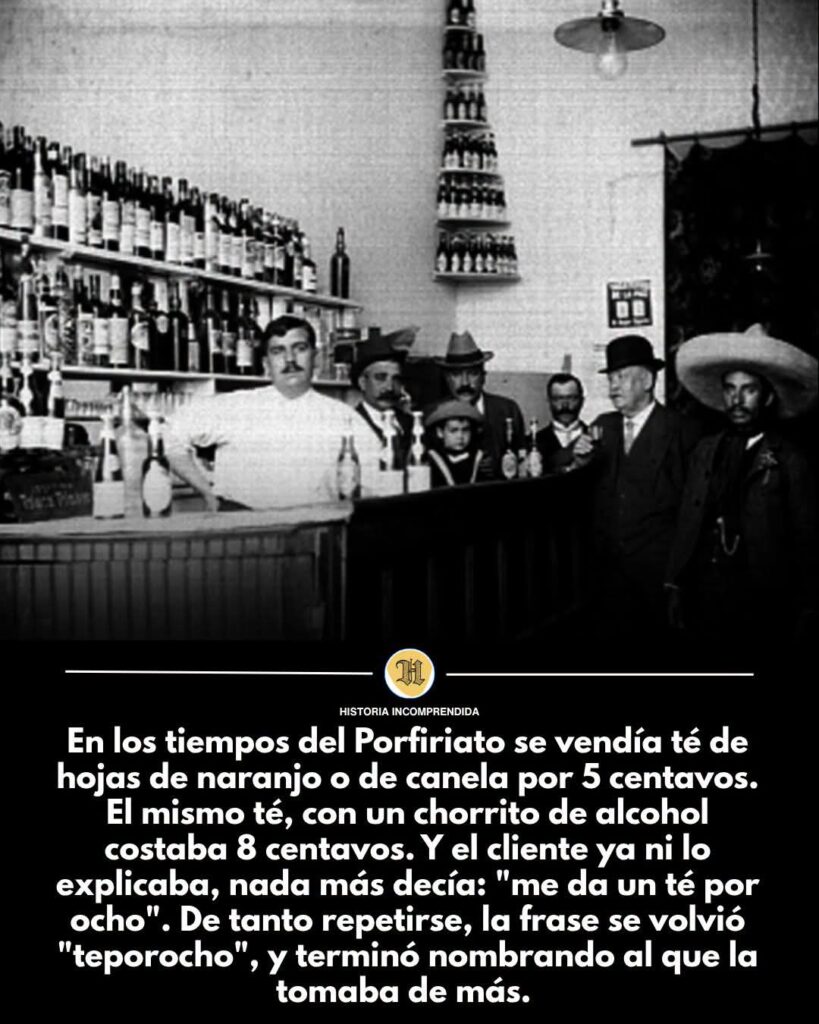
During the Porfiriato, orange-leaf or cinnamon tea was sold for 5 cents. The same tea, with a splash of alcohol, cost 8 cents. And the customer no longer had to explain it; they would simply say, “give me an eight-cent tea.” After being repeated so many times, the phrase became “teporocho,” eventually referring to someone who drank excessively.
There is a second version, recorded by Jesús Flores Escalante in his book Morralla del caló mexicano: alcoholic tea was sold at La Merced Market for ten cents, until a competing stall opened nearby offering it for less. To avoid losing customers, the original vendor lowered the price to eight cents and named his own business after the price: tea for eight; té-por-ocho.
The Mexican Academy of Language registers the word as a Mexicanism and defines it as an “indigent alcoholic,” but clarifies something that almost nobody mentions: the etymology is uncertain. There is no document supporting the eight-cent story, only oral tradition. Even so, it became firmly established in the speech of millions of Mexicans.
According to historian Julieta Ortiz of the National Autonomous University of Mexico, in 1895 the country had 12.6 million inhabitants: only 2 percent belonged to the privileged class, 8 percent were bureaucrats and professionals, and the remaining 90 percent consisted of workers systematically indebted to company stores, sometimes until death.
Researcher Nadia Menéndez Di Pardo, from the National Institute of Anthropology and History, documented that alcoholism was one of the leading causes of illness and mortality at the time, surpassed only by infectious diseases. Porfirian physicians associated it with liver cirrhosis, gastrointestinal disorders, epilepsy, and criminality, and defined it as a vice, degeneration, and social scourge: a technical criterion that served to control the lower classes.
The word became even more popular with Chin chin el teporocho, by Armando Ramírez, whose protagonist drinks “la teporocha”: 96-proof alcohol mixed with tamarind juice. Gabriel Retes brought it to the big screen in 1976.
In pre-Hispanic Mexico, pulque was sacred, and its consumption was reserved for elders, young warriors, and rituals; excessive drinking was severely punished. By 2019, 20 percent of fifth- and sixth-grade elementary school students and 15 percent of middle and high school students were experiencing problems with alcoholism.
Source: mexicodailypost