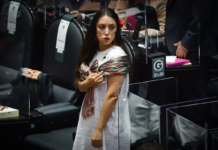

A panel organized by the ITAM Alumni Association addressed potential security issues that could arise during the 2026 World Cup.
Security and international relations experts warned of possible risks for Mexico and the United States in the lead-up to the 2026 FIFA World Cup, given the current international context and the lack of stronger regional coordination regarding border control.
During the panel “A Vision for Security in North America,” held at the 2026 Economic Outlook Seminar organized by the ITAM Alumni Association, Ana María Salazar, director of the consulting firm Grupo Salazar Slack SC, pointed out that the level of risk has increased and that the lack of coordination could create vulnerabilities during the sporting event. She warned of the possibility of an attack not only in the United States but also in Mexico.
In that regard, Arturo Sarukhán, former Mexican ambassador to Washington, D.C., emphasized that the World Cup represents a strategic opportunity that should have been used to strengthen regional security measures. “It could have encompassed a whole series of security actions to determine who enters and who doesn’t, in order to prevent a potential terrorist incident,” he stated.
Sarukhán recalled an incident last summer when eight Uzbek citizens entered Mexico after being smuggled by a human trafficking network based in Istanbul, Turkey, headed by an individual with ties to Al-Qaeda. According to his account, the migrants arrived by plane, crossed Mexican territory, and subsequently entered the United States. “I don’t want to speculate on what could happen in the context of a World Cup if something like that were to happen again,” he warned.
Mexico, the United States, and Canada are preparing for the 2026 World Cup. The former diplomat indicated that Mexico, the United States, and Canada have their own trusted traveler programs; However, he lamented that these systems are not interconnected. “The tragedy,” he said, “is that these mechanisms don’t communicate with each other.”
Given this, he emphasized the importance of moving toward a single trusted traveler scheme that would allow citizens of the three countries to travel safely across the continent. “This idea that we’ve been stuck to the control panel of a trinational or binational customs agency completely changes the conversation about border security,” he stated.
Sarukhán stressed that this approach is especially important in a context where, for the first time, large sectors of the United States consider the Mexican border to be the most vulnerable point in their national security. “We are going to continue to have a situation of constant friction,” he predicted.

Source: mexico.as