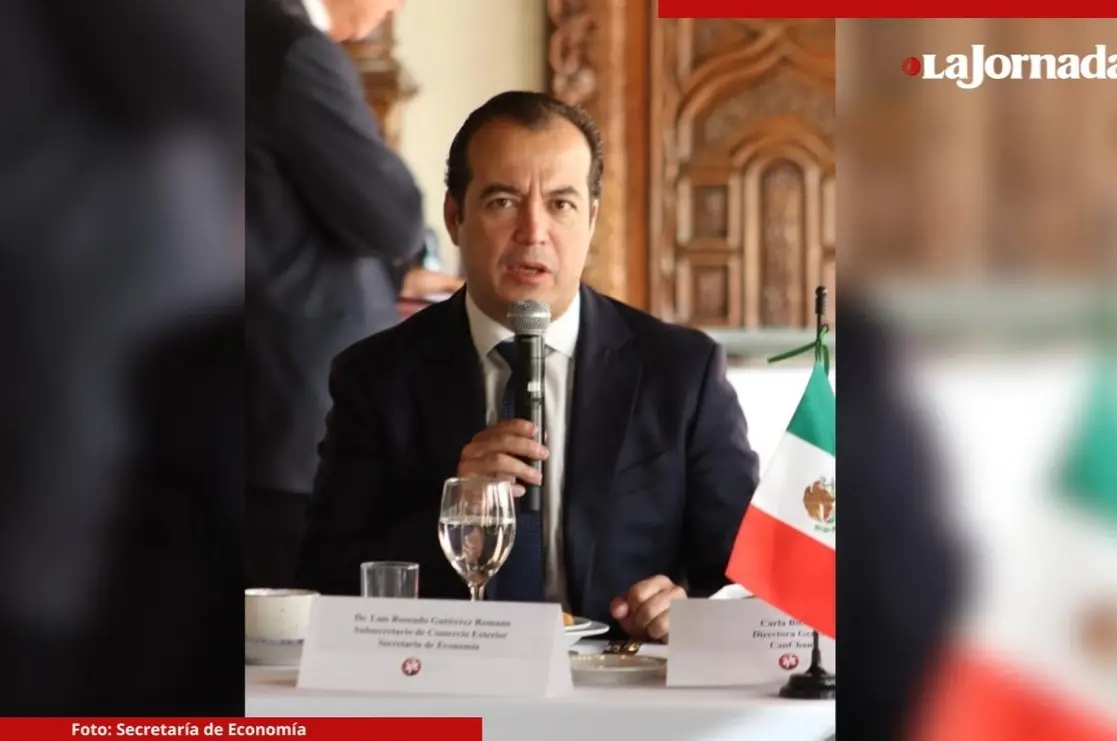

Mexico has a “historic opportunity” to restructure its economy and benefit from the new world we are experiencing, where 85 percent of its exports, with zero tariffs, give it an advantage over the rest of the world and allow it to gain market share in the United States, assured Luis Rosendo Gutiérrez, Undersecretary of Foreign Trade in Mexico, within the Ministry of Economy.
“From today onward, with all this uncertainty, we are beginning to see on a daily basis that Mexican exports continue to grow, even though we have a peso that is not just ‘strong,’ but ‘ultra-strong.’ This is good news in the complex world we are living in, where the buzzword is: uncertainty,” the official stated.
He explained that the only trade agreement, of the 14 that the United States has, that remains in place is the one between Mexico and Canada, where 85 percent of Mexican exports continue to have zero tariffs, a significant advantage over the rest of the world; for example, Japan and Korea pay 15 percent on their exports. China and Brazil are above 30 percent. “That allows us to gain market share in the United States.”
During the roundtable discussion, “Economic Outlook 2026,” organized by the Institutional Stock Exchange (BIVA) to analyze the economic and trade environment, Luis Rosendo asserted that, for this reason, Mexico has strong arguments to protect the United States-Mexico-Canada Agreement (USMCA) with its upcoming review in July.
When questioned by María Ariza, CEO of BIVA, about the risk of the USMCA being renegotiated and whether Mexico might be forced to make concessions, the Undersecretary of Commerce affirmed that, based on consultations held in the United States and Mexico, “the USMCA should be maintained, but improved,” with increased regional content requirements for the participating countries and the removal of obstacles.
“The teams continue working to reach a review in June—not necessarily a renegotiation—where we gain certainty for our economies (…) we will see a discussion on the rules of origin (…) Mexico has strong arguments to protect its Treaty and be a key player in the international arena,” Rosendo Gutiérrez asserted.
Establishing a Level Playing Field of Certainty
Carlos Serrano, chief economist at BBVA, for his part, emphasized that the United States is aware that Mexico does not compete with them in manufacturing production, but rather complements them through highly complex value chains, where of every $100 that Mexico exports to the United States, $26 has U.S. content.
Two or three years ago, nearshoring was a topic of discussion, so Serrano anticipates that nearshoring will be discussed again next year, as the Treaty is important for the United States.
Furthermore, if the Mexico Plan is strengthened, the national content in exports can be increased.
“Due to the 2020 pension reform, it is projected that by 2040, pension funds (Afores) will manage assets exceeding 50 percent of the Gross Domestic Product (GDP). This growing flow of capital represents an unparalleled opportunity to finance large infrastructure projects, such as ports and railways, through the stock market, thus integrating national savings into the country’s productive development,” Serrano added.
However, legal, energy, and infrastructure certainty are crucial. He asserted that Mexico has no more profitable option than to look to North America.

Source: jornada