
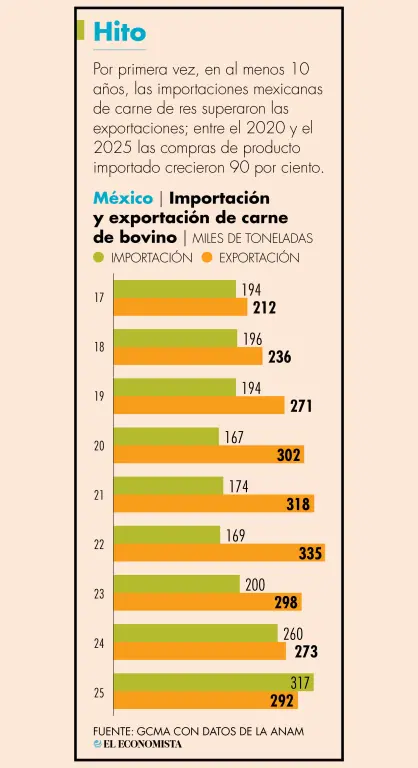
After more than ten years of maintaining a favorable trade balance, beef imports have finally surpassed exports, a phenomenon driven by a combination of macroeconomic factors and structural problems in domestic primary production.
According to a recent analysis by Juan Carlos Anaya, director of the Agricultural Market Consultants Group (GCMA), this shift is due to the fact that “beef imports are exceeding exports, reflecting a more competitive exchange rate for foreign purchases, a lower availability of cattle, and a reduction in domestic production.”
This loss of dynamism is evident in the decline in animal slaughter at both federally inspected (TIF) plants and municipal slaughterhouses, which has forced the country to become increasingly dependent on the foreign market.
The situation is particularly critical in the beef sector, where Mexico historically boasted of its self-sufficiency. However, the most recent figures confirm that “the country is no longer 100% self-sufficient in a context of reduced livestock supply and the closure of live cattle exports,” the report details.
This last factor, the collapse in shipments of live calves to the United States, has been a devastating financial blow to the sector, as it represented one of the “main historical generators of foreign exchange.” Sanitary restrictions and border closures for live cattle not only reduced dollar inflows but also limited the overall supply of cattle for slaughter, putting pressure on prices for the end consumer.
The imbalance is not limited to beef; the structural deficit is deepened by the high dependence on other proteins. Anaya emphasizes that “Mexico only produces 49% of its pork consumption,” while in the poultry sector, “self-sufficiency hovers around 80%, maintaining constant pressure on the external market.”
Although total meat exports showed a 10.8% increase in value due to improved international prices, the volume barely remained stable, surpassed by a 21.7% increase in the value of imports.
For the GCMA specialist, the challenge is clear: “The challenge by 2026 will be to rebuild livestock inventories, strengthen domestic production, and reduce external dependence, without losing competitiveness.”
While Mexico attempts to recover its production capacity, trading partners such as the United States and Brazil continue to consolidate their position as the main suppliers for Mexican consumers.
Source: eleconomista