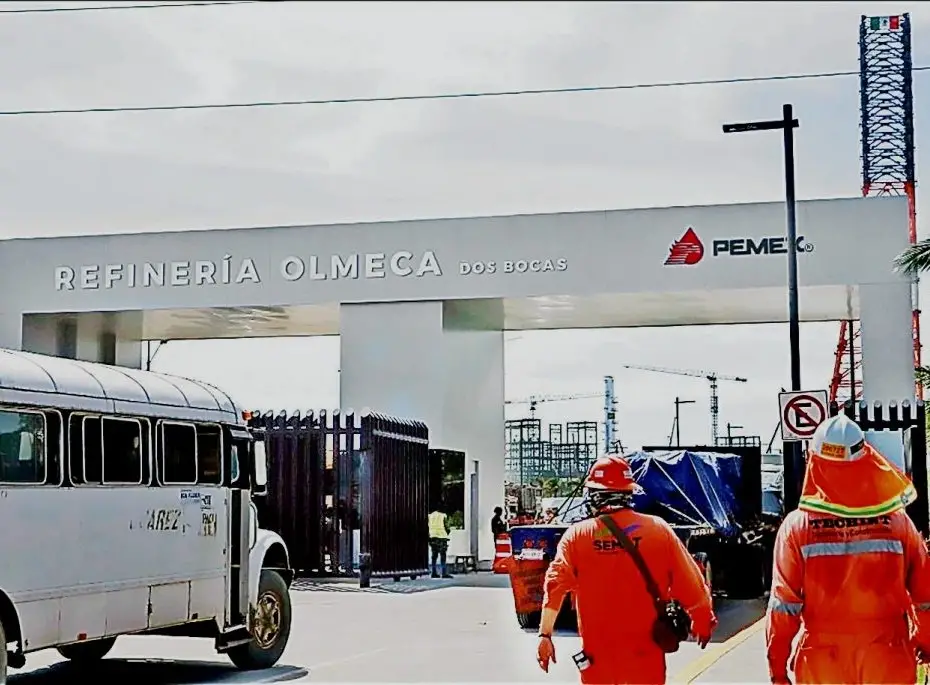

There are no local suppliers at Dos Bocas. No small or medium-sized Tabasco businesses are integrated into the project. No regional supply chains have grown thanks to the country’s largest energy project.
The Olmeca Refinery operates under a centralized and closed system, where public funds flow to large national and international corporations, almost always the same ones. There is no documentary evidence of a policy of economic integration with the state that hosts it, nor of a formal import substitution program or a plan to strengthen regional suppliers.
Official Pemex documents, obtained through information requests and reviewed by Grupo Cantón, allow for a precise reconstruction of the expenditure on the refinery between 2019 and September 2025.
The total amount reaches 180.016 billion pesos, including construction and operation. The figure is impressive, but what is truly revealing is not how much was spent, but how it was spent, who was paid, and under what contractual arrangements.
From the outset, Dos Bocas did not function as a project with broad benefits. The money did not flow to the local business sector nor was it distributed among a diverse network of suppliers. It was concentrated from the very design of the project.
An analysis of payment schedules shows that 83.8 percent of the spending ended up in the hands of just ten companies.
Eight out of every ten pesos allocated to Dos Bocas did not circulate widely: they were absorbed by a small group of corporations specializing in heavy engineering, platforms, industrial systems, and energy operations, with large-scale contracts impossible for local companies to compete for.
The most striking figure is at the top of the list. ICA Fluor Daniel received 68.259 billion pesos, equivalent to 37.9 percent of the total spending. Almost four out of every ten pesos spent on the refinery ended up with a single firm.
The second-largest recipient, Techint, received 20.079 billion pesos, another 11.2 percent. From there, the curve drops, but the pattern remains: multi-million-dollar contracts, few firms, high concentration.
The main contracts were not awarded to companies from Tabasco.

The concentration of funds is not limited to the construction phase. Cross-referencing the construction and operational annexes reveals another key finding: 31 contractors appear in both phases. In other words, the companies that were paid for the concrete, platforms, engineering, and industrial systems are the same ones that are now being paid for operation, startup, and maintenance.
The project created its own closed loop. The money flowed back into the same hands, again and again.
There is no documentary evidence of a strategy to incorporate new local suppliers as the project progressed, nor of a progressive program to transfer capabilities or integrate state-owned companies in later stages.
This is not a criminal accusation. The documents do not prove administrative irregularities. What they prove is structure: Dos Bocas was designed for large integrators and operated exactly as such, without making room for the surrounding economic environment.
The documents also allow us to reconstruct the true timeline of the money. The major economic impact of Dos Bocas has already occurred. In 2022, Pemex spent 39.465 billion pesos on construction, the highest figure of the entire period. That year saw the largest volume of contracts, payments, and economic activity related to the project.
The appendices provided by Pemex are exhaustive in their financial details, specifying payments, amounts, dates, work items, and beneficiary companies, allowing for a precise reconstruction of how public funds were spent. What they fail to do is explain the economic and social impact on the region. This is not an illegal omission; it is a structural one. Pemex reports financial execution, not territorial consequences.
The result is a historic investment without a local public balance sheet, without indicators of social return, and without a visible regional evaluation.
Taken together, the numbers for Dos Bocas tell a different story than the official narrative. It was neither a project with broad economic benefits nor an engine of regional economic integration.

Source: tabscohoy