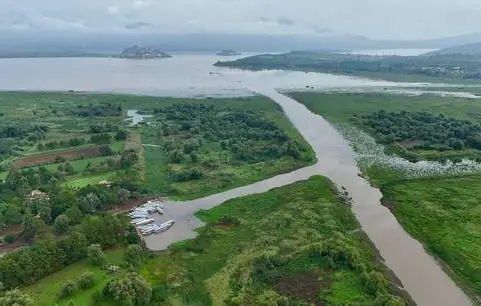

Lake Pátzcuaro has recovered 500 hectares of surface area in the last two years thanks to restoration efforts and abundant rainfall, reported the Michoacán Ministry of the Environment.
The Ministry also announced that for the third consecutive year, 1,000 workers will be hired through a temporary employment program to continue dredging the lake and restoring springs.
The head of the agency, Alejandro Méndez, explained that as part of the water cleanup efforts, 10 specialized machines will be used to begin work on canals such as the Erongarícuaro canal, where the temporary employment program will later be activated, along with the intervention of the State Fisheries Commission using aquatic machinery.
In a press conference, he added that this year’s lake restoration efforts will include 35 lakeside communities and islands such as Janitzio, Yunuén, and Urandén. Community nurseries will be established in these areas, mechanical soil stabilization practices will be implemented, and the Michoacán Secretariat of Rural Development will produce bio-inputs.
Among the priority actions for 2026, the intervention in the Chapultepec Canal stands out.
In that area, a comprehensive dredging operation will be carried out, extending to the lake’s main dock, to ensure optimal water flow, Méndez noted.
Meanwhile, Governor Alfredo Ramírez Bedolla emphasized that the priority for the recovery of Lake Pátzcuaro has been to restore its water sources, which number 89 springs.
“In Ihuatzio, we will rehabilitate three springs to complete the work that began last year, and dredge their canal so that the spring water can reach the lake. We will also leave the Erongarícuaro canal completely clear,” he announced.
The work on the Chapultepec canal, which spans four kilometers, will allow the free flow of water from the rehabilitated springs, specifically the Chapultepec spring and the La Alberca spring, which provide a water volume of approximately 613 liters per second during the rainy season and 550 liters per second during the dry season.

Source: jornada