
The story seemed to have been lost to the passage of time, shrouded in silence, absence, and incomplete memories. Today, that story has been revived thanks to the perseverance of one woman and the support of a community project that seeks to rescue the memory of Japanese immigration to Mexico.
Santa Sugaki is a descendant of one of the Japanese who arrived in Mexico in 1907, during the second wave of migration. Her grandfather, Shoujirou Sugaki, originally from Toyama Prefecture, arrived in the country as a teenager.
Years later, he started a family in Coahuila, but died young, leaving his only son an orphan with no clear information about his origins.
“He arrived at 17, single. Ten years after his arrival, he married a Mexican woman from Guerrero who became my grandmother, María Trinidad,” says Santa.
“They had their firstborn son, who was my father, José Luis Sugaki. My father was an orphan because my grandfather died young, at 32, and my grandmother perhaps at 28. So he was left orphaned and raised by other uncles and another family, and they never told him anything, he didn’t know anything,” she adds.
Shoujirou Sugaki arrived in 1907 by ship in Salina Cruz, Oaxaca. He came with several friends and headed to the Mexican border, to Piedras Negras, Coahuila, where he settled and opened a store.
Santa explains that her grandfather was a very kind man. There were difficult times, and since all the Japanese helped each other, he gave out many loans, until he had to close his store.
That’s how, along with three friends, he decided to go to the haciendas, what is now San Carlos, Coahuila, to work in agriculture, planting rice.
“That’s where he died, from a rattlesnake bite. And then, through the death certificates, I learned more details, like that he died in 1919, my father was born in July of 1919, and my grandfather died in August of 1919,” Santa explains.
The desire to know her roots has been with Santa since her adolescence. However, it wasn’t until five years ago that this longing began to take shape.
In the midst of the pandemic, through the Northeast Mexico-Japan Association, Santa found the necessary support to begin an investigation that seemed impossible.
With the guidance of specialists and the support of Dr. Mariko Nihei, the process progressed remarkably. In just four months, the Japanese family was located.
“Dr. Mariko Nihei told me, ‘I’m going to help you,’ and she did. We found them in four months,” she emphasizes.
“I waited 50 years for this moment, and it came in four months,” she says with emotion.
He recalls that after his time at the Universidad Interamericana del Bravo, he organized several events with the Northeast Mexico-Japan Association, including a trip to Las Esperanzas, where he met Dr. Nihei, engineer Miguel Ángel Kiyama, and Dr. Shinji Hirai.
He explains that he was able to contact a monk who soon traveled to Toyama, where he knew there were tombs over 160 years old belonging to the Sugaki family.
Thanks to the monk’s research, his dream came true, and he was able to meet his father’s first cousin.

“They got me the phone number and address, and I contacted him four months later, five years ago, but then the pandemic hit, and we couldn’t do anything,” he says.
“Today, social media is a blessing, because it helped me a lot. We made some calls, the doctor translated for me, because we have the language barrier,” Santa adds, explaining that this language barrier was overcome by family love.
After five years of video calls and emails, the long-awaited trip to Japan finally happened. Santa set foot on the land where her grandfather was born and visited the places she had only imagined for decades.
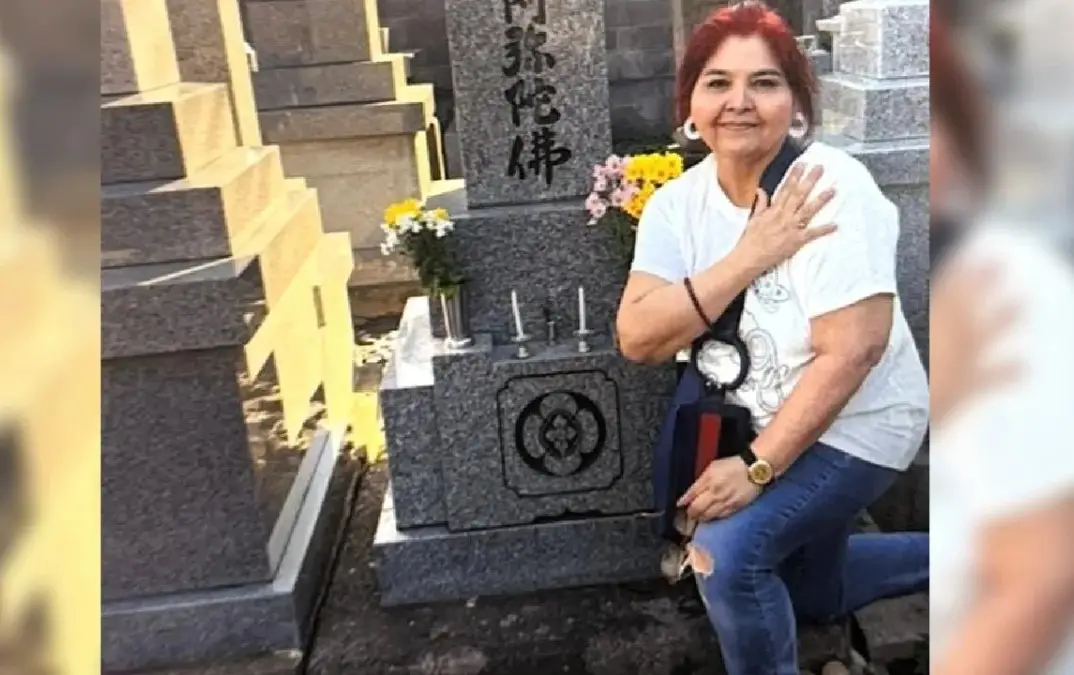
One of the most significant moments was visiting the family graves, some over 160 years old.
“My great-grandparents and great-great-grandparents were there. It was the first place I wanted to go,” she says.
“The welcome I received was beautiful. From the moment we arrived on the train, they already had a program planned for me and another friend who also accompanied me,” she says.
The reunion was marked by traditional ceremonies, family tours, and a gesture that deeply moved her: the presentation of a family tree documenting several generations of the Sugaki family.

Source: superchannel12