
Next August marks the 55th anniversary of the official founding of Cancún. Although it was in April 1970 that the first machinery arrived at Punta Sam, and with it, work began on what was then a pristine place, isolated from the rest of the country, with fine white sand and turquoise waters. A few families lived primarily off fishing. The federal government chose it to build a new tourist hub and develop the state of Quintana Roo economically.
Projected for around 200,000 inhabitants, Cancún now has almost a million. The vast majority came from various states in search of work and social improvement. It was a lifeline in the late 1970s for thousands of workers who lost their jobs due to the oil crisis, which particularly affected Campeche, Tabasco, and Veracruz. It did so again when global stock markets crashed in 1987 and Mexico experienced severe inflation.
A destination for nearly 30 million visitors, the city surpasses any projection of planned urban growth. Together with the Riviera Maya, it generates 35 percent of the country’s tourism revenue. Its tourism offerings are varied and concentrated especially along the 23 kilometers of hotel strip and related businesses. Outside this strip are neighborhoods with middle-class families and some high-income families. But deeper in, it is the city of service providers.
Although it was promised that the new tourist hub would not be yet another with an offensive social and economic divide between the population and the tourist center, everything failed. Real estate speculation prevailed, along with the official and private corruption that usually accompanies it. Furthermore, warnings from specialists and environmental groups about vulnerability to cyclones and rising sea levels due to climate change were ignored. And, for the past 14 years, the city has also suffered from the massive influx of sargassum seaweed.
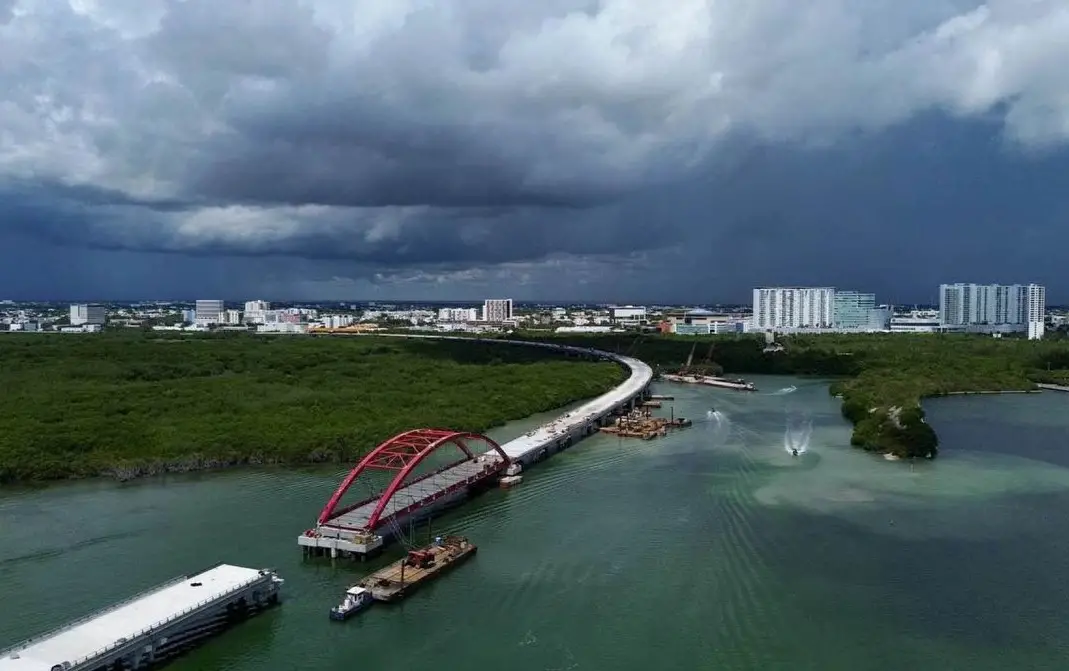
And to make matters worse, there is pollution, such as that found in the Nichupté lagoon system, which is interconnected to the sea through two inlets. The system comprises seven bodies of water interconnected by canals. It boasts extensive areas densely covered with mangroves. Furthermore, it is enriched by a diverse flora and fauna that serves as a habitat for birds, mammals, and reptiles.
The deterioration of its waters contrasts sharply with its beauty: from reduced oxygen levels and the presence of coliform bacteria, heavy metals, and abundant, varied trash, to the remains of dozens of boats of different sizes. In short, a beautiful ecosystem has become the final destination for all kinds of waste, due to the lack of enforcement by official agencies to ensure compliance with current legislation. Adding to all of this is the damage caused by the construction of the vehicular bridge that will cross it, as denounced by the Mayab Ecologist Group (GEMA).
Nichupté requires priority attention from the authorities. And a first step is to restore its environmental quality. In addition to eliminating the sources of pollution, it is necessary to use water body cleaning techniques that have already proven effective in Mexico. This was the case in the highly polluted Valsequillo reservoir, the final destination for all types of urban, agricultural, and industrial waste in the state of Puebla.
I am referring to the Aquadelle system. It consists of the application of advanced oxidation, generating and dosing ozone and oxygen simultaneously, and bacterial annihilation using ultraviolet light. The system injects oxygen and ozone into the water body in the form of nano- and microbubbles, which restores normal oxygen levels. This is achieved by reducing algae growth and eliminating microorganisms and nitrogen compounds.
The recovery of Nichupté can be carried out using Jetlife-type mobile units equipped with the Aquadelle system. This approach allows for effective oxygenation, disinfection, and reduction of waste and pollutants. The results are visible within a few weeks. Full recovery takes between nine and twelve months.
Restoring the splendor of this beautiful lagoon system is essential for Cancún. This is a task that must be undertaken jointly by hoteliers and tourism-related businesses and federal agencies. Among these is the Federal Attorney General’s Office for Environmental Protection, which, fortunately, is becoming increasingly active.

Source: jornada