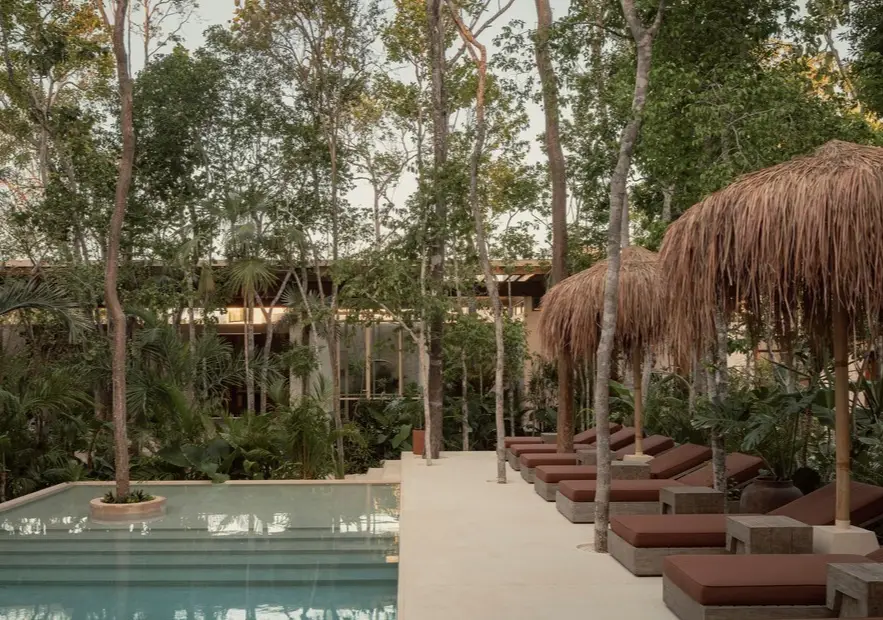

Located on the Quintana Roo coast, NABOA Tulum is conceived as an architectural exercise that explores the relationship between territory, human scale, and hospitality.
Far from replicating standardized tropical aesthetics, the project proposes a contemporary interpretation of the site through construction, material, and spatial decisions deeply connected to the Mexican Caribbean ecosystem.
The hotel was designed by Jaque Studio, led by Jesús Acosta, in collaboration with the Australian firm Studio Wenden. The building’s layout avoids monumental gestures and prioritizes a low footprint, fragmenting the program into light volumes.
Open spaces that connect with the landscape are a constant feature.

The strategy seeks to minimize the impact on vegetation, allow for permeability of the terrain, and promote cross-ventilation through controlled orientations and micro-perforations in the building envelope.
By forgoing a dominant geometry, the hotel adopts an almost silent presence: the pathways are constructed from shadows, gradual transitions, and thresholds that blur the boundaries between interior and exterior. Architecture acts as a climate mediation system, not as an isolated object.
One of the project’s conceptual pillars is the revival of chukum, a traditional natural finish from the Mayan region. Its application to walls and surfaces provides visual continuity, regulates light reflection in a highly irradiated environment, and creates a material thickness that breathes with the ambient humidity.
Its warm, matte terracotta tone allows for an integrated landscape interpretation, avoiding unnecessary contrasts with the tones of the mangrove and sand.
One of the materials is chukum, with terracotta tones.
The structure is complemented by regional woods—selected for their resistance to salinity—and local stone, used as a foundation and as a thermal element.
The heart of the hotel is a semi-exterior volume protected by a double-height pergola that functions as a covered plaza. More than a conventional lobby, it’s a communal space for gathering, shade, and a transitional climate.

The main lounge connects guests to the amenities.
Its strategic position allows for the organization of the rest of the program: to one side, the pool and garden; to the other, the pathways that lead independently to the suites.
The spatial sequence is built upon gradients of privacy, ventilated passageways, intermediate patios, and framed views that guide the perception of the landscape. The project relies on basic yet effective principles of tropical architecture: careful orientation, solar filters, ventilated roofs, and materials with high thermal inertia.
Studio Wenden’s curation doesn’t function as decoration but as part of the spatial experience. Custom-made woodwork—crafted with local woods—coexists with Oaxacan textiles, local ceramics, and pieces from brands like Caralarga. The palette is restrained, minimalist, and tactile, aiming to direct the guest’s attention to the light, the climate, and the landscape.
This strategy creates interiors that function as havens of calm, where the materiality absorbs the usual visual excess of the Caribbean and transforms each room into a sensory sanctuary.

The hotel features 10 suites, organized into three typologies that respond to criteria of orientation, size, and relationship with the outdoors. The Nest, conceived as relaxation capsules with views of the mangroves; The Tropical, with shaded terraces and open bathrooms; and The Pavilion, almost self-contained pavilions amidst the landscape.
The hotel’s program is seamlessly integrated with a user experience focused on the senses.
In all of them, cross-ventilation, latticework, and projected shadows become essential passive tools for reducing heat load and maintaining responsible environmental comfort.
The LU_LO restaurant, helmed by chef Carlos Bordonave, and the wellness area—featuring yoga, sound therapy, and a bar—expand the spatial logic of the complex.
The openness to patios, pavilions, and shaded decks allows the culinary and wellness experience to flow seamlessly between indoors and outdoors, maintaining the hotel’s climatic and landscape harmony.
Technical Specifications
Location: Tulum, Quintana Roo, Mexico
Architectural Project: Jaque Studio (Architect Jesús Acosta)
Furniture and Interior Design

Source: clarin