Formal employment in Mexico registered its worst start to the year in January since 2009, amid a series of labor and tax reforms being considered by companies for 2026 and a weak economy grappling with prolonged uncertainty due to Donald Trump’s tariff policies.
See more: Senate to discuss 40-hour workweek amid complaints about lack of clarity in the reform
In January 2026, 8,104 jobs were lost, representing a monthly decrease of 0.04%, according to the report from the Mexican Social Security Institute (IMSS).
The last time the IMSS recorded a drop in formal employment in January was in 2009, the year of the global financial crisis.
“Typically, during the first quarter of the year, formal jobs lost in December of the previous year are recovered. The January figures somehow reveal that there is no clear recovery trend.”
The Mexican labor market had shown signs of slowing down, as the historical trend of creating more than 100,000 jobs during the first month of the year declined from 2022 to 2025.
In January, employers created 3,037 permanent jobs; however, they eliminated 11,141 positions, resulting in a net loss of 8,104 jobs with social security benefits.
Alesi, from ManpowerGroup, pointed out that January typically sees significant job creation in the past year, but 2026 marked a year of losses with more than 11,000 positions.
Employment Declines in Manufacturing and Construction
In January of last year, at the beginning of the first year of President Claudia Sheinbaum’s term—a period characterized by a decline in investment—73,167 jobs were created, a higher figure than this January in the second year of her administration.
The agricultural sector registered the largest drop in employment with a 3.14% year-on-year decrease in January, followed by the extractive industry with a 2.4% reduction, the manufacturing industry with a 2.1% decrease, and the construction industry with a 2.1% decrease.
The services sector experienced moderate growth of 0.8% year-on-year, along with social and community services at 1%. Meanwhile, the electricity industry grew by 2.2% year-on-year, commerce by 3.6%, and the transportation and communications sector surprised with a 9.7% year-on-year growth rate.
By state, the State of Mexico, Mexico City, and Hidalgo led in formal job creation with annual increases of 4.8%, 4.6%, and 3.3%, respectively.
In contrast, employment in Campeche decreased by 4.1% annually, followed by Sonora with a 2.6% decrease and Tabasco with a 2% decrease.
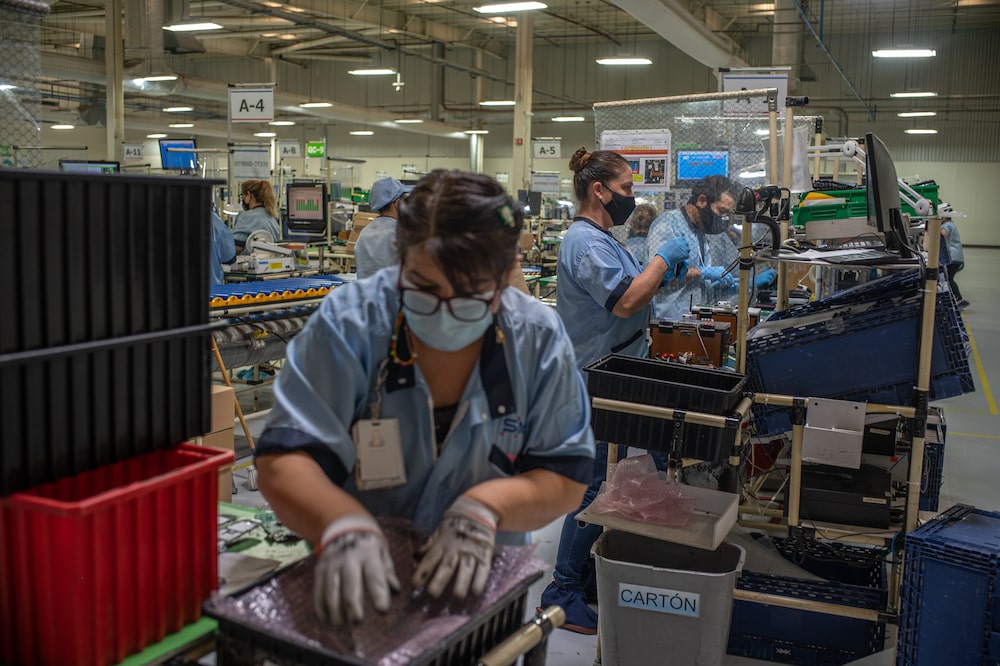
Workers package television remote controls at the SMK Corp. factory in Tijuana, Mexico, on Thursday, September 9, 2021. Companies across Tijuana found reasons to remain open throughout the pandemic. Large parts of the rest of Baja California and other northern states did the same, spurred by U.S. demand for Mexican-produced goods that had been boosted by stimulus payments from the Trump and then the Biden administrations. Photographer: Alejandro Cegarra/Bloomberg
Workers pack remote controls for televisions at the SMK Corp. factory in Tijuana, Mexico, on Thursday, September 9, 2021. (Bloomberg/Alejandro Cegarra)
The Mexican Social Security Institute (IMSS) justified the poor employment figures for January 2026 by citing the adjustment observed in employment associated with digital platforms.
However, the Mexican Institute of Finance Executives (IMEF) indicated that economic activity showed signs of weakness in January, with the manufacturing sector contracting and the services sector continuing to lose momentum.
Furthermore, a series of tax and labor changes took effect in January, which companies are currently weighing. One of these is the 13% increase in the minimum wage by 2026, which is also generating inflationary pressures, according to analysts.
In January, prices for soft drinks, juices, and cigarettes rose due to an increase in the excise tax (IEPS) effective January 2026, as well as for goods from China and other countries with which Mexico does not have trade agreements.
“The beginning of 2026 is characterized by cautious hiring, a direct response from employers to various economic and labor challenges. This moderation is a strategy while the evolution of the new annual context is evaluated.”
Source: bloomberglinea