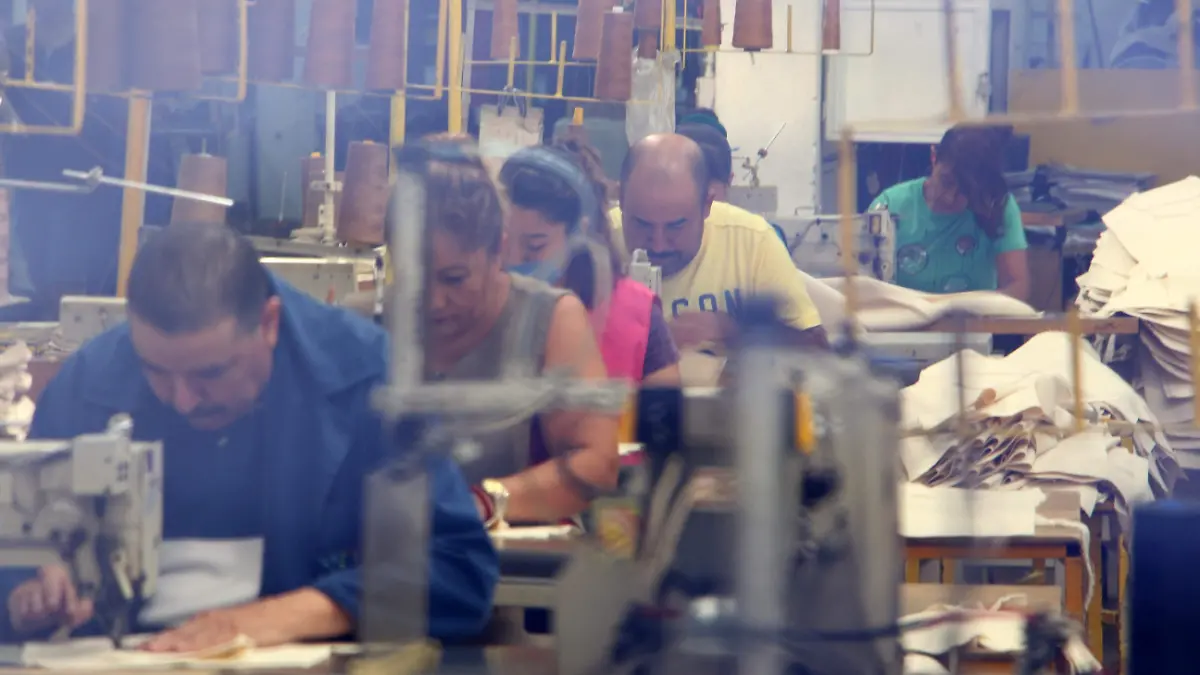
Seven out of ten people working in Mexico’s textile industry do not earn enough to rise above the poverty line, and 68% of them are women, according to a report released Monday by the organization ProDESC.
Despite the fact that the fashion industry is one of the most lucrative sectors globally and contributes around 95 billion pesos (approximately US$5.5 billion) to the national manufacturing GDP, it “operates under conditions of profound precarity,” the NGO stated in a press release.
Among the main findings, the report indicated that 72% of those working in this industry do not earn enough to rise above the poverty line.
In addition, 66% of jobs—one in three—are in the informal sector, according to the report, which was presented at the OECD’s Forum on Due Diligence in the Apparel and Footwear Sector.
Thus, the NGO highlighted the “contradictions” of an industry that generates 1.2 million jobs but “leaves more than half of its workforce without social security, formal contracts, or living wages.”
The report also found that 52% of workers in this industry lack social security, 42% do not have a stable contract, and 94% do not belong to a union.
“In Mexico, as in other countries, this industry has been sustained by systematic labor exploitation with a profound impact on communities and workers,” said Mercedes Ramírez, a member of ProDESC.
Ramírez emphasized that the upcoming review of the trade agreement between Mexico, the United States, and Canada (USMCA) is a “key opportunity” to strengthen protections for this sector, as well as corporate accountability.
The report also warned that “precarious working conditions disproportionately impact women,” who represent approximately 68% of the workforce in the garment industry, one of the most “feminized” branches of manufacturing.
Betty Ávalos, general coordinator of the Rosa Luxemburg Women’s Collective in Ciudad Juárez, Chihuahua, warned that “the garment industry functions because there are women working for low wages and without protection.”
“In the maquiladoras, we experience long hours, fear of organizing, and wages that aren’t enough to live on. While brands talk about responsibility, we workers continue to pay the price. There can be no real change if those of us who make the clothes every day aren’t listened to,” she stated.
On the other hand, the report indicated that 90% of brands do not report information about their salary levels or working conditions, according to the Fashion Transparency Index in Mexico.
Finally, the organizations Fundación Avina, Oxfam México and Ethos Innovación en Políticas Públicas agreed that Mexico faces the challenge of moving from voluntary commitments to binding regulatory frameworks that guarantee labor rights.
Source: oem