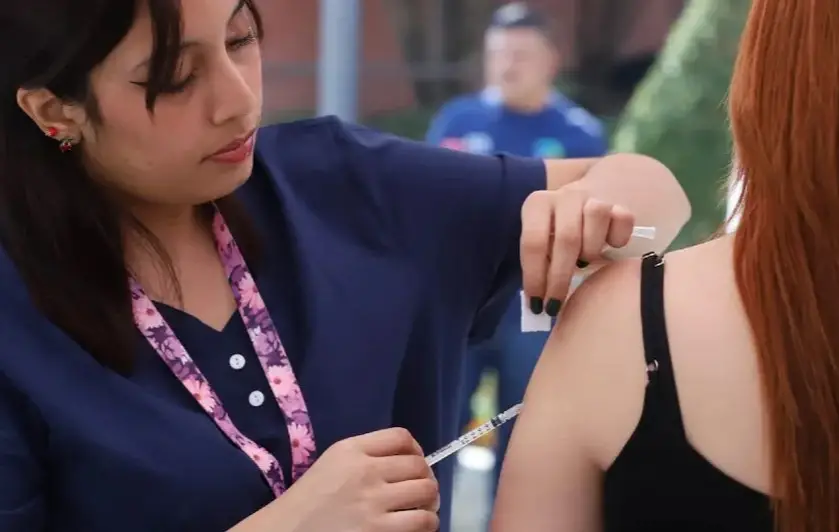

The Nuevo León Health Department announced large-scale measles vaccination campaigns this weekend as part of a strengthened health strategy following the confirmation of 20 measles cases so far in 2026 and the identification of community transmission in the state.
The Nuevo León State Health Secretary, Alma Rosa Marroquín, reported that the campaigns will take place Saturday and Sunday at the Explanada de los Héroes (Esplanade of the Heroes), in front of the Government Palace. Vaccination stations will operate from 8:30 a.m. to 3:00 p.m. and will target individuals with incomplete vaccination schedules or no clear vaccination history.
“This Saturday and Sunday, we will be at the Explanada de los Niños Héroes with a large number of vaccination stations for everyone who wishes to be vaccinated,” Marroquín stated. In addition to the large-scale vaccination drives at the Niños Héroes esplanade, Marroquín explained that the vaccination strategy includes an expanded territorial deployment, with vaccination stations set up in public squares, parks, shopping malls, hospitals, and medical units.
“We have gone to public squares, parks, shopping malls, and hospitals, and the public response has been very positive,” the official emphasized.
The goal, she said, is to bring vaccination closer to the population, facilitate access, and reduce the number of susceptible individuals as quickly as possible.
Marroquín explained that the virus is already circulating in the state, as not all infections are linked to travel history or contact with people from areas with outbreaks.
According to the latest epidemiological report, 20 cases have been recorded as of Wednesday.
“In approximately half of the cases, we identified a history of travel or contact with places where there was an outbreak, but in the rest, it was no longer possible to identify a direct source of infection, which indicates community transmission,” stated Alma Rosa.
The cases detected so far are not concentrated in a single municipality or neighborhood, but rather have appeared in a dispersed manner. In the households where two cases have been identified, they are people who live in the same home.
“We don’t have any municipalities or neighborhoods with major outbreaks. The cases have been isolated, and when there are two, it’s because they live in the same house,” the Secretary of Health pointed out.
The Secretary of Health acknowledged that the current situation is directly related to gaps in vaccination coverage, which have become more pronounced in recent years.
“In Nuevo León, our coverage hovers around 80%. However, when we go into rural areas and review vaccination records house by house, we see that this percentage doesn’t always reflect reality,” she explained. She indicated that this difference between administrative records and direct review has allowed them to identify pockets of susceptible populations, including children, adolescents, and adults.
“We found people who never received the vaccine, others who only have one dose, and many who don’t remember their vaccination history. That’s where the risk lies,” she noted.
She added that changes in the vaccination schedule and the decrease in attendance at health services during the pandemic influenced many people not to complete their vaccination schedule, particularly the second dose.
Epidemiological Surveillance and Vaccination Blockade
The Secretary of Health explained that, in each suspected case, a vaccination blockade is activated without waiting for laboratory confirmation, as part of epidemiological control.
“Without waiting for case confirmation, we implement a vaccination blockade around the index case, visiting nearby blocks to identify contacts and review vaccination records,” she explained.
This strategy is accompanied by active case finding, contact tracing, and ongoing epidemiological surveillance to promptly detect new infections.
Marroquín reiterated that the measles vaccine is free, not sold, and available at all public health facilities.
“If anyone is charging you for it, be suspicious and go to one of our medical units,” he warned.
“The worst thing that can happen is for us to become complacent and relax our efforts. Vaccination is one of the most important tools we have to prevent this disease,” he emphasized.

Source: milenio