
Indigenous and peasant communities, as well as land defenders in this state, revealed the operation of a new “land grab cartel” representing real estate and business interests. They allege that this cartel operates with the complicity of agrarian, municipal, state, and federal authorities, targeting beaches and ecologically protected areas with high economic or tourism value.
The protesters hold Governor Salomón Jara Cruz responsible for what is happening due to his “omission or complicity” in the illegal appropriation of land, and warn that the territory is being surrendered to organized crime. “If you open the door to these people, they will soon control investments, hotels, and all businesses.”
The indigenous Chatino community of Santiago Cuixtla, recognized as an agrarian community by Presidential Decree on March 27, 1989, has publicly denounced the operation of an alleged network dispossessing of communal lands in the Playa Palmarito area and the territories surrounding the Manialtepec Lagoon, belonging to the municipality of Villa de Tututepec de Melchor Ocampo, Oaxaca.
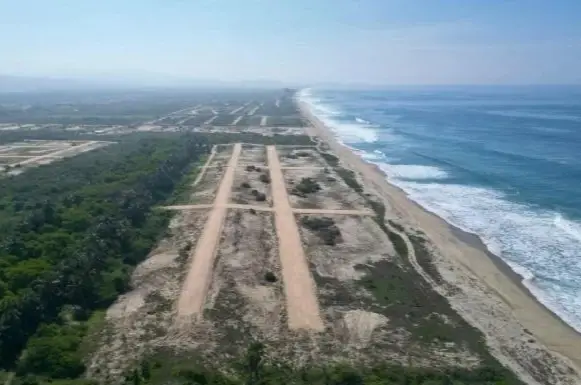
Land theft with high added value. Photo: Special.
Other cases include: Punta Colorada in Puerto Escondido, considered the last virgin beach in the area, with a natural area of 111 hectares encompassing wetlands, mangroves, and rich biodiversity.
Meanwhile, in the community of Tilzapote, a court order seized more than 300 hectares of land belonging to the San Francisco Cozoaltepec agrarian community, in the municipality of Santa María Tonameca. The community members claim that agrarian authorities and the Federal Judiciary conspired to dispossess this community and force the Mexican State to pay 6 billion pesos.
Similarly, with the support of the State Police, on January 29, private individuals entered Salchi Beach, belonging to Cuatunalco, Pochutla, to seize land belonging to land defender Miguel Sánchez Hernández.
Other beaches at risk due to development projects include Playa Brasil, Punta Chivo, Barra de la Cruz, El Coyul in San Pedro Huamelula and San Agustín, as well as El Coyote.
Land defenders Ernesto Chávez Ramos, Oralia Ramírez, Hortencia Chávez, and Noé López Rojas have stated that they are being legally persecuted for opposing the business interests that seek to appropriate these areas.
According to documents and complaints filed with agrarian courts and the prosecutor’s office, there are at least 10 cases of public access to beaches being blocked, as well as the destruction of ecosystems by mega real estate projects in the Costa-Istmo region of Oaxaca. These cases were mentioned to Proceso by affected individuals who requested anonymity for fear of reprisals.
Several proceedings are underway in the agrarian courts, in addition to complaints filed with the State Attorney General’s Office for the crimes of dispossession, fraud, threats, impersonation of authority, and other related offenses. However, there has been no progress in these cases, according to the complainants.
The community members’ fear is one: “If we continue, they will kill us.”
This new “land grab cartel” joins a previous one identified in 2022 by other victims—reported on by Proceso magazine—who made public a similar network linked to former governor Alejandro Murat. This network included public servants from the Civil Registry, the Public Registry of Property, the Oaxaca State Cadastral Institute, and at least six notaries public who, according to investigations, illegally seized properties through suspicious transactions, such as presenting documents belonging to deceased individuals, among other irregularities.
In total, more than 200 complaints were filed against this first “land grab cartel.”

Source: proceso