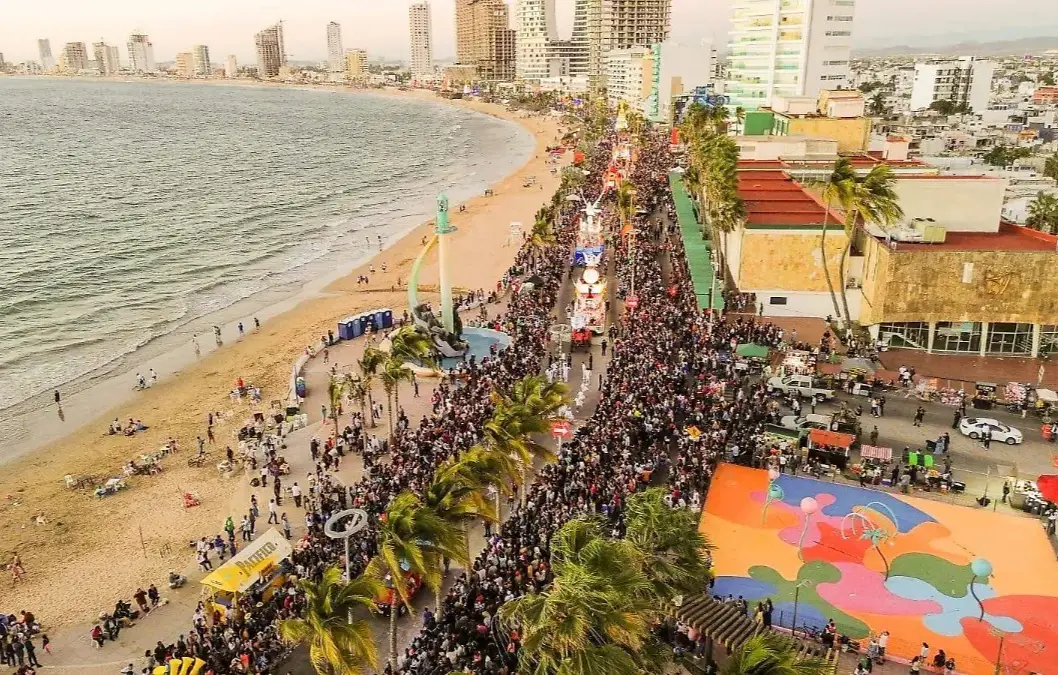

Carnival is Mazatlán’s biggest celebration and one of the most emblematic cultural events in Sinaloa and Mexico, but it costs an average of 76 million pesos of public funds each year, with minimal return on investment.
Currently, Carnival has characteristics that make it a potentially profitable product if a different subsidy scheme is designed—that is, a transition to a sustainable financing model that guarantees real revenue for the city.
An analysis of the Mazatlán government’s financial statements for the period 2022-2025, conducted by the Mazatlán Citizen Observatory, revealed that a total of 305.1 million pesos was spent on Carnival alone during those years, while total revenue generated—in the same period—barely reached 150.1 million pesos, less than half of the public investment.
This confirms that the city’s biggest celebration depends largely on the public budget.
The director of the Mazatlán Carnival Observatory (OCM), Gustavo Rojo, explained that in 2022 the Carnival had a public investment of 100 million pesos and an income of only 24 million pesos; in 2023 it was 61.8 million pesos and an income of 42.9 million pesos; in 2024 it was 65 million pesos and an income of 38.5 million pesos; and in 2025 public spending was 78.3 million pesos and an income of 37.7 million pesos.
“We wanted to analyze the cost of the carnivals, and we found that there is an urgent need for a new sustainable model within the Mazatlán City Council for holding this festival,” he said.
He pointed out that despite the high investment, in none of the analyzed editions has the Carnival managed to cover its own operating expenses, despite the high attendance and tourist importance.
However, it is observed that sponsorships, concessions, and events such as the coronations offer the opportunity for the Carnival to generate its own income through these means, using alternative financing models.
This context compels us to question the priorities of public spending and the real impact of the Carnival compared to other municipal needs, as well as the feasibility of exploring different sources of funding.
Another observation is the limited direct participation of sectors that benefit economically from the Carnival’s economic impact, such as hotels, retail, restaurants, and private sponsors. At least, there is no clear official information on how they contribute to the financing before and during the Carnival.
“We believe it is urgent that Carnival transition to a new, self-sustaining subsidy model with greater financial transparency, clear rules on income generation and distribution, and cost-benefit analysis. We also believe that alternatives could include the creation of a mixed board of trustees, a resource management trust (combining public and private funds), or a decentralized public agency with a pluralistic council comprised of representatives from the productive sectors, citizens, civil organizations, and authorities. As an organization, we consider Carnival a profitable event, but not in purely financial terms; therefore, its funding must be evaluated and made transparent,” he emphasized.
Source: oem