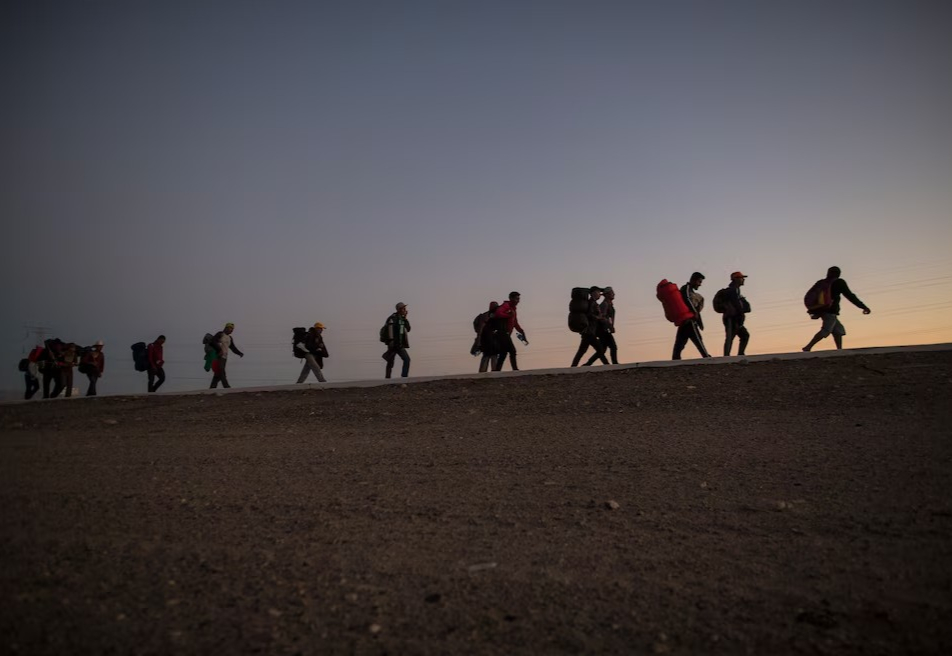

A network trafficking Guatemalan migrants to the United States was detected by Mexican authorities after its centers of operation were identified in Chihuahua and Mexico City.
Ulises Lara López, spokesperson for the Attorney General’s Office (FGR), reported that intelligence work carried out by agencies within the Security Cabinet and the Criminal Investigation Agency (AIC), in collaboration with Customs and Border Protection (CBP), led to the location of this criminal organization.
The investigation revealed that this network was sending Guatemalan migrants to the Ciudad Juárez, Chihuahua, border crossing, with the intention of them entering the United States through El Paso, Texas.
The FGR spokesperson explained that the migrant trafficking network’s main area of operation was Ciudad Juárez, Chihuahua, but that it also had connections in Mexico City.
Investigations indicate that since 2024, they had been using safe houses to shelter Guatemalan migrants while they facilitated their illegal entry into the United States.
After detecting their operations, authorities carried out raids on five residences in Ciudad Juárez, where they arrested the alleged leader of the criminal gang and four of its members, who are accused of organized crime for the purpose of human trafficking.
The five individuals were identified as José Isaac “N”, alias “Isaac”; Luis Antonio “N”, alias “Perusi”; José Ramón “N”, alias “El Noño”; José Ramón “N”, alias “Niño”; and Gonzalo “N”, alias “El Gori”, the latter identified as the alleged leader of the Guatemalan migrant trafficking network.
It should be noted that last February, Guatemalan authorities carried out a police operation that led to the identification and dismantling of a human trafficking network that transported migrants from Guatemala to the United States.
According to María Esther Guzmán, a section prosecutor with the Guatemalan Prosecutor’s Office Against Transnational Crimes, during their passage through Mexico, migrants were kidnapped to force their families to pay large sums of money.
The dismantling of this criminal gang was carried out as part of Operation Migrant Merchants Northwest Region, which began following a kidnapping report.
Under the name “Migrant Merchants,” this human trafficking network operated from Guatemala to send migrants to Mexico.
Their area of operation was the municipalities of Nentón and San Pedro Soloma in the department of Huehuetenango, where they offered lodging and food in places they called warehouses before transporting the migrants to the United States.
According to the prosecutor, undocumented migrants were kidnapped while passing through Mexican territory, and their families were extorted for their release. The money had to be deposited into accounts in Guatemala and other countries where the kidnappers originated.
“Many of the victims never reach their destination, as they are sexually exploited in many border areas. Others who resist extortion are murdered, and those who manage to arrive are left with exorbitant sums of money that they must deposit with their families in Guatemala to receive the payments,” Guzmán explained at a press conference.
Migrants relax at sunset on Gardi Sugdub Island, off the Caribbean coast of Panama, on February 23, 2025, where they spent the night before attempting to board boats to Colombia, a day after returning from southern Mexico. They had abandoned their hopes of reaching the United States due to President Donald Trump’s anti-immigration campaign. (AP Photo/Matias Delacroix)
Their modus operandi also revealed that the human trafficking network reported the arrival of migrants to criminal organizations so they could be allowed to continue their journey.
After detecting their operations since February 2024, Guatemalan authorities arrested their leaders and collaborators, who demanded payments of approximately 179,000 to 300,000 pesos from the migrants’ families.

Source: infobae