The seats furthest from the stadium are usually the cheapest and least coveted, but in Monterrey, everyone wants a spot in the highest section. From there, a couple of years ago, a fan took a photo that has gone viral. It shows the pitch, the stadium’s curves, and, in the background, Cerro de la Silla (Saddle Mountain). This is no coincidence. BBVA Stadium was designed so that the light enters at the precise angle and so that the mountain becomes part of the game’s scenery. In one of the country’s three largest cities, the mountains and the food are impressive, but there’s something that surpasses everything else: the passion for soccer.
The Rayados team has a loyal fanbase that never abandons them. Marcela Charles and Marcela González, both 58 years old, religiously go to the stadium every two weeks. “We’re with the team for every game, through thick and thin,” they say before heading into the match against Chivas de Guadalajara. Its home, in the municipality of Guadalupe, stands like a cathedral, welcoming fans every other Saturday. It’s the Steel Giant, which, with just over a decade of history, is poised to make history as the venue for four matches of the 2026 World Cup. This week it will also host the playoff matches for the national teams of Bolivia, Iraq, and Suriname.
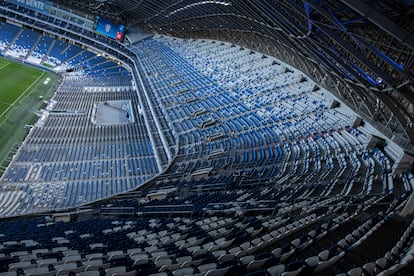
The need arose when the old Estadio Tecnológico became too small for a rapidly growing fanbase. Design work for a new stadium began in 2008, the cornerstone was laid in 2010, and construction started a year later. On August 2, 2015, the stadium opened its doors. The vision was always ambitious: to build the most spectacular stadium not only in Mexico, but in all of Latin America. “For the first time, we have an official home for Rayados. We’ve always been a team that played away games, at the Tec de Monterrey and the Estadio Universitario. Our move to our home comes 30 years after the club’s founding. It’s a space designed for the fans of Monterrey,” explains Alberto Molina Caballero, director of operations for Club Monterrey.
“For the first time in our city’s sporting history, a stadium was built exclusively for soccer, a venue that also rivals the best stadiums in the world,” Molina affirms. With a capacity for more than 53,000 spectators, 336 suites, and nearly 5,000 premium seats, the stadium quickly became an architectural icon.
The design, which frames Cerro de la Silla as a natural backdrop, has earned it international acclaim. The BBC selected it as the “most beautiful sports venue in the world,” and it received the Design Excellence Award from the Kansas City Institute of Architecture in the United States. It was designed by the American firm Populous in collaboration with the Mexican firm VFO Arquitectos, with Federico Velasco as lead designer. “Airflow enters through vents in the metal facade, ventilating the stadium and keeping spectators and players cool and comfortable. The cantilevered roof, a large 55-meter structure, also provides comfort and shade inside the stadium,” explains the Populous website.

Source: elpais