This Tuesday marks National Taco Day, and Puebla boasts one that originated in its Historic Center. Due to its context and roots, it was initially called the “Arab taco” because of its resemblance to dishes from the Middle East, though it has now become a classic and an icon of the state’s gastronomy.
The Arab taco emerged in Puebla following the fusion of Iraqi and Mexican cuisine during World War I and World War II, a result of migration from the Middle East and parts of Europe, such as Greece and Turkey. These migrations were primarily driven by religious reasons.
The vertical spit of meat is inspired by the preparation of Turkish kebabs and Greek gyros; however, it underwent some significant changes to adapt the dish and make it iconic.
Undoubtedly, one of the most significant changes was the incorporation of pork instead of the traditional lamb or chicken consumed in many Muslim countries due to religious beliefs.
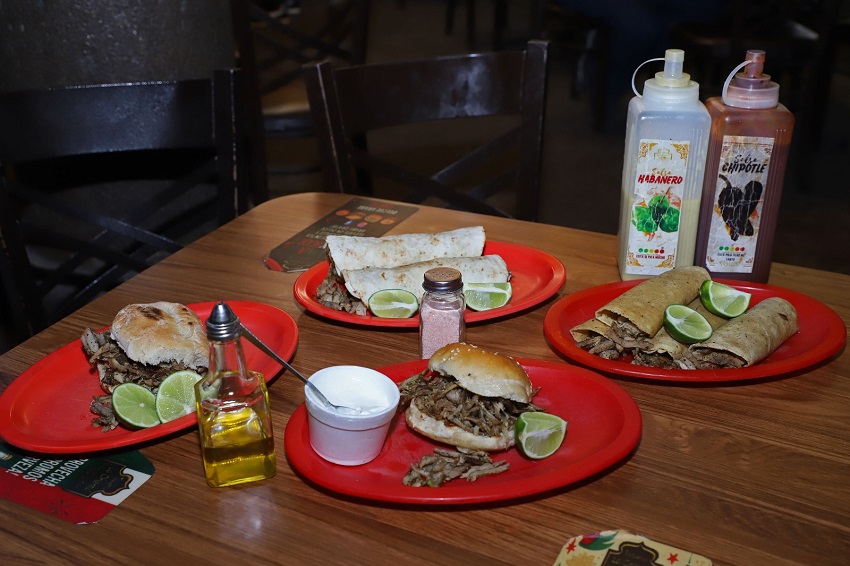
This meat is seasoned in the same way as gyros or kebabs. Furthermore, some key elements are incorporated, such as the bread. Instead of a traditional flour tortilla, it’s served on a piece of pita bread, although nowadays it’s also made on a hybrid between a tortilla and bread.
Along the same lines, there’s also the oriental taco. This contains the same meat but is served on a corn tortilla, a presentation that was implemented during the 1960s.
The dish has continued to evolve, and this type of meat can now be seen served on a torta de agua or cemita, both traditional breads from Puebla.
Originally, the Arab taco was served plain, without dressing or salsa, but over time a chipotle salsa was developed, perfectly meeting the needs of consumers at the time.
In some versions, it’s also served with jocoque (a traditional Arab-style sour cream) and olive oil, while in others it’s simply served with onions and serrano peppers.
There are different versions about the origin of the Arab taco, however, they all lead us to the heart of Puebla’s capital city, specifically in front of the cathedral.
The Galeana family arrived there and later expanded, opening several taquerias throughout the city.
One of these taquerias is Bagdad. Zacarías Galeana, manager and grandson of the founder, told TELEDIARIO in an interview that his family were the pioneers. They even have the option of ordering pita bread on their menu, just as it was in 1933.
He also pointed out that the Arab taco originated out of necessity to generate income, so they adapted the concept to local tastes. Instead of chicken and lamb, which were rare and expensive to obtain at the time, they decided to season pork.
He also mentioned that they were the first to add jocoque (a type of sour cream), since before chipotle sauce was invented, locals would ask for some kind of dressing or salsa, and that’s how they started offering this traditional dish.
Another of Puebla’s most traditional taquerias is La Oriental, the birthplace of the Arab taco. The current manager and fifth-generation owner of this business, Rodrigo Galeana, revealed that one of its main secrets is that the meat is cooked on the famous vertical spit, but over charcoal.
He also explained that this dish is extremely important because it unites various cultures and is now one of the most traditional in Puebla’s cuisine.
Source: telediario