Juan Carlos Guerrero Rojas is a name unknown to the long-established business community in Tabasco. “I had never heard of him until now, when the issue of the party came up,” says a Tabasco businessman who for years rented industrial warehouses to Petróleos Mexicanos (Pemex) on the Villahermosa-Cárdenas highway.
The businessman, who prefers to remain anonymous, confesses that it has been difficult to cope with the non-payment that the Mexican oil company has maintained with suppliers since 2014.
During a visit to Tabasco, he met with various businesspeople and political leaders, who said they were unfamiliar with most of the successful businesspeople who have recently obtained multi-million-dollar contracts with Pemex.
Read also: Expert questions whether oil spill is due to ship; Points to possible infrastructure flaws
The Secretary of Government of Tabasco, José Ramiro López Obrador, stated that Juan Carlos Guerrero Rojas “is not a businessman who has only been around for six or eight years. He is a businessman who has been with Pemex for nearly 20 years,” but public contracts confirm that he and his circle of associates have indeed benefited—at least from 2019 to the present, during the administration of Octavio Romero Oropeza, also from Tabasco—from contracts with the state-owned oil company.
In Tabasco, under the auspices of the Fourth Transformation, at least 20 businesspeople have experienced exponential growth in the last seven years, moving from company to company with shares or maintaining several with contracts with Pemex. But those who maintain current contracts and could be traced for this investigation are the associates of the businessman who rose to fame for throwing a lavish quinceañera party for his daughter in early March.
Among Juan Carlos Guerrero Rojas’s inner circle are Ángel Ernesto García Castillo, José del Carmen Olán Arce, and Héctor Peralta Grappin, who in 2020 sold their shares in Petroservicios Integrales México, a company with contracts worth up to 4 billion pesos with Pemex. They are also involved with at least 39 other companies, some linked to Pemex through contracts.
Héctor Peralta Grappin is widely known for having served as mayor of Comalcalco while part of the political group of the current governor of Tabasco, Javier May Rodríguez, with whom he later had disagreements. He is also Guerrero Rojas’s main partner in most of the companies where Guerrero Rojas is listed as the principal shareholder.
José del Carmen Olán Arce is not widely known, but in addition to selling his shares in Petroservicios Integrales México to Guerrero Rojas, he maintains a partnership with Guerrero Rojas and Peralta Grappin in the company Petróleos Tabasqueños S.A. C.V., which was opened in 2016 and does not currently hold any public contracts.
Olán Arce owns another company, Top Oil Services, S.A. de C.V., which does hold open public contracts with Pemex for up to $28 million for drilling services in Ciudad del Carmen, in the state of Campeche.
Ángel Ernesto García Castillo is not well-known among the Tabasco businessmen who have been Pemex contractors for decades, but among independent local journalists who have been tracking the Comalcalco Group, he and his brother Andrés García Castillo—nicknamed “The Actor” in Tabasco—are recognized. Andrés is a partner in several construction-related companies, and his connection to Marcos Torres Fuentes, a Pemex executive who sponsored the quinceañera celebration that brought this group of businessmen into the public eye.
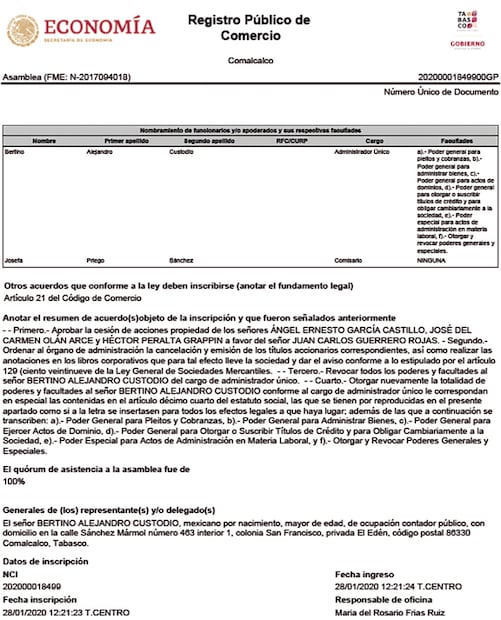
Ángel Ernesto García Castillo is a shareholder in Construcciones Garza S.A. Construcciones Garza, S.A. de C.V., was incorporated in Cárdenas, Tabasco, in 2001, and moved its registered office to Comalcalco in 2010. The company was primarily contracted for projects with municipalities, and starting in 2019, it began receiving contracts to build at the Olmeca Refinery in Dos Bocas, Paraíso, Tabasco.
On its website, Construcciones Garza boasts of constructing a structural steel bridge to support heavy traffic at the Olmeca Refinery, of being responsible for the design and installation of a fire suppression system using high-density polyethylene (HDPE) piping, and of having built part of the refinery’s oily drainage system, which has been criticized for recent oil spills into the Seco River.
“I passed by the convention center the day the party was supposed to be. Being used to knowing everything that goes on in Villahermosa, I thought, ‘How strange that I wasn’t invited to this event,’ and I asked the security guard. ‘It’s a private event, sir,’ he told me. Later it turned out to be the infamous party, and only then did I learn this man’s name and his wealth,” admits Carlos Madrazo Cadena, a restaurant owner and member of the group of business leaders who maintain constant communication with the state government.
The party not only surprised the entire country, but also the people of Tabasco, who, amidst the crisis caused by Pemex’s failure to pay its suppliers, weren’t expecting to see such extravagance. “It was stupid; all it did was put him in the media spotlight,” says a businesswoman who used to provide catering services for Pemex suppliers in Tabasco, and now has no clients.
“I used to rent apartments for between 25,000 and 30,000 pesos a month to the executives of these large multinational corporations that work for Pemex. Now I have many vacancies, and the few that are rented I had to offer for between 12,000 and 15,000 pesos. I couldn’t keep my catering business afloat anymore. In short, I think a little bit is better than not earning anything at all,” he admits.
Business owners say that some buildings have closed and private schools have seen a drop in enrollment due to the exodus of skilled workers from these companies, which had to drastically reduce their operational capacity by 2025.
EL UNIVERSAL contacted several of Villahermosa’s most prestigious schools to obtain an interview or their perspective on the crisis. Only the public relations department of Colegio Arjí denied the situation. “Not us. We maintain our enrollment of over a thousand students, and it hasn’t decreased at any point,” they responded.
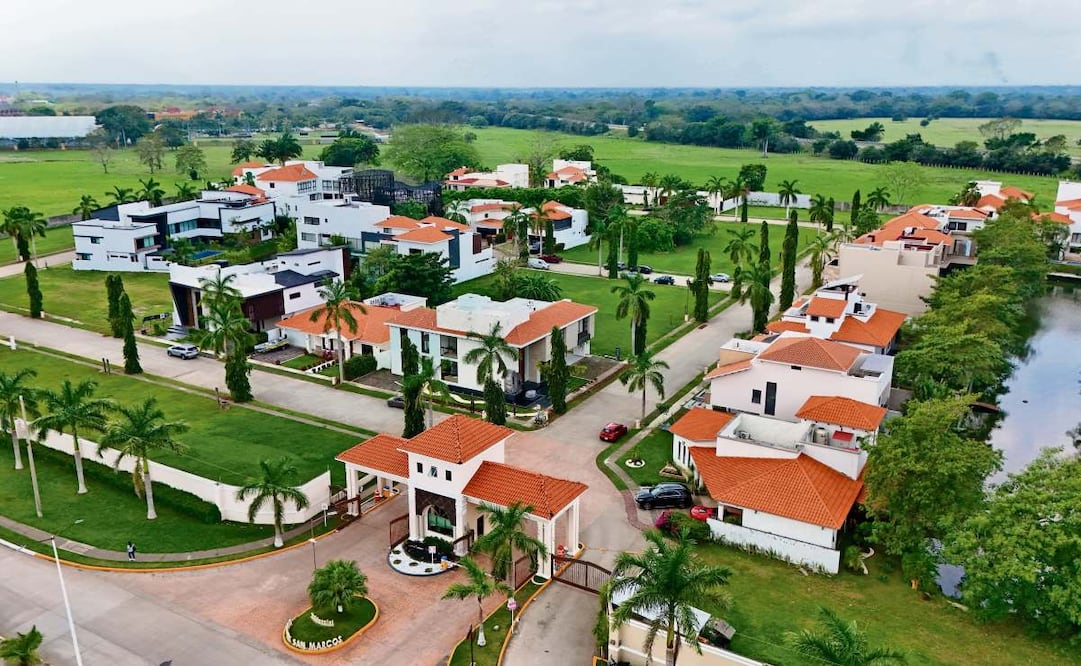
Although the city feels like it’s in decline, the scarcity isn’t visible everywhere. On the outskirts of downtown Villahermosa lies El Country, an exclusive residential area surrounded by private schools such as Instituto Cumbres Villahermosa, Greenville International School, and Colegio Anáhuac Villahermosa. The gated communities are connected by a central avenue.
El Gran Diario de México flew over the area: luxury SUVs are a common sight, all the houses have enormous solar panels, and there are numerous security measures in place. Further along the road are the Jardines del Country II and Real Campestre residential areas, which share similar characteristics.
A former executive of the oil company Baker Hughes, who was laid off after the company closed several offices in Ciudad del Carmen in 2024 due to non-payment, claims that the layoffs were massive and across all departments.
The engineer—who also requested anonymity, as he continues to work in the sector, but now in Villahermosa—states: “My boss called me to his office and told me: ‘We can no longer pay salaries like yours, there’s no money.’”
The former Baker Hughes executive explains how the decline began due to the lack of payments: while contracts allowed a 45-business-day grace period for Pemex suppliers to make payments, a new clause, established in contracts starting in 2022, gave a final deadline of 120 days.
“Half a year without getting paid… many companies started to go under, and then there was the 2024 default. Imagine the money that comes out of this oil business, and even with everything, it’s still profitable for companies to wait for payments.”
Source: eluniversal