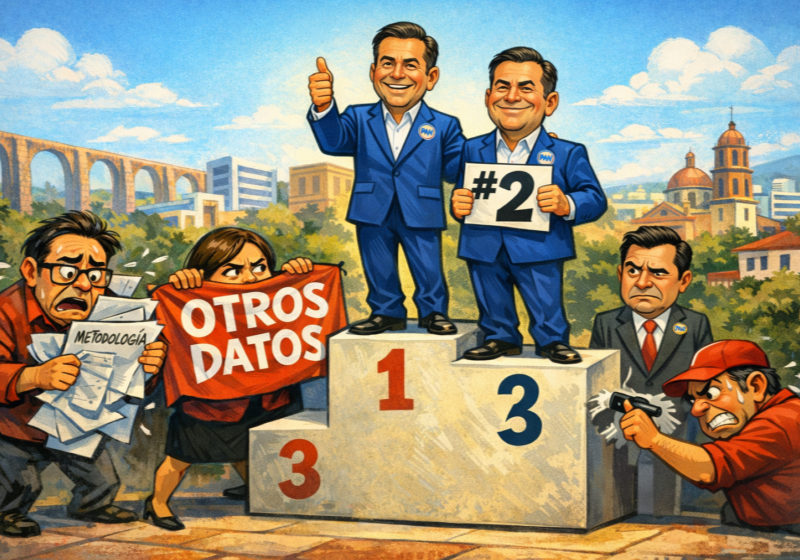

There’s something profoundly fascinating about polls: when they align with the official narrative, they’re an accurate snapshot of reality; when they don’t, they automatically become “methodologically questionable.” This week, Polls MX released its ranking of governors, and, to the surprise of those who still believe that repeating a story makes it true, the highest-rated governors are—once again—from the PAN and PRI parties. Yes, those same governors who, according to certain rhetoric, should already be archived along with the past they promised to bury.
Manolo Jiménez tops the list in Coahuila, but the truly unsettling fact comes right after: Mauricio Kuri, governor of Querétaro, has now positioned himself in second place nationally, dethroning Teresa Jiménez of Aguascalientes. Just like that, without fanfare, without epic narratives, and without needing much explanation. Because, of course, when Querétaro appears at the top, there’s always an awkward pause. Didn’t they say the country had already changed? Didn’t the transformation come to sweep away everything that came before? So how is it that one of the PAN’s strongholds remains so unscathed… and even enjoys high approval ratings?
Given this situation, it’s striking that while in other states the issues revolve around rampant security, institutional crises, or governments trapped in their own narratives, in Querétaro the debate, paradoxically, continues to be about growth. About how to manage development, not how to prevent collapse. A minor distinction, certainly. One that, curiously, ends up being reflected in approval ratings.
Now, the real elephant in the room isn’t who’s on top, but who fails to appear with the same consistency. Morena may boast territorial expansion, political control, and an omnipresent narrative, but when it comes to approval ratings—that uncomfortable metric that measures what people really feel—the story changes. And it changes considerably. In Querétaro, moreover, the situation is complicated by an additional factor: internal fragmentation. The differences, the vying for leadership, and that eternal competition to see who best embodies the project end up diluting any serious attempt at consolidation. But surely all of that is part of a broader strategy. One that, like many other things, we will understand later. Or perhaps not.
And then we arrive at the most uncomfortable point of all: if the rankings show that the PAN and PRI governments continue to be well-regarded, then something doesn’t add up with the dominant narrative. And when reality doesn’t add up, there are two options: question reality… or question the narrative. Spoiler alert: the second option is almost never chosen. In Querétaro, election after election, the result seems to repeat itself with a consistency that borders on offensive to those who insist that the landscape has already changed. The PAN wins, governs, and, according to these data, maintains approval ratings that are not only competitive but outstanding. Could it be that the Querétaro electorate hasn’t grasped the historical moment? Or is it simply that they are voting based on what they see and experience?
With 2027 drawing ever closer, these kinds of rankings aren’t just a snapshot: they’re a warning. One that states, bluntly, that in states like Querétaro, the PAN (National Action Party) is not only still relevant, but strong. That the PRI (Institutional Revolutionary Party), despite the extinction predictions that are repeated every election season, continues to appear at the top. And that the competition won’t be as easy as some would like to believe. Because gaining ground is one thing… and maintaining approval is quite another. But hey, there’s still time. Time to adjust strategies, to rethink messages, or, in the worst-case scenario, to keep explaining why the numbers “don’t reflect reality.”
Meanwhile, in Querétaro, the PAN continues to gain ground. And the most unsettling thing of all is that it doesn’t seem to be a coincidence.

Source: codiceinformativo