
The mountainous region between the municipalities of Morelos and Guachochi, in Chihuahua, where a mega-drug lab with industrial capacity was located, is an area historically controlled by Gente Nueva and the faction known as Los Salgueiro, structures linked to the Sinaloa Cartel.
In this area, near Sinaloa, where state and federal authorities seized facilities capable of housing between 50 and 100 people working simultaneously, cells operate that form part of the armed, production, and logistical apparatus of the organization founded by Joaquín “El Chapo” Guzmán and which currently maintains a presence through various factions, including those linked to his sons, Los Chapitos.
What is known about the Gente Nueva criminal organization?
Gente Nueva is an armed wing of the Sinaloa Cartel created around 2007 to dispute territories, mainly Ciudad Juárez, with rival groups such as La Línea.
Over time, their sphere of influence expanded into the southern part of the state and the mountains, where they evolved from a shock cell into a structure for territorial control, security, and route protection.
Within this network is the Salgueiro family, considered one of the most powerful factions in Chihuahua and Durango. Led by Noel Salgueiro, alias “El Flaco,” and his brothers, they consolidated their presence in the mountainous region, particularly in municipalities such as Guadalupe y Calvo, Balleza, Parral, Matamoros, and surrounding areas, from where they operate activities related to the production, storage, and trafficking of drugs.
Mexican and U.S. authorities have linked this group to operations involving methamphetamine, heroin, cocaine, and marijuana, as well as to the control of poppy cultivation areas in the mountains, in the so-called Golden Triangle.
In addition to production, the structure has been identified as a generator of violence and responsible for securing trafficking routes to northern Mexico and the U.S. border.
Six production areas, ovens, and dozens of gas cylinders: this is the site that was seized.
This context allows authorities to understand that the recent discovery is being analyzed as part of a consolidated criminal corridor.
The seized complex is located about nine hours from the state capital, in a remote, difficult-to-access area between Morelos and Guachochi, an area identified as a stronghold of these Sinaloa Cartel cells due to its natural connection to the mountains of Durango and Sinaloa.
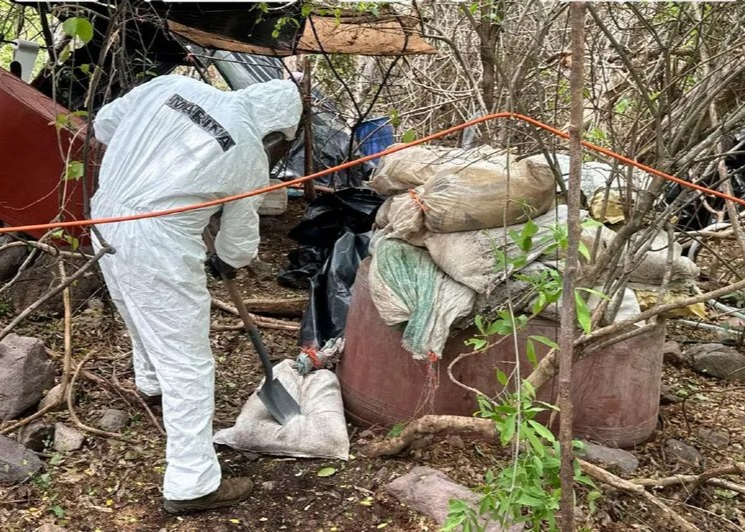
According to the State Attorney General’s Office (FGE), the site was not a makeshift laboratory, but a complex divided into at least six production areas, with one of the properties measuring up to 850 square meters, in addition to a second operational camp.
In the first area, 19 1,000-liter drums were found; In another area, two boilers and pallets with sacks bearing industrial labels were found; a third contained 17 large-capacity containers, acetone tanks, restrooms, and storage areas.
Another section included ovens connected by hoses to tanks, as well as dozens of gas cylinders, indicating continuous heating and chemical transformation processes.
The most extensive area contained at least five ovens, seven interconnected tanks, dozens of additional containers, and more than 100 gas cylinders, suggesting a continuous, large-scale operation.
In a second camp, condensers, boilers, additional ovens, nearly 200 gas cylinders, containers up to 1,000 liters in size, empty drums with industrial labels, and chemical materials in solid and liquid states yet to be identified were located.
Food supplies, utensils, and logistical equipment were also seized, confirming that the site was permanently inhabited and operated, not only as a production point but also as a work base in the mountains.
State Attorney General César Jáuregui indicated that, based on the location and characteristics of the complex, the facilities were linked to a group operating in Sinaloa and that the drugs produced were distributed to various regions of the country.
The volume of supplies, the infrastructure, and the layout of the site allow it to be classified as one of the largest clandestine complexes detected in Chihuahua, with characteristics that place it closer to an industrial plant than a rudimentary laboratory.
According to estimates from the federal Security Cabinet, the seizure prevented the production of approximately 2.88 tons of methamphetamine, representing an economic loss of nearly 966 million pesos for criminal organizations.
The discovery revealed the role of the Sierra de Chihuahua not only as a trafficking route but also as an active area for the production of synthetic drugs, under the control of Sinaloa Cartel structures that combine territorial control with the production of designer drugs in the mountains.

Source: milenio