
During his visit to Mexico, White House Trade Representative Jamieson Greer emphasized the Trump Administration’s intention to reindustrialize the U.S. and defined Mexico as a key partner in securing supply chains.
Jamieson Greer, the White House Trade Representative, stressed that the United States is more concerned about its trade deficit with China than with Mexico.
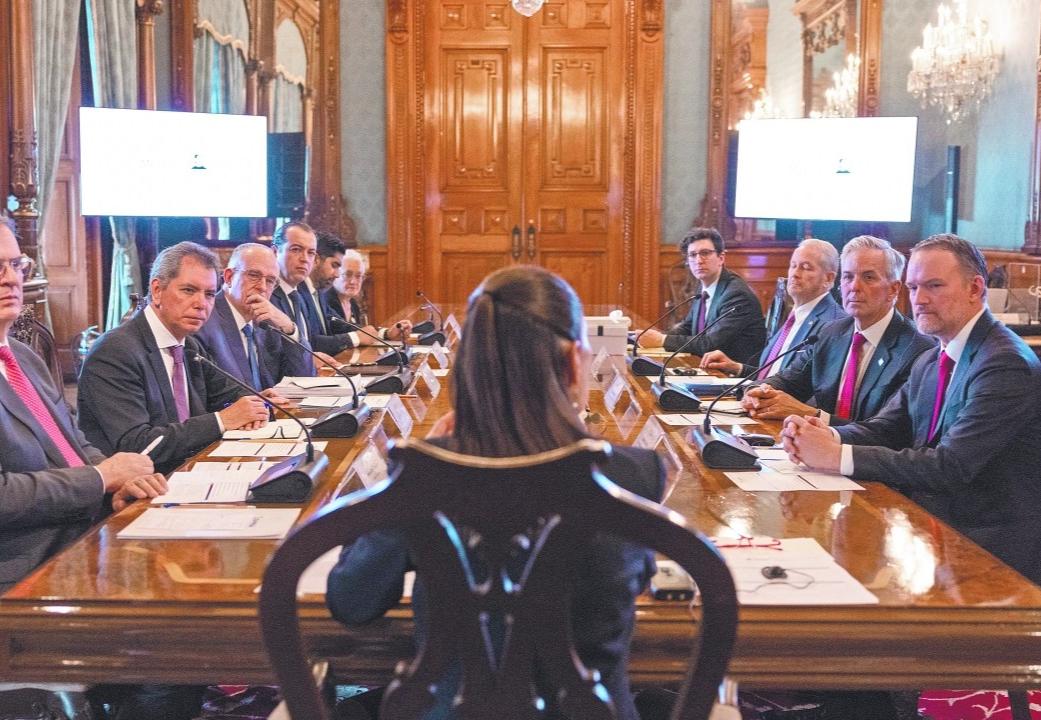
At a meeting during the second round of formal bilateral negotiations, held at the headquarters of the Mexican Banking Association (ABM) in Mexico City, Greer stated that reducing the U.S. trade deficit with the world is a priority for President Donald Trump’s administration.
According to sources present at the meeting, Greer acknowledged that shared value chains are less of a concern regarding the negative balance with Mexico in the U.S. trade balance, compared to the deficit with China.
It’s worth noting that the United States’ global trade deficit in goods decreased by 24% from April 2025, when Trump first implemented tariffs on the rest of the world, to February 2026, compared to the same period the previous year.
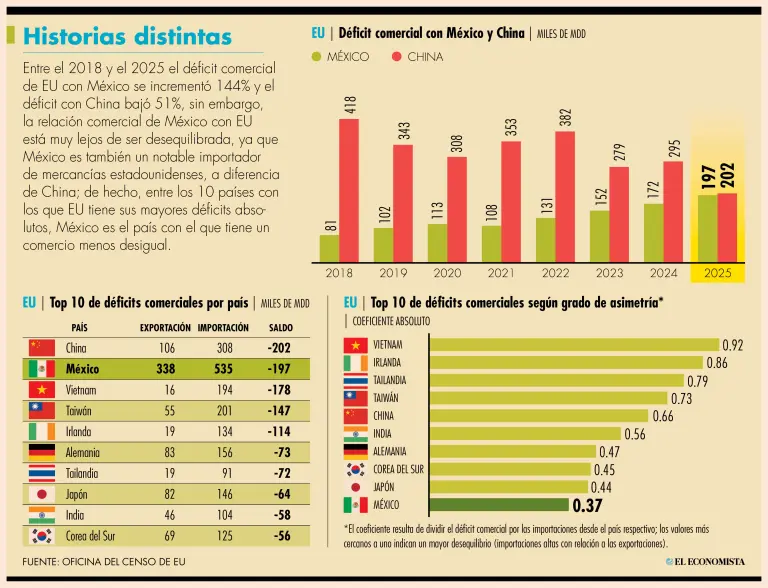
Considering all of 2025, Mexico came close to surpassing China in the trade surplus each country achieves in its goods trade with the United States.
On the one hand, China’s trade surplus fell 31.6% compared to 2024, to $202.071 billion, still remaining the largest among all of the United States’ trading partners.
Meanwhile, Mexico’s trade surplus was $196.913 billion, representing a year-over-year increase of 14.8%.
According to the consulting firm SAI Consultores, at the end of the last decade, trade value-added data revealed that for every $100 of the final value of a good that the United States imports from Mexico, $40 was of U.S. content.
The equivalent share in the case of Canada was $25. In contrast, for every $100 of imports from China and the European Union, only $4 and $2, respectively, were of U.S. inputs.
In April 2015, Trump imposed reciprocal tariffs in response to what he considered a national emergency caused by his “large and persistent” trade deficit of $1.2 trillion, which had increased by 40% in the previous four years.
At the meeting at the Mexican Banking Association (ABM), Greer highlighted the Trump Administration’s intention to reindustrialize the United States and defined Mexico as a key partner in supply chain security.
From the USTR’s perspective, the United States will prioritize rebalancing its trade relations, reducing trade deficits, opposing non-tariff barriers to its exports, and eradicating dumping and other anti-competitive practices that harm American industries and workers.
On April 16, before the House Appropriations Committee, Greer stated that in addition to the tariff program, Trump has reached agreements with numerous trading partners to address unfair practices that contribute to the U.S. trade deficit.
These new trade agreements cover more than half the world’s population. According to Greer, the nine Reciprocal Trade Agreements with Malaysia, Cambodia, El Salvador, Guatemala, Argentina, Bangladesh, Taiwan, Indonesia, and Ecuador represent “real and meaningful access” to markets for U.S. exports. The United States has also signed agreements with the United Kingdom, the European Union, Japan, and South Korea. Greer added that he expects to finalize even more agreements in the coming weeks.
Previously, in January 2026, in a letter to the World Trade Organization (WTO), the Office of the United States Trade Representative (USTR) stated that, for decades, many countries, including “close partners” of the United States, sought artificial trade advantages through subsidies, wage suppression, monetary policy, and labor and environmental abuses.
“The result for the United States was a growing trade deficit and waves of offshoring,” it said.
Finally, in a joint statement about the meeting, Greer thanked President Sheinbaum for her “warm welcome” to Mexico City and her “strong leadership in expanding bilateral cooperation.”
Greer also thanked the Secretary of Economy, Marcelo Ebrard, for his leadership in the “active and constructive collaboration” between the Ministry of Economy and the USTR.
Source: eleconomista