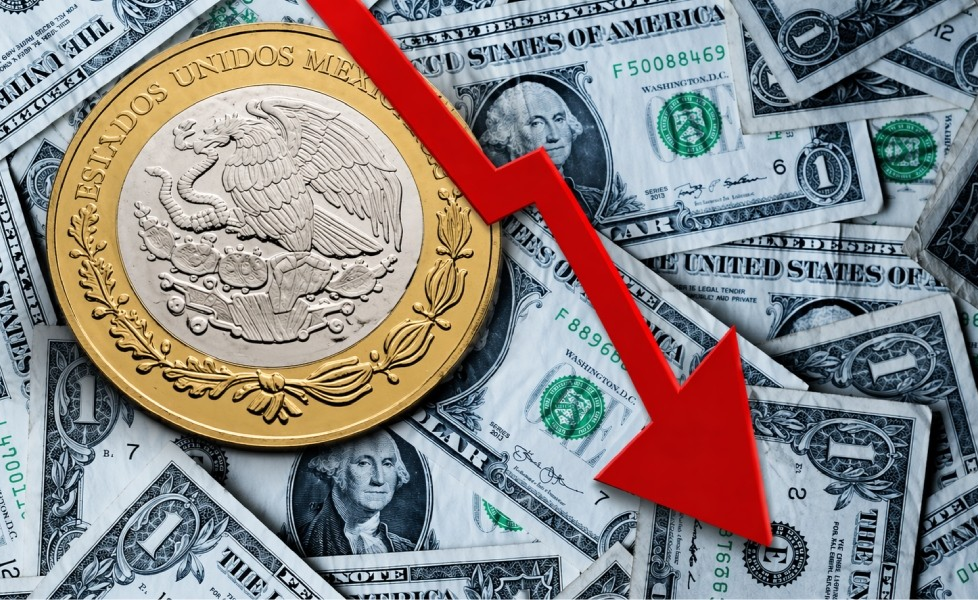

The peso began the session with a depreciation of 0.17%, or 3.0 centavos, trading around 17.36 pesos per dollar, with the exchange rate reaching a low of 17.3297 and a high of 17.4063 pesos per dollar. The peso’s depreciation occurred alongside a 0.09% strengthening of the US dollar, according to its weighted index, marking its largest daily gain since April 2nd.
Among the major currency pairs, the most depreciated today were: the Russian ruble at 0.87%, the Indonesian rupiah at 0.69%, the New Zealand dollar at 0.49%, the Norwegian krone at 0.47%, and the Chilean peso at 0.38%. On the other hand, the only currencies appreciating are: the Colombian peso (up 0.16%), the Israeli shekel (up 0.14%), the Brazilian real (up 0.10%), and the Hong Kong dollar (up 0.01%).
Against this backdrop, tensions surrounding the Strait of Hormuz have escalated again, with recent episodes of ship interceptions and military actions in the area, increasing risks to the global energy supply. It’s worth noting that approximately 20% of global oil and liquefied natural gas trade passes through this waterway, so any disruption has significant implications for international energy prices.
WTI crude oil opened trading at $93.93 per barrel, up 0.37%, marking its fourth consecutive session of gains. Furthermore, during overnight trading, WTI reached a high of $97.22 per barrel. Since the start of the war, this commodity has risen by 40.04 percent.
Meanwhile, Brent crude oil opened the session trading at $102.26 per barrel, up 0.34 percent. This marks its fourth consecutive session of gains, reaching a high of $106.15 per barrel. Thus, compared to February 27, Brent shows an increase of 41.65 percent.
Natural gas in Europe is trading at €44.59 per MWh, up 2.37 percent, its fourth consecutive session of gains. Furthermore, this commodity reached a high of €45.85 per MWh, a level not seen since April 13. Since the start of the war, it has accumulated an increase of 41.54 percent.
The capital markets are showing widespread losses amid rising tensions in the Middle East. In the Asian session, Japan’s Nikkei fell 0.75%, after three consecutive sessions of gains. Despite the decline, the Japanese index reached a new all-time high of 60,013.98 points. Hong Kong’s Hang Seng fell 0.95%, while Shanghai’s CSI 300 dropped 0.28%. In Europe, the STOXX 600 declined 0.25%, Germany’s DAX fell 0.34%, and London’s FTSE 100 lost 0.53%. In the United States, the Dow Jones Industrial Average fell 0.55%, the Nasdaq Composite lost 0.33%, and the S&P 500 declined 0.30%.
Precious metals opened the session with widespread losses. Gold is trading at $4,729 per ounce, down 0.22%, after gaining 0.42% yesterday. Meanwhile, silver is trading at $76.30 per ounce, down 1.81%, erasing yesterday’s gain of 1.28%.
Regarding economic indicators, in the United States, initial jobless claims for the week ending April 18 were released, totaling 214,000, up 6,000 from the previous week and above the market expectation of 210,000. Continuing jobless claims for the week ending April 11 reached 1.821 million, up 12,000 from the previous week and above the market expectation of 1.816 million.
In Europe, the Eurozone manufacturing PMI for April was released, coming in at 52.5 points, up from March’s 51.6 points and its highest level since May 2022. However, the services PMI fell 2.8 points in April to 47.4 points, its lowest level since February 2021. Similarly, the composite index dropped from 50.7 points in March to 48.6 points in April, well below the market expectation of 50.2 points and its lowest level since November 2024. This decline suggests that consumers are being affected by the war in the Middle East.
The slowdown in headline inflation was driven by a contraction in non-core inflation, which fell for the first time since the second half of January, reaching -0.13%. However, this bi-weekly contraction is attributable to a seasonal effect, as this component typically declines during the first half of April when compared to the same period last year. Within this category, the energy and government-regulated tariffs subcomponent registered inflation of -1.34%, although this is the smallest price drop since 2013 when compared to the same period last year. This contraction was due to the fall in energy prices (-2.51%), while inflation in government-regulated tariffs limited the decline in non-core inflation, as it accelerated to 0.70% bi-weekly, the highest for a similar period since 2013.
Conversely, core inflation registered a slight acceleration, reaching 0.18% bi-weekly. This acceleration was primarily due to merchandise inflation, which rose to 0.25% biweekly. Within this category, it was noted that inflation in both subcategories accelerated: non-food merchandise inflation reached 0.38%, and food merchandise inflation reached 0.11%. It’s worth mentioning that food inflation remained low, as it is the lowest since 2007 when compared to the same period last year. Meanwhile, services inflation slowed to 0.12% biweekly, falling below the 0.2% threshold where it had remained for the previous four biweekly periods. This was because inflation in other services slowed substantially to 0.08%, the lowest for the same period since 2014. At the same time, education inflation remained at 0.00% for the third consecutive biweekly period. However, the slowdown in core inflation was limited by housing inflation, which reached 0.18%, the highest for the same period since 2023.
On an annual basis, headline inflation stood at 4.53%, marking two consecutive fortnights of deceleration. However, inflation has remained above 4% for four consecutive fortnights, a level well above the Bank of Mexico’s 3% target. Furthermore, it is concerning that both of its components are registering inflation above 4%.
- Agricultural product inflation reached 8.68% annually, its fifth consecutive fortnight above the Bank of Mexico’s 3% target. Within this category, fruits and vegetables registered inflation of 23.03%, its third consecutive fortnight above 10%. This is concerning, as it stems from lower agricultural production and insecurity within the country, problems that will not be resolved in the short term and that could keep inflation in this sector under pressure in the medium term. Conversely, inflation for livestock products fell 0.84%, the lowest inflation rate since the first half of April 2024.
- Inflation for energy and government-regulated tariffs reached 2.83% annually, accelerating for the third consecutive two-week period. This upward pressure was driven by government-regulated tariffs, whose inflation accelerated to 6.45%, the highest since the first half of June 2023. In contrast, energy inflation slowed to 0.80%, although it remains high.
Core inflation stood at 4.27%, marking its fifth consecutive two-week period of deceleration. This should be interpreted with caution, as it marks 231 consecutive fortnights above the 3% target. Internally, inflation in both of its categories slowed:
- Merchandise inflation reached 4.10%, marking five consecutive fortnights of deceleration and registering its lowest inflation rate since the first half of October. Non-food merchandise inflation stood at 2.97%, the lowest inflation rate since the first half of May 2015. Meanwhile, food merchandise inflation slowed to 5.41%, moving away from its recent peak recorded in the first half of February (6.28%).
- Services inflation slowed to 4.44%, the lowest inflation rate since the first half of February. This slowdown was almost entirely due to inflation in other services, which stood at 5.09%, the lowest since the second half of December 2025. Meanwhile, housing inflation (3.54%) and education inflation (5.96%) remained stable compared to the previous three fortnights.
Source: realestatemarket